When a child in your Minnesota program is exposed to measles, quick, calm steps keep children safe and parents informed. This short guide helps directors and providers know what to do first, who is at risk, when to give post-exposure shots, and how to handle exclusion, cleaning, and reporting. For general health and safety basics for childcare settings, see Basic Health and Safety in Childcare,e and for tips on keeping good immunization records, ds see our guide on immunization records.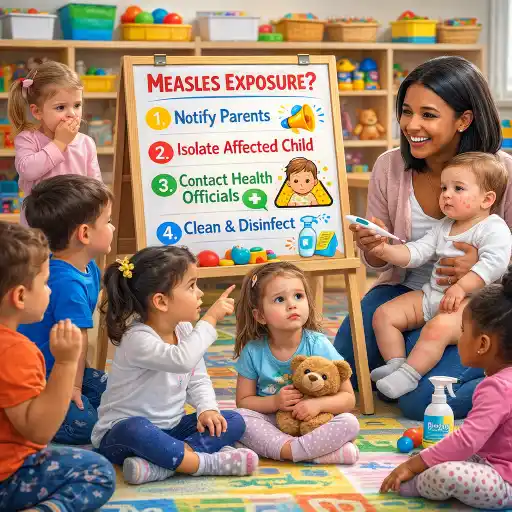
Why this matters:
1) Measles spreads very easily and can make young children very sick. See Minnesota Department of Health for what measles is and how it spreads: Measles - MN Dept. of Health.
2) Acting fast protects infants, children who are not fully vaccinated, pregnant staff, and children with weak immune systems.
Remember: state requirements vary - check your state licensing agency. Use your program records and local public health partners to act fast. The next four sections answer common questions step-by-step.
What should I do right away if a chiiswas exposed to measles?
- 📞 Call your local public health or the Minnesota Department of Health right away. Measles must be reported immediately. See Reporting Measles (MN Dept. of Health).
- 👩⚕️ Ask the family and the child’s healthcare provider about symptoms and exact exposure times. Do not send the child to a clinic without calling first, so staff can protect others. See MN guidance on what to do after exposure: If you or your child has been exposed.
- 🧾 Pull the child’s file now. Check #MMR doses, medical exemptions, and dates. Use your immunization records system or MIIC if available; Minnesota tools are described in Childcare Providers' Immunization Reporting.
- 🩺 Basic health and safety: For programs working to keep immunization records organized and verify proof of immunity quickly during an exposure event, ChildCareEd's Administering Basic Health and Safety
 Buy Now $24.00 is a 3-hour online course covering core health and safety practices, including recordkeeping and illness response — directly supporting the immunization file review, MIIC lookup, and family communication steps described throughout this article. Staff should also maintain up-to-date basic life support (BLS) certification so they can respond to breathing or cardiac emergencies in childcare; see BLS certification for healthcare providers.
If the exposed child has symptoms (fever, cough, runny nose, red watery eyes, or rash), keep them home and call the clinic before arriving. If the child is well, keep them home while public health checks their risk and decides the next steps. If a child develops severe respiratory distress, altered consciousness, or other signs of a medical emergency while in your care, trained staff may need to provide immediate aid; consider ensuring staff hold current BLS certification through AidCPR so they can give effective life-saving support until emergency responders arrive.
Notify staff and families with clear, simple facts. Use templates from the CDC Be Ready for Measles Toolkit. Do not name the child in public messages.
Who in my program is at risk, and how do I check immunity?
- 👶 Infants under 12 months (too young for routine MMR)
- 🧒 Children who have not had two doses of the MMR vaccine
- 🤰 Pregnant staff and visitors who are not immune
- ⚠️ People with weak immune systems
How to check who is immune:
- 🔎 Review written vaccine records in each child’s file. The MN law requires providers to keep these records; see Childcare Providers Immunization Reporting.
- 📁 Acceptable proof of #immunity: 2 documented doses of MMR, lab evidence of immunity, lab confirmation of past measles, or birth before 1957 for some adults. For details, see CDC recommendations: Measles Vaccine Recommendations (CDC).
- 🖥️ Use the Minnesota Immunization Information Connection (MIIC) or ask parents for clinic records if files are missing.
If someone’s documentation is missing or unclear, contact your local health department or MDH. They will help decide if the person is susceptible and needs post-exposure care or exclusion. For healthcare-worker-style guidance on evaluating immune status, see Managing Measles Exposures in Healthcare Workers (useful for staff decisions).
When should we offer post-exposure vaccine or immune globulin (IG)?
- 💉The MMR vaccine within 72 hours of first exposure, can prevent measles in many exposed, susceptible people.
- 🩸 Immune globulin (IG), within 6 days of exposure, can prevent or lessen measles for high-risk people (infants, pregnant people, and immunocompromised persons) when the vaccine is not appropriate. Do not give MMR and IG at the same time because IG can make the vaccine less effective.
How to decide who gets what:
- 👧 Children who are eligible and unvaccinated: offer MMR within 72 hours. See CDC vaccine timing: Measles Vaccine Recommendations (CDC).
- 👶 Infants under 12 months, pregnant people, and people with weak immune systems: consider IG. MN guidance on post-exposure prophylaxis explains who should get IG: Measles Information for Health Professionals - MN Dept. of Health.
- 📞 Always consult your local public health before giving IG—supply and dosing need public health input.
Document any PEP given, tell families what was done, and record the time of exposure and when the vaccine or IG was given.
How do we manage exclusion, cleaning, reporting, and communication after exposure?
1) Exclusion rules (who must stay away and when):
- ⏳ Susceptible people (no proof of #MMR or immunity) should be excluded from day 5 after first exposure through day 21 after last exposure. This matches MN and CDC guidance used to limit spread. See Managing Measles Exposures (MN Dept. of Health) and CDC infection control: Measles Infection Control (CDC).
- 📅 If someone gets MMR after exposure, exclusion rules still often apply—public health will advise whether they can return.
- 🦠 Infectious disease prevention and control: To help staff confidently manage exposure response, exclusion timelines, and cleaning protocols, ChildCareEd's Prevention and Control of Infectious Diseases Buy Now $16.00 is a 2-hour online course covering how to recognize symptoms, follow isolation and exclusion guidelines, and reduce disease spread in group care settings — a direct match for the day-5-to-day-21 exclusion rule, ventilation steps, and reporting timeline outlined in this guide.
2) Cleaning and air safety:
- 🧼 The measles virus can hang in the air up to 2 hours after an infected person leaves. Ventilate and clean rooms. Follow CDC airborne precautions guidance for any clinic visits: CDC measles precautions.
- 🧽 Clean toys and surfaces with approved disinfectant. Keep the exposed area empty if possible while the air clears.
3) Reporting and communication:
- 📣 Report suspected or confirmed measles to MN Dept. of Health immediately (24/7): Reporting Measles (MN Dept. of Health).
- ✉️ Use clear, short notices to families explaining exposure, what you did, and what families should watch for. The CDC Be Ready for Measles Toolkit has sample letters and flyers.
4) Keep careful records of who was exposed, action taken (PEP, exclusions), and when people return to care. Good records make follow-up easier and faster.
Conclusion and practical takeaways
1) Act fast: notify public health, check #immunity, and communicate clearly.
2) Use MMR within 72 hours or IG within 6 days for eligible people—work with public health on decisions.
3) Exclude susceptible people from day 5 to day 21 after exposure, follow cleaning and ventilation guidance, and report immediately to the MN Dept. of Health.
Common mistakes to avoid:
- ❌ Waiting to call public health. Report suspected measles immediately.
- ❌ Accepting verbal vaccination reports. Ask for written records or use MIIC.
- ❌ Giving MMR and IG at the same time. Space them per guidance.
Quick FAQ
- Q: Can a child return after one MMR dose given after exposure?
A: Public health will advise. Often, exclusion still applies until the full time window passes. - Q: Do I call the parent first or public health?
A: Call public health immediately, then tell families using a brief, factual notice. - Q: Where do I find sample family letters?
A: Use the CDC Be Ready for Measles Toolkit. - Q: Who decides on IG?
A: Local public health and the child’s healthcare provider decide together.
For more detailed steps and downloads for childcare settings,s see our general health and safety guide at ChildCareEd Basic Health & Safety and the Minnesota Department of Health measles pages linked above.
- 🤯 ¿Por qué este niño está teniendo un comportamiento difícil de repente?
- 🏡🗣️ ¿Cómo hablo con los padres sobre los comportamientos que su hijo aprendió en casa?
- 🥺👋 ¿Por Qué la Despedida de la Mañana es Tan Emocional?
- 👶😴¿Es Normal que los Niños Griten o Lloren al Despertarse?
- 😅❌ ¿Cómo Puedo Manejar a un Niño que Dice “¡NO!” a Todo en el Aula?
- Que es Título 22 en California?
- ¿Cuáles son los pasos, los requisitos y las opciones en línea para la certificación de 90 horas para cuidado escolar en Maryland?
- Normas de Licenciamiento de Cuidado Infantil en Virginia para Centros Diurnos Infantiles y Hogares Diurnos Familiares
- Lista para Guardería en Casa en California: Cómo Iniciar una Guardería en el Hogar
- Apoyo en Preescolar para Retrasos del Habla: Estrategias Simples que Ayudan
- Retraso del Habla en la Guardería: Cómo Pueden Ayudar los Proveedores
- Cómo Trabajar en el Cuidado Infantil en California: Requisitos y Pasos
- Diversión fresca de verano: actividades del Día Nacional del Helado para niños
- Canciones, juegos y preguntas de círculo para niños
- La mejor manera de hacer seguimiento a la capacitación de su equipo de daycare How to Organize Staff Training for Your Child Care Center Cómo organizar la capacitación del personal para su centro de cuidado infantil
- How Can New York Child Care Providers Protect Children Now That Measles Is Back in 2026?
- How should your Minnesota childcare program respond if a child was exposed to measles?
- How should New York child care providers respond to a measles exposure?
- What should child care providers know about immunization records and illness policies?
- Reglas y regulaciones de guarderías en Minnesota 2026: Requisitos actuales y próximos cambios
