A child clutching a favorite toy and shouting “Mine!” can test even a calm classroom—but it is also a chance to teach skills that grow through practice. Learn how to guide children toward cooperation without shaming or forcing them to give up a toy, and explore Social Foundations and Responsive Classrooms Buy Now $24.00 for deeper strategies in social-emotional learning, positive guidance, and conflict resolution. Providers who want to strengthen their day-to-day interactions can also explore Working Together: Teachers & Preschoolers  Buy Now $0.00, a free course focused on positive communication and supportive teacher-child relationships.
Why can sharing be so difficult for young children?
Sharing asks children to manage several demanding skills at once: waiting, handling disappointment, communicating a need, and considering another person’s perspective. These capacities develop gradually. Toddlers may be focused on immediate wants and still learning to regulate impulses, while preschoolers are building a stronger understanding of fairness and cooperation. As ZERO TO THREE notes in its guidance on helping young children with sharing, difficulty sharing is common in early childhood; it is not proof that a child is selfish or that an educator has failed.
It helps to distinguish sharing from taking turns. Sharing can mean using common materials together or giving another child part of something. Turn-taking means one child uses an item while another waits. Children may manage one form more readily than the other. Their response can also reflect fatigue, crowding, sensory overload, uncertainty about when a turn will end, or limited communication tools.
Instead of asking, “How do I make this child share?” try, “What skill is this child practicing, and what support would make it possible?” That reframing protects the child’s dignity while keeping expectations for safety and respectful interactions clear.
- Expect progress to be uneven; development and temperament differ.
- Protect personal or treasured items when appropriate, while teaching care for shared classroom materials.
- Remember that learning to wait, ask, and negotiate is part of the goal—not just handing over a toy.
How can educators teach sharing without forcing it?
Teach the component skills when children are calm, then coach briefly when a real disagreement occurs. Modeling concise, repeatable phrases gives children language they can borrow. Try “Can I have a turn when you’re finished?”, “You can go next,” or “Would you like to trade?” Role-play with puppets, blocks, or a ball makes the words familiar before children need them in a charged moment.
Make the plan visible and predictable. A sand timer, picture card, turn tag, or first-then visual can help children understand who is using an item and what happens next. A timer is a support, not a magic solution: choose a reasonable interval, explain the sequence, and offer the waiting child another activity. Some children need a longer initial turn to become absorbed in play before a transition is fair and manageable.
Offer limited, genuine choices rather than commands. For example: “Would you like to use the timer or play together with different cars?” or “You may finish this part, then Maya is next.” When children try a helpful step, name it specifically: “You asked for a turn instead of grabbing. That kept the play safe.” Specific feedback identifies the skill to repeat.
- Practice turn-taking during low-pressure activities such as rolling a ball or adding blocks to a shared tower.
- Let children choose special items to put away before group play, when feasible.
- Use parallel play or shared roles as a bridge: one child builds the road while another drives the cars.
For additional classroom ideas, see ChildCareEd’s guidance on teaching sharing and turn-taking without forcing it. The aim is growing participation and problem-solving—not perfect generosity on demand.
What routines create meaningful practice?
Children learn social skills through repeated experiences, not a single lecture after a conflict. Build brief, supported opportunities into the ordinary rhythm of the day. Predictable routines reduce uncertainty and let children practice asking, waiting, contributing, and noticing peers in manageable ways. The CSEFEL brief on positive social interactions describes how educators can teach peer skills, rehearse them, and then reinforce children’s use of those skills during play.
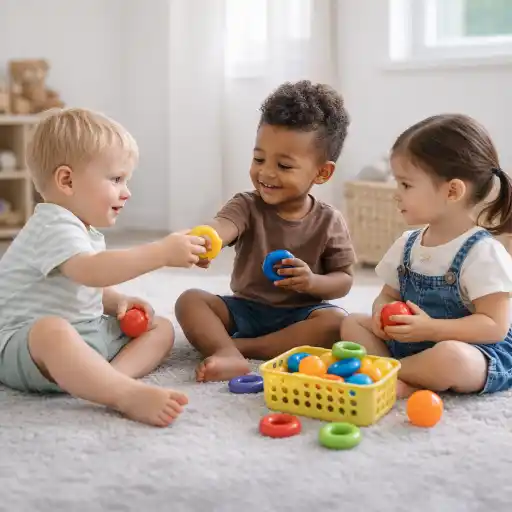
Set up short collaborative activities with a clear purpose: make a group collage, build a roadway with assigned roles, pass story props around, or take turns adding ingredients to pretend-play “soup.” During activities, stay close enough to prompt without taking over. A brief cue—“Ask Leo for the blue block”—may help a child succeed; step back as children become more capable of managing the exchange.
- Assign rotating buddy jobs, such as passing napkins or watering plants.
- Pause during stories to ask how a character might feel and what a friend could do.
- Use turn cards or picture sequences at high-interest centers so expectations are visible.
- Notice small acts of cooperation: waiting briefly, inviting a peer, trading, or returning a material.
Review the environment, too. Popular materials in short supply, crowded play areas, and abrupt transitions can make cooperation harder. When possible, add duplicates of frequently contested materials, define center spaces clearly, and give children transition warnings. Use brief observations to see which times, materials, or group arrangements lead to difficulty. These notes can guide practical adjustments instead of turning the child into the only focus of the plan.
How should providers respond to conflict in the moment?
When a conflict begins, first keep everyone safe. Move close and use a calm, short limit: “I can’t let you hit. Hands stay safe.” Avoid lengthy explanations while a child is overwhelmed. Once the immediate risk is addressed, describe what you see neutrally: “You have the truck, and Kai wants a turn. You both want to use it.” Neutral narration slows the interaction without labeling either child as bad or selfish.
Acknowledge feelings while maintaining the boundary. “You’re upset because you were still playing. Waiting is hard.” This does not mean a child gets everything they want; it shows that the adult understands the feeling and can help with a plan. When children are calmer, offer two or three workable options:
- “Would you like a timer, a trade, or to play together?”
- “You can finish this turn while your friend chooses another activity.”
- “Let’s find another shovel so you can both keep playing.”
Support repair after the children have recovered. Repair might mean returning a toy that was grabbed, helping rebuild a structure, checking whether a peer is okay, or practicing a phrase for next time. A forced apology during distress may not teach reflection; a concrete, related action can help restore the play relationship. Remove a toy only when needed for immediate safety or when the material itself is creating danger. Otherwise, teach a solution rather than relying on removal as punishment.
These small interactions develop #empathy and communication alongside #sharing. Consistent, calm #guidance helps children practice #turntaking and build more positive #relationships through everyday #play.
How can teams support children who need more help?
Some children need additional or different routes into peer play. Language differences, communication delays, anxiety, sensory needs, disability, or unfamiliar routines can make asking and waiting more demanding. Support should make the skill accessible rather than lower the expectation that everyone deserves safety and inclusion. Try pictures, gestures, sign language, communication devices, shorter turns, a quieter play area, or practice with one peer and a trusted adult.
Before a challenging play period, prime the child with a specific plan: “When you want the truck, point to this card or say, ‘Turn next, please.’” Rehearse the exchange briefly with a puppet or adult. A rotating peer partner can help children enter play, but avoid assigning one child the ongoing responsibility of managing another child’s behavior. Offer invitations and roles that give each child a meaningful contribution.
Families can share helpful information about a child’s preferred communication, favorite materials, cultural expectations, and strategies that work at home. Share strengths-first observations, such as “Jordan waited until the timer rang today,” and agree on one phrase to practice across settings when appropriate. If difficulties remain frequent, intense, injurious, or significantly limit participation despite consistent support, collaborate with the family, program leadership, and qualified specialists. Document observable patterns—what happened before, what the child did, and what helped—without assigning a diagnosis. State requirements vary - check your state licensing agency.
Directors can support consistency by helping staff agree on a few common phrases, modeling them during coaching, and reviewing observations together. For further professional learning, consider Supporting Social Learning: Creating Classrooms that Care Buy Now $24.00, Staying Positive: Guidance for Preschoolers Buy Now $24.00, and You’re Not My Friend Anymore: Learning Conflict Resolution Buy Now $16.00.
Conclusion: What are the best ways to support children who struggle with sharing?
The most effective support treats sharing as a developing skill, not a test of character. Keep children safe, use concise language, make turns predictable, and teach practical options such as waiting, trading, playing alongside one another, or asking for a turn. Short role-plays and cooperative routines give children useful practice before the next toy dispute arises.
Remember to notice effort, adapt the environment, and work with families and colleagues when a child needs more individualized support. Avoid forced surrender, shame, and long lectures during distress; prioritize connection, coaching, and meaningful repair. Progress may be gradual, and small steps—one request, one brief wait, one successful repair—are real growth. By responding consistently and respectfully, providers help children build skills that support friendship and cooperation well beyond the classroom.
- CDA Home Visitor Subject Area 3 Part 3 Birth to 5
- CDA Preschool Credential with Portfolio Review
- CDA Family Child Care Credential with Portfolio Review
- CDA Bridge Bundle: Preschool
- Pediatric RSV First Aid & CPR/AED
- CDA Bridge Bundle: Family Child Care
- CDA Bridge Bundle: Family Child Care without Portfolio Review
- CDA Bridge Bundle: Infant/Toddler without Portfolio Review
- CDA Bridge Bundle: Preschool without Portfolio Review
- CDA Bridge Bundle: Infant/Toddler
- The Power of International Sign Language in Early Childhood Education
- Childcare Educators in NYC: Surviving the Holiday Season in the Concrete Jungle
- CDA Certification en Español: Recursos y Consejos para Educadores Bilingües
- How can Georgia preschool teachers use positive guidance to help preschoolers share during indoor play?
- How can we celebrate diversity and inclusion in California early childhood classrooms?
- Celebrando la amistad en el cuidado infantil durante el Día de los Mejores Amigos
- How can New York child care programs teach conflict resolution and sharing?
- How can we help children learn to wait, take turns, and manage frustration?
- How Can Child Care Directors Make Inclusive Practices Consistent Across Every Classroom?
- How Do You Explain Ego to a Child Without Making It Sound Like a Bad Thing?
- When Learning Feels Hard: Positive Discipline Strategies for Children Who Struggle
- What Morning Meeting Activities Build Belonging?
- What Are Age-Appropriate Ways to Teach Gratitude Before Thanksgiving?
- How Can Teachers Encourage Sharing Without Forcing It?
- How Can Child Care Providers Teach Young Children to Take Turns?
- What Should Child Care Providers Do When a Child Refuses to Share?
- What Should Child Care Providers Do When a Child Refuses to Share?
- How Can Child Care Providers Help Children Set Simple Goals and Share Their Interests?
- How Long Should Circle Time Be for Preschoolers?
- What Are the Best Ways to Support Children Who Struggle with Sharing?
