Preschool conflict can feel exhausting, but each disagreement is also a small laboratory for learning communication, self-regulation, and empathy. For focused professional development, explore You’re Not My Friend Anymore: Learning Conflict Resolution  Buy Now $16.00 to strengthen your classroom coaching and gain practical strategies for guiding children toward safe solutions.
Providers seeking a broader foundation may also benefit from Social Foundations and Responsive Classrooms Buy Now $24.00, which addresses positive guidance, social competency, self-regulation, conflict resolution, and age-appropriate problem-solving.
Why should conflict be treated as a learning opportunity?
Conflict is a normal part of preschool development. Children are still building language, impulse control, perspective-taking, and emotional regulation. A disagreement over a truck may quickly become grabbing, yelling, or crying because the child’s emotional response develops faster than the words needed to explain a need. The behavior is not proof that a child is “bad”; it is information about a skill that requires teaching and practice.
When adults respond calmly and intentionally, conflict becomes a meaningful social-emotional lesson. Children learn that strong feelings can be acknowledged without permitting unsafe actions, and that problems can be solved without humiliation or punishment. This supports #empathy, communication, collaboration, and growing independence.
NAEYC’s three-step approach to helping children navigate conflict emphasizes stating the behavior, explaining its implications, and addressing it with an appropriate alternative. The goal is not to eliminate every disagreement. It is to help children gradually move from impulsive reactions toward supported problem-solving.
- Children express needs with safer words or communication tools.
- Peers practice listening, turn-taking, compromise, and repair.
- Teachers discover environmental or routine factors that contribute to conflict.
- The classroom becomes more predictable, respectful, and emotionally safe.
How can educators prepare children before conflict occurs?
Conflict-resolution skills are easiest to use when they are taught during calm moments. Choose three or four short phrases that match children’s language abilities, then use them consistently throughout the day. Useful examples include “Stop, please,” “I’m using it,” “Can I have a turn?” “I need help,” and “Let’s trade.” Pair words with gestures, photographs, signs, or augmentative communication when appropriate.
Use puppets, picture books, and brief role-play to rehearse common classroom situations. A puppet can hold a desired truck while children suggest respectful ways to ask for it. Keep practice playful and short; repetition is more valuable than a long lesson. Children who are multilingual, neurodivergent, or developing speech may need additional wait time and visual supports.
The physical environment is also a teacher. Observe where disagreements happen most often and adjust predictable triggers:
- 🧸 Provide duplicate high-interest materials when feasible.
- Use visual timers or turn cards to make waiting concrete.
- Create clearly defined play zones with low, labeled shelves.
- Post a visual schedule and offer transition warnings.
- Provide a calm space with feeling cards, books, and simple breathing tools.
Teach expectations positively, such as “kind hands, kind words, and safe feet.” Explain and demonstrate what children can do instead of relying only on prohibitions. State requirements vary - check your state licensing agency.
What should teachers do during an active conflict?
During an active conflict, safety and regulation come before reasoning. Move close, block unsafe actions if necessary, check for injury, and use a steady voice. Avoid asking several questions while children are highly distressed; they may not yet have access to the language or cognitive flexibility needed to respond.
A concise sequence is “connect, calm, and coach”:
- Stop safely: “I won’t let you hit. Hitting hurts.”
- Name the problem: “You both want the red truck.”
- Acknowledge feelings: “You look frustrated.”
- Support regulation: “Let’s take one breath together.”
- Prompt communication: “Try, ‘Can I have a turn when you’re done?’”
- Offer limited solutions: “Timer, trade, or play together?”
Use observable language rather than labels. Instead of “You are being mean,” say, “You pulled the truck from Ava’s hands.” This preserves dignity while making the behavior understandable. The adult may need to provide the words for one child, offer two choices to another, or simply wait while a child points to a visual.
Comfort an injured or frightened child first. Then coach the child who used unsafe behavior toward a replacement skill. A preschooler may not be ready to apologize immediately. Repair should occur after regulation and should be meaningful rather than forced.
How can children participate in creating solutions?
Once children are safe and sufficiently calm, invite them to describe what happened without turning the conversation into a courtroom. Listen to each child and acknowledge that different perspectives can exist. Helpful prompts include “What happened?” “How did you feel?” and “What did you need?”
Next, brainstorm more than one solution. Children might suggest taking turns, trading, finding another material, playing together, or asking an adult for assistance. Do not dismiss ideas too quickly; brainstorming gives children practice in flexible thinking. Then evaluate options for safety and acceptability.
- What is the problem?
- What can we say?
- What are two possible solutions?
- Which solution will we try?
- Did it work, or do we need a new plan?
A workable agreement that children help create is often more powerful than an adult-imposed answer. Finish by checking for agreement: “Are you both okay with this plan?” Then describe the skill specifically: “You listened, offered a trade, and made a plan together.”
Repair may include returning a material, rebuilding a tower, checking on a peer, giving space, or using an apology when the child is ready. Do not force hugs, eye contact, or physical closeness. Respectful repair includes the other child’s boundaries.
How can teachers use play and stories to make practice engaging?
Preschoolers learn through active participation, so conflict resolution should not be limited to corrective conversations. Plan short, playful experiences that let children rehearse emotional vocabulary, listening, and problem-solving.
- Puppet problem-solving: Have two puppets disagree over a toy and invite children to suggest words and solutions.
- Solution matching: Match picture cards showing conflicts with cards showing possible solutions.
- Cooperative construction: Give a small group one building challenge and coach turn-taking, planning, and shared decision-making.
- Story pauses: Stop before a character solves a problem and ask, “What could they say or do?”
- Repair practice: Role-play returning an item, rebuilding something, checking on a friend, or offering space.
Books and stories help children discuss conflict at an emotional distance. Ask questions such as “How did the character feel?” “What did the character need?” and “What could happen next?” Accept multiple reasonable answers. This builds perspective-taking without requiring children to disclose a personal incident.
Model the skills yourself. You might say, “I feel frustrated because we are running late. I’m going to breathe and make one plan.” NAEYC’s guidance on peacemaking in early childhood classrooms emphasizes acknowledging children’s peacemaking, creating space for peace, modeling problem-solving, listening carefully, respecting the whole child, and celebrating positive stories. For a timely classroom connection, educators can plan International Day of Peace activities that foster empathy, kindness, and cultural awareness.
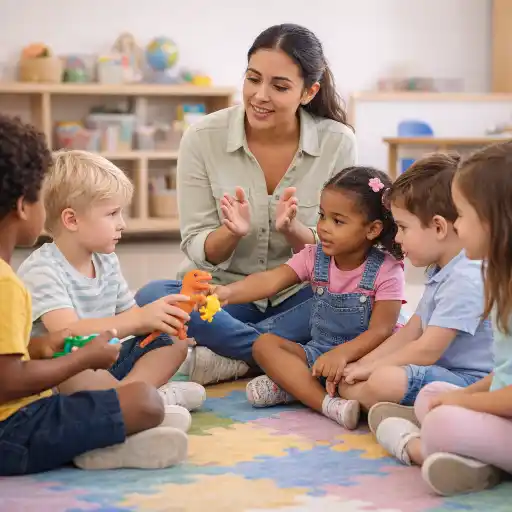
What common mistakes should educators avoid?
Even experienced providers can unintentionally make conflict more difficult. The first common mistake is giving a long lecture while children are dysregulated. Use one clear safety statement, then teach more fully after the child is calm.
A second mistake is forcing sharing. Children may need to finish using an object, and immediate compliance does not necessarily create cooperation. Teach timed turns, trades, parallel play, or collaborative use instead. A third mistake is requiring a rushed apology. A scripted “sorry” without understanding may end the conversation but does not necessarily repair the relationship.
- Instead of: “Just use your words.” Try: “Say, ‘I need a turn,’ or point to the turn card.”
- Instead of: “Say sorry right now.” Try: “What can we do to make the problem better?”
- Instead of: “You are a bully.” Try: “You pushed when the line stopped. Pushing can hurt.”
- Instead of: removing a child as punishment, try: a supported calm space followed by teaching and practice.
Repeated conflict may reflect fatigue, hunger, sensory overload, language differences, crowded spaces, exclusion, or difficult transitions. Record the time, location, materials, people involved, what happened before, the behavior, and the response. An ABC framework—antecedent, behavior, consequence—can help the team identify patterns and teach replacement skills.
Distinguish ordinary peer disagreement from persistent intentional harm or a significant power imbalance. Any recurring or dangerous behavior requires adult protection, family collaboration, documentation, and appropriate program procedures.
How can directors and families create consistent support?
Children retrieve new skills more easily when adults use shared language. Directors can select two or three common scripts, display them in classrooms, and rehearse responses during staff meetings. Coaching should address tone, proximity, wait time, safety, and whether the adult taught an alternative behavior rather than merely stopping the incident.
Family communication is most effective when it begins with strengths. Share a positive observation, describe the concern objectively, and explain the plan: “Jordan cooperated during art. We are noticing grabbing during cleanup, so we are practicing ‘Can I have a turn?’ and using a visual timer. Would you try the same phrase at home?” Invite families to share cultural, linguistic, and developmental perspectives. Families looking to foster cooperation and empathy between young children at home may also find ideas in this Montessori approach to supporting sibling relationships.
Adapt supports so every child can participate. Visual language, extra transition time, smaller groups, sensory adjustments, and alternative communication can make conflict-resolution routines more accessible. If a child frequently injures others, experiences significant distress, or does not respond to consistent instruction, collaborate with the family and appropriate specialists. The purpose is to understand the need and teach a safer way to meet it—not to shame or exclude the child.
For additional professional learning, consider Teach with Respect! Buy Now $35.00, which focuses on respectful modeling, guidance, and conflict resolution; Raising Peaceful Learners: The Montessori Advantage Buy Now $16.00, which explores grace, courtesy, and peace education; and Supporting Social Learning: Creating Classrooms that Care Buy Now $24.00, which emphasizes community building, relationships, open dialogue, and children’s problem-solving.
Conclusion: What is the most effective way to teach preschool conflict resolution?
The most effective approach combines prevention, explicit instruction, calm in-the-moment coaching, meaningful repair, and consistent adult language. Teach short phrases when children are calm, design the environment to reduce predictable stressors, protect children during unsafe moments, and invite them to help create solutions once they are regulated.
Conflict resolution is not a one-time lesson or a demand for perfect independence. It is a developmental process supported through repetition, modeling, visuals, play, family partnership, and reflection. When educators respond with warmth and clear boundaries, children learn that their feelings matter, unsafe behavior can change, and problems can be solved together. Your patient daily coaching helps build lasting skills in #communication, #self-regulation, #problem-solving, #empathy, and respectful relationships.
- 18-Hour Train the Trainer
- You're Not My Friend Anymore: Learning Conflict Resolution
- CDA Preschool Credential with Portfolio Review
- Social Foundations and Responsive Classrooms
- 45 Hour Preschool Methods and Materials
- Teach with Respect!
- CDA Bridge Bundle: Preschool
- 24 Hour Texas Pre-Service
- CDA Bridge Bundle: Preschool without Portfolio Review
- Texas Director Credential
- Building Social Foundations
- Proporciones de Cuidado Infantil y Tamaños de Grupo por Edad en Maryland (Guía Rápida para Centros y Hogares)
- Proporciones de Cuidado Infantil y Tamaños de Grupo por Edad en Virginia (Guía Rápida para Centros y Hogares)
- Cómo Ser Maestra de Preescolar en Virginia
- Teaching Preschoolers How to Work Through Conflict
- Celebrando la amistad en el cuidado infantil durante el Día de los Mejores Amigos
- How can New York child care programs teach conflict resolution and sharing?
- How Can School-Age Programs Teach Conflict Resolution That Actually Works?
- Team-Building Games for Preschoolers That Teach Cooperation
- Happy or Sad? Preschool Activities That Help Children Read Emotional Clues
- How Can Child Care Providers Help Children Develop Self-Control?
- How Can Child Care Providers Turn Conflict Into Learning?
- How Can Child Care Providers Teach Children What to Say During Conflict Beyond “Use Your Words”?
- How Can Child Care Providers Teach Children to Solve Conflicts With Each Other?
- How Can Child Care Providers Teach Conflict Resolution to Preschoolers?
- How Can Child Care Providers Teach Preschoolers to Wait Their Turn?
- What Are the Best Ways to Support Children Who Struggle with Sharing?
