Conflict is a daily reality in early childhood settings, but it does not have to disrupt learning or relationships. By using developmentally appropriate scripts, predictable routines, and calm coaching, providers can help children build #empathy, communication, and problem-solving skills; for a deeper learning experience, explore You’re Not My Friend Anymore: Learning Conflict Resolution  Buy Now $16.00, which can strengthen professional knowledge and support practical classroom implementation.
Why does conflict resolution matter in early childhood programs?
Young children are still developing language, impulse control, perspective-taking, and emotional regulation. A disagreement over a block, a place in line, or an adult’s attention may therefore become physical or highly emotional before a child can explain what happened. This behavior is not evidence that a child is “bad”; it is information about a skill that still needs teaching.
When adults respond with safety, warmth, and clear guidance, conflict becomes an instructional moment. Research on classroom-wide social-emotional learning indicates that explicit instruction, modeling, practice, and family involvement can strengthen children’s social-emotional competence and reduce challenging behavior (systematic review of preschool SEL interventions).
- Children learn to express needs without aggression.
- Peers practice listening, negotiation, and perspective-taking.
- Teachers spend less time repeatedly solving the same disputes.
- Classroom relationships become more predictable and emotionally safe.
The goal is not to eliminate every disagreement. The goal is to help children move from impulsive reactions toward increasingly independent problem-solving.
What can providers do before conflicts begin?
Prevention begins with thoughtful environmental design and consistent routines. Many conflicts arise when children must wait too long, compete for scarce materials, navigate crowded spaces, or stop play without warning. Observe when and where disputes occur, then adjust the conditions rather than assuming the child is the sole problem.
- 🪴 Create clearly defined play zones with low shelves and labeled materials.
- Use visual schedules and brief transition warnings.
- Offer duplicates of highly desired materials when possible.
- Use timers or turn cards to make waiting concrete and predictable.
- Provide a calm area with feeling cards, books, and simple breathing tools.
- Schedule uninterrupted play so children have time to sustain cooperative activity.
Teach the classroom expectations when children are calm. Three concise rules—such as “kind hands, kind words, and safe feet”—are easier to remember than a long list of prohibitions. Pair each rule with pictures, demonstrations, and role-play. The Manitoba guide on behavior emphasizes organized play environments, predictable activities, appropriate materials, opportunities for choice, and adult support for peer interactions (Best Practices for Guiding Children’s Behaviour).
State requirements vary - check your state licensing agency when adapting routines, documentation procedures, or behavior guidance policies.
What should staff do during an active conflict?
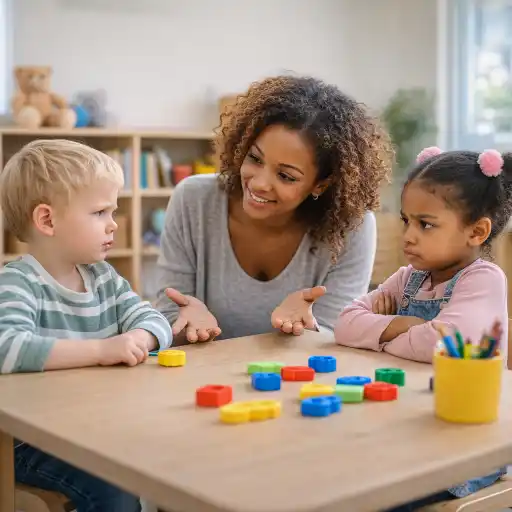
In the moment, children may be unable to process a lecture or several questions. Use a brief sequence: connect, calm, and coach. First, protect everyone from harm. Move close, block unsafe actions if necessary, and use an even voice. Then attend to injuries and acknowledge the emotion without approving unsafe behavior.
- Stop safely: “I won’t let you hit. Hitting hurts.”
- Name what you see: “You both want the red truck.”
- Support regulation: “Let’s take one breath together.”
- Prompt language: “Say, ‘Can I have a turn?’”
- Offer limited choices: trade, use a timer, or play together.
- Repair: ask, “What can we do to make it better?”
A useful three-step teaching approach is to state the behavior, explain its implications, and address it with an appropriate alternative. NAEYC describes this approach as a way to support both self-regulation and language development (A Three-Step Approach to Help Children Navigate Conflict). Keep your language concrete: “You grabbed the shovel. Maya fell. Ask for a turn or choose another shovel.”
Children do not need identical responses. A toddler may need a single phrase and close adult support, while a preschooler may generate a solution with prompting. Safety always comes first; independence develops gradually.
How can teachers explicitly teach problem-solving skills?
Children rarely learn conflict resolution simply by being told to “share.” They need direct instruction, repeated practice, and opportunities to use skills during calm periods. Short lessons during circle time, guided play, or small groups can make the process familiar before emotions run high.
Teach a simple routine such as “Stop, breathe, talk.” Practice phrases that match children’s developmental and language abilities:
- “Stop.”
- “I’m using it.”
- “Can I have a turn when you’re done?”
- “I don’t like that.”
- “I need help.”
Use puppets, photographs, stories, and role-play to represent common classroom dilemmas. Invite children to generate more than one possible solution, then discuss whether each option is safe and fair. The Conflict Resolution Solution Cards can provide visual prompts for preschool children.
Specific encouragement is more useful than general praise. Say, “You waited for the timer and then gave the truck to Jordan,” rather than simply saying, “Good job.” Reinforce effort, not only successful outcomes. If a child tries a phrase but still needs assistance, acknowledge the attempt and model the next step.
Conflict resolution is also about repair. Children can return an object, help rebuild a structure, offer space, check on a peer, or try a respectful statement. Do not force physical affection or a rushed apology; meaningful repair should respect the other child’s consent and emotional readiness.
How should directors support staff, families, and consistent practice?
Children benefit when every adult uses similar language and expectations. Directors can select two or three shared scripts, post them in classrooms, and rehearse them during staff meetings. Coaching should focus on observable actions: proximity, tone, wording, wait time, and whether the adult guided children toward a replacement skill.
Documentation is most useful when it identifies patterns rather than labels. Record the time, location, materials, people involved, antecedent, behavior, adult response, and outcome. An ABC framework can reveal that recurring conflict follows a difficult transition, limited access to a preferred toy, fatigue, or unclear expectations. The team can then change the environment or schedule and monitor whether the pattern improves.
Family communication should begin with a child’s strengths. Share one positive observation, describe the concern objectively, and identify the shared plan: “Sam worked cooperatively during art. We are noticing grabbing during cleanup, so we are practicing ‘Can I have a turn?’ and using a visual timer. Would you try the same phrase at home?” Communication resources emphasize that tone, culture, listening preferences, and power relationships influence how conflict conversations are received (Communication & Conflict Resolution).
- ❌ Avoid long lectures during a meltdown; teach after regulation returns.
- ❌ Avoid forcing children to share immediately; teach turns, trades, and alternatives.
- ❌ Avoid inconsistent adult reactions; agree on a small set of responses.
- ❌ Avoid treating a calm corner as punishment; introduce and practice it proactively.
For additional professional development, consider Social Foundations and Responsive Classrooms Buy Now $24.00, which addresses self-regulation, positive guidance, conflict resolution, and age-appropriate problem-solving; Teach with Respect ONLINE Buy Now $24.00, which focuses on respectful relationships and strategies children can use to resolve conflict; and Raising Peaceful Learners: The Montessori Advantage Buy Now $16.00, which explores grace, courtesy, and peace education. For more context on this approach, read about how Montessori education supports social-emotional growth and collaboration.
When does a recurring conflict require additional support?
Some conflict is expected; repeated, intense, or dangerous behavior deserves a coordinated response. Look for patterns across settings and times rather than relying on a single incident. Consider additional support when a child frequently injures others, cannot access replacement communication despite consistent teaching, experiences significant distress, or shows behavior that interferes substantially with participation and relationships.
Begin by reviewing prevention, supervision, communication demands, sensory conditions, and adult responses. Collaborate with the family and, when appropriate, mental health consultants, early intervention providers, or special education professionals. The purpose is not to punish or exclude the child, but to understand the function of the behavior and design supports that teach a safer way to meet the same need.
Individualization matters. One child may need visual language, another may need more time to transition, and another may benefit from a quieter play area or smaller group. Cultural and linguistic responsiveness is equally important: conflict scripts should be understandable, respectful, and aligned with family perspectives whenever possible.
Maintain confidentiality and follow program policies for incident reporting, injury documentation, mandated reporting, and parent notification. A written behavior support plan should specify prevention strategies, replacement skills, adult responses, family collaboration, and a review date. CSEFEL guidance stresses that positive relationships, preventive practices, explicit social-skill instruction, individualized intervention, family involvement, and specialized services work together as a comprehensive approach (CSEFEL What Works Brief).
Progress may be gradual. Celebrate smaller indicators: a child seeks help before hitting, accepts a timer, names a feeling, or participates in repair.
Conclusion: How can conflict become a learning opportunity?
Effective conflict resolution in child care combines prevention, immediate safety, explicit teaching, and relational support. Arrange spaces and routines to reduce unnecessary competition, respond to active conflict with brief and calm language, teach practical scripts during peaceful moments, and guide children toward repair rather than shame.
The central question is not how to stop children from ever disagreeing. It is how to help them develop the language, emotional regulation, empathy, and problem-solving abilities needed to navigate disagreement safely. With consistent adult modeling and thoughtful collaboration among teachers, directors, and families, ordinary classroom conflicts can become meaningful practice for lifelong relationships.
Quick implementation checklist:
- Choose three shared conflict-resolution phrases for staff.
- Post a visual problem-solving sequence at children’s eye level.
- Practice one role-play scenario each week.
- Review one recurring conflict and adjust the environment or routine.
- Document patterns and celebrate incremental progress.
Small, steady responses matter. Your calm presence communicates that children are safe, capable of learning, and worthy of support even when their behavior is challenging.
- You're Not My Friend Anymore: Learning Conflict Resolution
- CDA Preschool Credential with Portfolio Review
- The ABCs of Behavior: Turning Challenges into Learning Opportunities
- CDA Bridge Bundle: Family Child Care
- 24 Hour Texas Pre-Service
- CDA Bridge Bundle: Family Child Care without Portfolio Review
- CDA Bridge Bundle: Infant/Toddler without Portfolio Review
- CDA Bridge Bundle: Preschool without Portfolio Review
- Texas Director Credential
- 🎈 Better Together: Why Little Friends Make a Big Difference in Early Childhood
- Proporciones de Cuidado Infantil y Tamaños de Grupo por Edad en Virginia (Guía Rápida para Centros y Hogares)
- Celebrando la amistad en el cuidado infantil durante el Día de los Mejores Amigos
- Canciones, juegos y preguntas de círculo para niños
- Team-Building Games for Preschoolers That Teach Cooperation
- Child Care Worker Skills and Qualities That Matter Most on a Difficult Day
- Why Are Coping Skills Important for Preschoolers?
- How Can Child Care Providers Teach Problem-Solving Skills in Early Childhood?
- How Can Child Care Providers Turn Conflict Into Learning?
- How Can Child Care Providers Teach Children What to Say During Conflict Beyond “Use Your Words”?
- How Can Child Care Providers Respond When Children Exclude Others From Play?
- How Can Child Care Providers Teach Children to Solve Conflicts With Each Other?
- How Can Providers Handle Biting in the Toddler Classroom?
- How Can Child Care Providers Teach Young Children to Take Turns?
- Why Do Toddlers Push Other Children? What Should Providers Know?
- How Can Child Care Providers Teach Conflict Resolution to Preschoolers?
- How Can Child Care Providers Teach Preschoolers to Wait Their Turn?
- How Can Teachers Turn Everyday Classroom Problems Into Learning Opportunities?
- How Can Educators Teach Respectful Disagreement in a Montessori Classroom?
- How Can Child Care Providers Help Children Repair a Conflict Beyond “Say Sorry”?
