Helping children choose clothing for the weather and planned activities turns an everyday transition into meaningful science, language, and independence practice. Pair the hands-on Summer Clothing Sort with Basic Science in Early Childhood Buy Now $25.00 to strengthen your ability to guide observation, prediction, and inquiry while earning two hours of focused professional training.
Why does clothing choice matter in early childhood?
Choosing clothing is a practical life skill with clear connections to health, comfort, safety, and participation. When children decide whether they need a hat, sweater, raincoat, or sandals, they are interpreting environmental information and applying it to a real problem. The decision is simple for adults, but it requires young children to notice temperature, precipitation, sunlight, wind, and the demands of an activity.
Clothing decisions also support autonomy. A child who can select a jacket before going outside is practicing planning, sequencing, communication, and self-care. These small successes build confidence and reduce dependence during busy transitions. The goal is not perfect independence immediately; it is gradual participation supported by patient adults and accessible materials.
Seasonal experiences can become curriculum rather than interruptions. ChildCareEd’s guidance on seasonal changes and school preparation emphasizes connecting weather, outdoor experiences, and learning. In the same way, clothing can become an entry point for #science, vocabulary, classification, and problem-solving.
How can educators connect weather, clothing, and activities?
Begin with observation rather than memorization. Invite children to look outside, feel the air with an adult, and describe what they notice. Avoid presenting weather as a fixed rule such as “summer always means shorts.” A cool summer morning, a rainy day, or a water-play activity may require different choices.
Use questions that encourage reasoning:
- What do you notice about the sky and the ground?
- Will we be dry, warm, cool, or protected from the sun in this clothing?
- What will we do outside today?
- Which item could we add or remove if our bodies feel uncomfortable?
Then connect the choice to the activity. Children may need lightweight clothing and sun protection for gardening, waterproof items for puddle exploration, or secure footwear for climbing. For water play, discuss clothing that can get wet and the need for dry clothes afterward. For a windy walk, compare a loose hat with one that fits securely.
Use accurate but accessible language: “This raincoat helps water move away from your body,” or “These shoes have soles that help us grip the ground.” Such explanations build early causal reasoning without overwhelming children with technical detail.
How can the Summer Clothing Sort become a meaningful science experience?
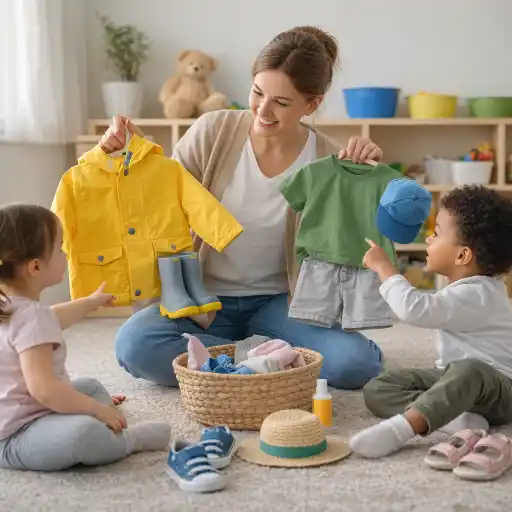
The Summer Clothing Sort can serve as a small-group invitation, science-center activity, or transition-time review. Before children sort, show the materials and name each item. Ask them to notice features such as fabric thickness, openings, coverage, texture, and intended use.
Begin with a simple category: clothing that helps us stay cool, clothing that protects us from the sun, and clothing used for wet activities. Later, invite children to create their own categories. A child might sort by color, body location, material, or whether an item is worn indoors or outdoors. Accepting multiple reasonable classifications encourages flexible thinking.
- 🌞 Ask children to select an outfit for a sunny playground day and explain one choice.
- Compare two items: Which provides more coverage? Which might dry faster?
- Add activity cards such as gardening, water play, hiking, or indoor movement.
- Invite children to revise their choices when the weather or activity changes.
Extend the activity with a daily weather chart. Children can record the conditions, select clothing symbols, and compare decisions across several days. This supports counting, graphing, vocabulary, and documentation. The ChildCareEd resources collection identifies Summer Clothing Sort as a preschool science and fine-motor resource, making it a practical addition to an intentional learning center.
How can providers support independence without creating frustration?
Independence grows when the environment makes success possible. Store frequently used items at children’s eye level, use picture labels, and provide enough time for children to attempt choices before adults step in. A small “weather-ready” area might include hats, lightweight layers, rain gear, spare socks, and a visual sequence for getting dressed.
Use graduated support:
- First, invite the child to observe and choose.
- Next, offer two appropriate options rather than making the entire decision.
- Use a visual prompt or gesture if the child is unsure.
- Model the reasoning aloud, then invite the child to try again.
- Provide physical assistance only as needed and preserve the child’s participation.
Be attentive to sensory, motor, cultural, and medical needs. Some children may avoid certain textures, need adaptive fasteners, or require clothing accommodations documented in an individualized plan. Choice does not mean every child must select from the same options. Inclusive practice means offering realistic, comfortable alternatives.
Keep language supportive: “That sweater feels scratchy. Let’s find another warm layer,” rather than “You are being difficult.” Clothing routines can be emotionally charged, especially when children are rushed. Calm pacing and predictable choices protect relationships while teaching the skill.
How can programs make clothing choices safe and consistent?
Clothing education should complement—not replace—program safety procedures. Before outdoor play, staff should check weather, heat index, wind, precipitation, air quality, and the condition of the play area. ChildCareEd’s weather chart guidance recommends a brief, repeatable check before each outdoor block and clear decisions to proceed, modify, or remain indoors.
When rain keeps the group indoors, engaging rainy-day activities for preschoolers can help children stay active and connected to play.
Directors can create a one-page clothing and weather protocol that identifies:
- recommended layers and spare clothing;
- sun, heat, cold, rain, and air-quality precautions;
- how staff monitor children for discomfort;
- when outdoor activities are shortened or moved inside;
- family responsibilities for labeling and replenishing clothing.
Teach children to notice comfort, but never rely on children alone to identify risk. Young children may continue playing while overheated, chilled, wet, or fatigued. Active supervision remains essential. State requirements vary - check your state licensing agency.
Common mistakes include treating seasonal labels as rigid rules, overlooking the activity itself, and expecting children to dress independently before they have practiced the sequence. Avoid these pitfalls by using real weather observations, modeling decisions, and documenting accommodations. Share expectations with families in several formats so clothing guidance is accessible and respectful.
What other ChildCareEd courses can strengthen this practice?
Clothing choices sit at the intersection of science, independence, curriculum, and responsive teaching. The following English-language ChildCareEd courses can help providers deepen related professional skills:
- Basic Science in Early Childhood Buy Now $25.00 — supports intentional exploration, questioning, experimentation, and scientific reasoning.
- Building Early Science Foundations
 Buy Now $16.00 — focuses on play-based inquiry and discovery, particularly for younger children.
 - Supporting Children’s Independence Buy Now $24.00 — offers strategies for confidence, self-regulation, and everyday skill development.
- Lesson Planning for Preschoolers Buy Now $24.00 — helps educators design purposeful, developmentally appropriate learning experiences.
- Creating Engaging and Meaningful Learning Experiences Buy Now $55.00 — connects choice, purposeful play, inclusion, and individualized support.
Course hours, format, and state recognition can differ, so review the course details and verify local requirements before enrolling. Training is most useful when it leads to a concrete classroom application: a weather observation routine, an accessible clothing shelf, a family communication note, or a documented small-group investigation.
How can educators assess children’s learning during clothing activities?
Assessment can remain informal and embedded in play. Observe whether children can identify clothing items, connect them to weather conditions, explain a choice, revise a decision, and participate in dressing routines. Record children’s words rather than relying only on correct answers. A statement such as “Maya chose boots because the ground was wet” demonstrates reasoning and language development.
Use brief documentation prompts:
- What did the child notice?
- What choice did the child make?
- What explanation or prediction did the child offer?
- What support helped the child participate?
- What would be an appropriate next step?
For children developing English, pair spoken words with photographs, gestures, and home-language connections. For children with disabilities, assess access and participation rather than conformity to one dressing method. A child who points to a picture, uses a communication device, or selects between two objects is demonstrating meaningful decision-making.
Share strengths-based observations with families. “Your child noticed that the playground was wet and selected boots” is more informative than “Your child needs to learn weather clothing.” Collaboration helps families reinforce the same vocabulary and routines at home.
Conclusion: How can clothing choices become everyday science and independence practice?
Children learn to choose clothing best when educators connect real weather observations with real activities, provide accessible choices, and invite explanations. The Summer Clothing Sort offers a low-preparation way to practice classification, vocabulary, fine-motor coordination, and early scientific reasoning while keeping the learning connected to children’s lives.
Use a consistent sequence: observe the conditions, identify the activity, select clothing, explain the reasoning, and revisit the choice after play. Support independence gradually, honor sensory and cultural needs, and maintain adult responsibility for safety. With intentional teaching, getting dressed becomes more than a transition—it becomes a daily opportunity for #independence, inquiry, and confident participation.
- Moving About the Classroom: Effective Transitions for Everyday
- Birth to Five CDA Credential with Portfolio Review
- Engaging Indoor Activities for Inclement Weather
- Emergent Learning & Development
- 45-Hour Infant and Toddler Curriculum
- Creating Environments that Nurture Growth and Community
- Texas Director Credential
- Building Bridges for Dual Language Learners
- Montessori Cultural Activities: Exploring the World Through Play and Learning
- Moving About the Classroom: Effective Transitions for Everyday
- CDA Certification en Español: Recursos y Consejos para Educadores Bilingües
- Capacitación en Salud y Seguridad Preventiva en Línea para Proveedores de Cuidado Infantil
- Cómo Iniciar el Proceso de Obtención de la Licencia de Cuidado Infantil
- Regulaciones de Licenciamiento de Cuidado Infantil en California para Centros y Hogares de Cuidado Infantil Familiar
- Proporciones de Cuidado Infantil y Tamaños de Grupo por Edad en Maryland (Guía Rápida para Centros y Hogares)
- Proporciones de Cuidado Infantil y Tamaños de Grupo por Edad en Nueva Jersey (Guía Rápida para Centros y Hogares)
- Proporciones de Cuidado Infantil y Tamaños de Grupo por Edad en Virginia (Guía Rápida para Centros y Hogares)
- Consejos de Supervisión Activa para Salones de Preescolar y el Juego al Aire Libre
- Cómo Trabajar en el Cuidado Infantil en California: Requisitos y Pasos
- Cómo Ser Maestra de Preescolar en Maryland
- How can Washington forest and nature center field trips work well on a rainy day?
- Canciones, juegos y preguntas de círculo para niños
- How Can Child Care Programs Keep Young Children Safe in Cold Weather?
- Why Is Outdoor Play Essential for Healthy Child Development?
- How Can Providers Bring Nature-Based Learning Into Any Program?
- How Much Outdoor Play Do Preschoolers Need Each Day?
- How Can Child Care Providers Teach Children to Choose Clothing for Weather and Activities?
- How Can Child Care Providers Help Children Explore Weather Indoors and Outdoors?
- How Can Holiday-Neutral Movement Activities Create a More Inclusive Classroom?
- How Can Child Care Programs Prepare Safe Transportation Routines for Wet and Icy Weather?
