Nature-based learning does not require a forest, a large budget, or a complete program redesign. With intentional routines, adaptable materials, and thoughtful safety systems, providers can make a sidewalk, courtyard, window garden, or playground a meaningful learning environment; Creating the Natural Outdoor Classroom  Buy Now $16.00 can help you turn those ideas into practical classroom strategies while supporting professional learning. For curriculum connections, Building Early Science Foundations Buy Now $16.00 offers developmentally appropriate approaches to exploration, experimentation, and discovery.
Why does nature-based learning matter in every early childhood program?
Nature-based learning is more than taking children outdoors. It uses natural places, materials, and phenomena as contexts for play, relationships, inquiry, movement, and environmental understanding. Natural Start Alliance describes nature-based preschool as having two connected goals: whole-child development and environmental literacy (nature-based teaching practices).
This approach matters because children need frequent opportunities to move, notice, wonder, communicate, and regulate their bodies. The CDC connects outdoor play with physical activity, attention, behavior, language, and emotional development, while systematic reviews summarized by Children & Nature Network report promising links to self-regulation, social interaction, motor competence, and nature relatedness. The evidence is encouraging but not a claim that nature is a cure-all. Rather, nature can strengthen high-quality practice already in place.
For directors and providers, one outdoor investigation can address several priorities:
- Gross-motor development through carrying, climbing, balancing, digging, and walking.
- Language development through descriptive words, conversations, storytelling, and questioning.
- Early science and math through observing, sorting, comparing, measuring, and predicting.
- Social-emotional growth through collaboration, manageable challenges, and calming sensory experiences.
The most sustainable programs begin with consistent, modest changes. A ten-minute observation walk repeated several times a week may be more valuable than an elaborate event that occurs once a year. In your #program, nature becomes a dependable partner rather than an occasional reward.
How can providers start when space, time, or resources are limited?
A small site can still offer rich experiences. Head Start emphasizes that effective nature play does not require expensive or elaborate spaces, and Children & Nature Network identifies trees, pathways, logs, boulders, gardens, sand, water, and loose parts as flexible design elements. The goal is not to imitate a wilderness area; it is to create invitations that encourage children to interact with the living and material world.
Begin with an environmental inventory. Walk through your yard, entryway, sidewalk, or nearby approved space and identify what children can see, hear, touch, move around, or revisit. Then create small, flexible zones:
- 🌱 A planting or care zone with containers, herbs, or hardy local plants.
- A movement zone using stumps, stepping paths, low platforms, or marked routes.
- A discovery zone with magnifiers, clipboards, baskets, and picture cards.
- A construction zone with crates, cardboard, fabric, sticks, pinecones, and other safe loose parts.
- A quiet observation zone with shade, seating, and a predictable retreat option.
Programs without yards can use window gardens, indoor plants, seasonal nature tables, photographs, natural-material baskets, and short walks around the building. Families and community partners may contribute containers, seeds, clean natural materials, or knowledge about local plants and traditions.
Avoid purchasing materials before observing how children use the space. Their interests should guide additions. If children repeatedly gather leaves, add sorting trays and drawing tools. If they build with sticks, offer rope, cloth, and questions about balance and shelter. This responsive approach keeps nature-based learning affordable and relevant.
How do educators connect outdoor experiences to curriculum goals?
Intentional teaching does not require rigid lessons. It requires a clear purpose, attentive observation, and willingness to follow children’s questions. Natural Start Alliance recommends emergent, play-based curriculum in which children’s interests and abilities guide learning opportunities. A teacher may plan to explore measurement but discover that children are fascinated by worms; the experience can shift toward length, habitat, moisture, respect, and comparison.
Use a simple planning cycle:
- Notice: Record what children repeatedly touch, collect, discuss, or revisit.
- Interpret: Connect the interest to developmental domains and learning goals.
- Invite: Add a few materials, words, or questions that extend thinking.
- Document: Capture a child’s quote, action, drawing, construction, or theory.
- Revisit: Extend the experience through books, art, dramatic play, measurement, or indoor reflection.
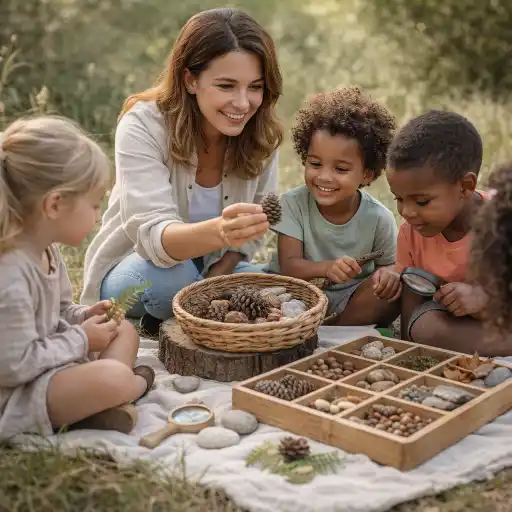
For example, children collecting stones can sort by size, make patterns, compare weight, dictate a story, or design a small habitat. Infants may explore safe textures, changing light, and outdoor sounds through close adult narration. Toddlers can fill containers, notice shadows, and match photographs to objects. Preschoolers can predict, tally findings, sketch changes, and collaborate on longer investigations. For preschoolers curious about the sky, Space Exploration Day can offer a timely way to extend outdoor observation into age-appropriate science activities.
Keep the learning target visible but concise: “What feels rough?” “Which object is heavier?” “Where did the shadow move?” These prompts support vocabulary, reasoning, and #inquiry without turning play into a worksheet. Documentation can remain manageable: one photograph, one child quote, and one sentence explaining the learning is often enough to communicate meaningful progress.
How can programs make nature-based learning inclusive?
Inclusion means every child has authentic ways to participate, not merely access to the same activity. Children differ in mobility, sensory processing, communication, attention, health, culture, and comfort with materials such as mud, insects, or uneven ground. Inclusive nature play resources emphasize designing with families, caregivers, and children rather than making assumptions about what participation should look like.
Offer multiple entry points:
- Provide active and quiet options so children can move, observe, or pause.
- Use adaptive tools such as thick-handled scoops, tongs, seated work surfaces, and lightweight containers.
- Pair spoken directions with photographs, gestures, tactile cues, and home-language vocabulary.
- Allow children to watch before touching and to participate through drawing, pointing, listening, or storytelling.
- Plan accessible routes and stable surfaces while preserving open-ended exploration.
Mixed-age groups can share an investigation while adults adjust the questions. An infant might listen to leaves rustling; a toddler might carry a basket; a preschooler might count and compare the collected items. These are not lesser versions of the same activity. They are developmentally appropriate forms of participation.
Equity also includes practical preparation. Maintain a lending collection of boots, rain pants, hats, sunscreen, coats, and spare clothing. Ask families about cultural relationships with land, food, plants, weather, and animals. Use home languages in labels and conversations. When children see their families’ knowledge represented, nature-based learning becomes a place of belonging rather than another setting where they must adapt alone.
How can providers balance healthy risk with responsible safety?
Children need opportunities to test balance, judge distance, carry materials, and solve manageable problems. Healthy risk is different from an uncontrolled hazard: risk is a challenge children can encounter with appropriate preparation and adult support, while a hazard is an unreasonable danger that adults should remove or control. Natural Start Alliance recommends site assessments, benefit-risk thinking, emergency procedures, suitable clothing, hygiene practices, and effective supervision.
Build safety into ordinary routines:
- Complete a brief hazard scan for glass, animal waste, unstable structures, standing water, poisonous plants, and damaged equipment.
- Set boundaries that preserve exploration while maintaining sight and sound connection.
- Assign staff to zones and require active supervision: watching, listening, positioning, counting, and interacting.
- Use a weather and air-quality decision chart to determine whether outdoor time continues, shortens, or moves indoors.
- Plan for hydration, shade, sun protection, insects, allergies, hand hygiene, toileting, and emergency communication.
- Review incidents and near misses so policies improve rather than simply assign blame.
CDC guidance highlights precautions related to heat, sun, insects, playground injuries, water play, and constant supervision near water. Follow applicable public health and licensing guidance; state requirements vary - check your state licensing agency. For additional staff development, Effective Supervision in Child Care Buy Now $25.00 addresses active supervision strategies that apply indoors and outdoors.
Common mistakes are usually fixable:
- Overprotecting: remove hazards while allowing developmentally appropriate challenges.
- Overloading: offer two or three focused invitations instead of every material at once.
- Inconsistent routines: use the same gear, boundary, headcount, and transition procedures each day.
How can teams sustain nature-based learning with families and staff?
Sustainability depends on shared expectations. Staff need time to practice supervision, plan short invitations, and reflect on observations. Directors can begin with a weekly team question: What did children notice? What learning did we see? What adjustment would make participation safer or richer next time?
Create a simple implementation plan:
- Choose one predictable outdoor block, even if it lasts only fifteen minutes.
- Select one learning goal, such as descriptive language, counting, balance, or observation.
- Prepare a small grab-and-go kit with clipboards, magnifiers, containers, wipes, visual cues, and spare layers.
- Assign supervision zones and review the weather decision process.
- Document one child’s words or actions and share the learning with families.
- Reflect after a week and expand only when the routine feels manageable.
Family communication should explain what children are learning, what clothing is needed, and how safety is managed. Photos and brief learning notes help caregivers understand that sticks, mud, repetition, and wandering conversations are meaningful curriculum. Invite families to contribute local knowledge, recycled containers, seasonal observations, or stories connected to nature.
Have an indoor continuation plan for unsafe weather. Children can revisit outdoor photographs, examine natural materials, care for plants, create maps, dictate stories, or investigate light and shadows indoors. This protects continuity without suggesting that outdoor learning is successful only when conditions are perfect. Staff who want more support designing indoor alternatives may explore Engaging Indoor Activities for Inclement Weather Buy Now $24.00.
Conclusion: How can any program make nature part of everyday learning?
Providers can bring nature-based learning into almost any program by starting with the environment already available, observing children closely, connecting experiences to meaningful goals, designing multiple ways to participate, and establishing clear safety routines. A large forest is not required. A planter, a shadow, a handful of stones, a changing sky, or a short walk can become a rich context for movement, language, science, creativity, relationships, and environmental care.
Begin with one manageable change: schedule a short observation walk, create a portable nature kit, add a quiet outdoor zone, or invite children to care for a container garden. Document what children do and say, involve families, and refine the practice with your team. With consistency and thoughtful support, your #outdoors can become a dependable extension of the curriculum—welcoming, developmentally appropriate, and full of possibility.
Five professional learning options for providers and directors
- CDA Certification en Español: Recursos y Consejos para Educadores Bilingües
- Proporciones de Cuidado Infantil y Tamaños de Grupo por Edad en Maryland (Guía Rápida para Centros y Hogares)
- Proporciones de Cuidado Infantil y Tamaños de Grupo por Edad en Virginia (Guía Rápida para Centros y Hogares)
- How can we use prairie animals and nature activities with young children in Oklahoma?
- How can Texas childcare providers use wildlife and outdoor discovery to teach young children?
- Capacitación CDA gratuita en Illinois
- Summer Field Trips for Daycares in Maryland
- How can North Dakota early childhood programs teach children about nature and wildlife?
- How can learning environments support children's development?
- Canciones, juegos y preguntas de círculo para niños
- Simple Field Trip Ideas Without Leaving the Classroom
- Can forest preschool activities be integrated into traditional programs?
- How can I bring a Forest Preschool (nature-based learning) to my program?
- What Makes a Great Home Daycare? 10 Things Parents Notice First
- How Can Providers Bring Nature-Based Learning Into Any Program?
