When a preschooler misses a match, the way you respond can shape whether the game feels like a safe place to try or a test to pass. Learn how to guide literacy learning without taking over the fun, and explore Play Safe, Think Big: Literacy Through Play  Buy Now $10.00 for practical ideas on supporting early literacy while supervising play. A thoughtful balance helps children build skills, confidence, and a lasting willingness to participate.
Why does the balance between correction and encouragement matter?
Preschool literacy games work best when children feel free to listen, make a guess, and try again. A teacher’s guidance can focus attention on sounds, letters, vocabulary, or print, but frequent interruptions can shift children’s focus from discovery to avoiding mistakes. The goal is not to remove teaching; it is to make teaching responsive enough that children remain engaged and willing to take risks.
Playful activities create meaningful reasons to talk and listen. In a bingo game, for example, children might hear an animal name, scan the pictures, choose a card, and explain what they noticed. Research on play-based learning describes its potential to support children’s engagement and learning, while reminding educators that an activity’s value depends on its design and facilitation. The teacher’s tone, pacing, and response to errors matter as much as the materials.
A useful guiding question is: does this prompt help the child think or communicate, or does it simply show that the adult knows the answer? Encouraging responses do not mean praising every action indiscriminately. They mean noticing effort, building on children’s ideas, and offering enough support to move learning forward while preserving agency and enjoyment.
- Keep the learning goal visible, but let children explore within it.
- Respond to mistakes as information about what support may help.
- Protect the shared pleasure, curiosity, and connection that make the game worthwhile.
How can you tell when correction has become too much?
There is no fixed number of corrections that fits every child or activity. Instead, watch the interaction. If a child stops responding, looks to the adult for approval before each move, withdraws from the game, or becomes distressed after repeated corrections, the guidance may be crowding out participation. Other children may continue playing but contribute less language or take fewer independent turns.
Correction can also become excessive when an adult interrupts every attempt to refine pronunciation, insists on one exact response, or quickly supplies the answer before the child has time to think. In a literacy game, a child’s partial understanding is valuable. A child who points to a picture after hearing its name may be demonstrating receptive understanding even if they do not yet say the word independently.
Pause and consider whether the error matters to the immediate learning goal. If the game focuses on listening for animal names, a small pronunciation variation may not need interruption. If the child is matching a beginning sound, a brief, warm prompt may be useful. Developmentally appropriate practice recognizes that children develop at different rates and need responsive, positive interactions that support interest and enjoyment.
- Notice whether the child remains curious and willing to take a turn.
- Ask yourself whether your correction adds information or merely repeats “no.”
- Use observation over time rather than judging a child from one game.
What guidance helps children learn without taking over?
Start with a clear, brief prompt, then wait. A pause gives children time to process language, scan the board, and make a choice. If a child is unsure, offer a hint or a choice rather than immediately naming the answer. For example: “You’re looking for the animal that says ‘moo.’ Which picture could it be?” This supports reasoning while keeping the child in the role of active player.
When a child makes a mismatch, acknowledge the attempt and invite another look: “You chose the horse. Let’s listen again: I said ‘cow.’ Which picture shows the cow?” If the child still needs help, model the answer briefly and return the turn to them. You can also recast their response: “That is a horse. You found the animal with the long mane.” This confirms meaning and adds language without a harsh interruption.
Use questions that open space for children’s thinking, such as “What did you notice?” or “What helped you decide?” NAEYC guidance on scaffolding emphasizes listening to children’s ideas, asking purposeful questions, and allowing time for thinking. One thoughtful question is usually more effective than a rapid series that makes the activity feel like an oral quiz.
- Try: “You’re close. Let’s look at the pictures together.”
- Try: “I heard you say ‘sheep.’ What does the sheep look like?”
- Try: “Would you like a clue, or would you like a little more time?”
- 🧩 Celebrate noticing, persistence, and helpful listening—not only correct answers.
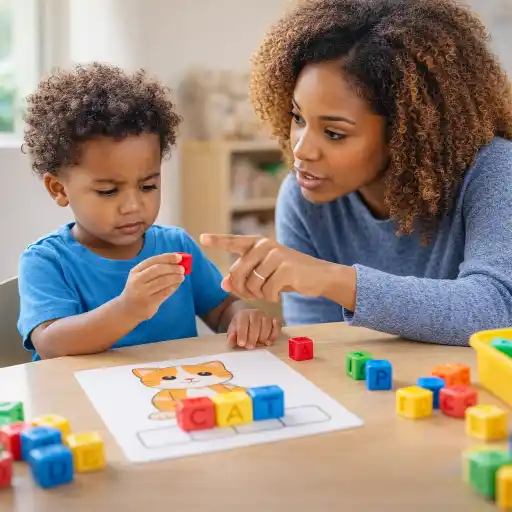
How can a literacy game stay joyful and inclusive?
Make participation flexible. Children can answer by speaking, pointing, touching a picture, signing, using eye gaze, or communicating with an AAC tool. Allowing varied response modes does not lower the literacy goal; it gives more children a way to show what they understand. Pair spoken directions with clear images, gestures, or objects, particularly when children are learning more than one language or benefit from visual support.
Consider the size and pace of the game. A small group, fewer picture choices, larger markers, and uncluttered boards can make matching more accessible. Keep rounds short enough to maintain interest, and use a cooperative goal—such as completing one shared board—if competition creates pressure. A printable resource such as Bingo Cards - Farm Animals Edition Buy Now $1.99 offers a hands-on cut, color, paste, and play format that can bring vocabulary, listening, and fine-motor practice together.
Children’s enjoyment is not a distraction from literacy learning. It is part of a context where they may be more willing to listen, communicate, and return to a new word or idea. Keep the mood warm and predictable, while ensuring materials are appropriate for the children’s ages and that supervision remains active.
- Preview the routine: listen, find, mark, and wait.
- Offer a partner or shared board when individual play feels demanding.
- Invite children to take turns calling clues or choosing the next picture.
How can you choose the right amount of support in the moment?
Think of guidance as a ladder: begin with the least intrusive support that is likely to help, then add more only when needed. First, observe. Next, give wait time. Then repeat or simplify the clue, add a gesture or visual cue, offer two choices, and finally model the response. This sequence keeps the child engaged as a thinker instead of turning the adult into the game’s answer key.
Match the prompt to the goal. If you are building vocabulary, name the picture and invite children to repeat, point, sign, or describe it. If you are focusing on listening comprehension, use a simple clue and allow time to connect it with an image. If the child is already successful, extend the challenge: “What else do you know about that animal?” or “Can you make a clue for us?” Guidance should respond to what children show, not follow a script regardless of their engagement.
After the game, record brief, objective observations: what the child heard, what they did, and what support helped. For instance, “Matched cow from the spoken name; matched sheep after a repeated clue and a picture choice.” This is more useful than a label such as “good listener” or “not ready.” State requirements vary - check your state licensing agency when determining whether training meets a particular professional-development requirement.
- Observe before stepping in.
- Use the smallest helpful prompt, then return the turn to the child.
- Adjust the next round based on patterns across experiences, not a single response.
How can you tell whether the game is teaching and still feels like play?
Look for both learning and engagement. Children may begin to recognize familiar words, attend to a spoken cue, describe a picture, ask for a turn, or help a peer. They may also show playfulness by making animal sounds, laughing at a silly clue, or suggesting a new rule. These behaviors can coexist with purposeful instruction; a playful game does not have to be either “free time” or a formal lesson.
Use follow-up experiences to deepen learning without turning one game into a prolonged drill. After animal bingo, read a related picture book, add toy animals to dramatic play, invite children to draw a favorite animal, or revisit key words during conversation. The printable Farm Animals bingo activity Buy Now $1.99 can be adapted for small groups or centers, while children’s interest guides how you extend it.
For a fuller grounding in literacy through play, the English-language course Play Safe, Think Big: Literacy Through Play Buy Now $10.00 explores supervision and emerging literacy skills. It can help providers develop practical classroom strategies and strengthen professional knowledge; check with your state licensing agency to confirm whether any course applies to a specific training requirement. Consider also exploring these relevant English-language courses:
- Language and Literacy Foundations in Pre-K Buy Now $16.00
- Reading Aloud and Storytelling Buy Now $16.00
- Science of Reading Foundations in the Pre-K Classroom Buy Now $16.00
- Assessment of Language and Literacy Skills Buy Now $24.00
In short, correction is too much when it reduces children’s willingness to participate, explore, or communicate. Keep feedback brief, kind, and connected to the learning goal; offer wait time and the least support that helps; and make room for laughter, choice, and collaboration. A well-facilitated preschool literacy game can nurture both emerging skills and the confidence to keep trying.
- 45 Hour Child Growth and Development
- CDA Preschool Credential with Portfolio Review
- Birth to Five CDA Credential with Portfolio Review
- CDA Bridge Bundle: Preschool
- Pediatric RSV First Aid & CPR/AED
- CDA Bridge Bundle: Family Child Care without Portfolio Review
- CDA Bridge Bundle: Preschool without Portfolio Review
- Texas Director Credential
- Every Moment Matters: Schedules and Transitions
- CDA Certification en Español: Recursos y Consejos para Educadores Bilingües
- ❄️ ¿Qué actividades al aire libre funcionan bien para los niños de Illinois en cada estación? 🌷🍂
- Requisitos Para Ser Maestra Principal En Un Daycare: Lo Que Necesitas Para Empezar
- Physical Activity Tips for Kids of Different Ages
- Que es Título 22 en California?
- ¿Cuál es la diferencia entre un certificado CDA y la credencial CDA?
- Actividades de Motricidad Gruesa que Desarrollan el Equilibrio, la Coordinación y la Fuerza
- ¿Cómo solicito la licencia para una guardería en California?
- Regulaciones de Licenciamiento de Cuidado Infantil en California para Centros y Hogares de Cuidado Infantil Familiar
- Cómo Trabajar en el Cuidado Infantil en California: Requisitos y Pasos
- Cómo Ser Maestra de Preescolar en Illinois
- Cómo Ser Maestra de Preescolar en Wisconsin
- Cómo Ser Maestra de Preescolar en California
- Cómo Ser Maestra de Preescolar en Maryland
- Canciones, juegos y preguntas de círculo para niños
- How Can Child Care Providers Create Print-Rich Early Childhood Environments?
- How Can Child Care Programs Build an Effective Social-Emotional Curriculum?
- How Can You Differentiate Sight-Word Bingo for Mixed-Ability Groups?
- How Should Providers Respond to Invented Words in Children’s Stories?
- How Much Correction Is Too Much During a Preschool Literacy Game?
