Why does “because” make a difference in fall learning?
Preschoolers often notice details before they can fully explain them. A child may point to a curled leaf and say, “It’s dry,” or watch leaves scatter and announce, “The wind did it.” When an educator gently invites the child to add “because,” the conversation can move from naming an observation to making a connection: “I think this leaf is dry because it crumbles when I touch it.” The goal is not to demand a complete sentence every time; it is to help children make their ideas visible in a way that feels manageable and meaningful.
Explaining an idea draws together observation, memory, vocabulary, and early reasoning. Head Start’s guidance on concept development encourages educators to help children describe, explain, predict, and connect new experiences with prior knowledge. NAEYC likewise recommends open-ended prompts that stretch children’s thinking. Fall offers vivid, tangible evidence—colors, textures, seeds, weather changes—so a child has something concrete to refer to while practicing an explanation.
These exchanges also build relationships. When adults listen instead of rushing to correct or supply answers, children learn that their ideas deserve attention. A welcoming #classroom makes it safer to offer a guess, revise it, or listen to another perspective. “Because” is not a test of correctness; it is an invitation to share the thinking behind an idea.
- Children practice connecting what they notice with what they think may be happening.
- Educators gain insight into children’s questions, prior knowledge, and emerging theories.
- Peers hear different explanations and can compare ideas respectfully.
How can educators invite children to explain what they notice?
Start with a genuine observation, then ask one clear question and give children time. Instead of “What color is this leaf?” try “What do you notice about this leaf?” Follow the child’s response with a prompt that invites a reason: “What makes you think that?” or “What did you see that gave you that idea?” NAEYC’s guidance on questions that stretch children’s thinking emphasizes adapting prompts to children’s developmental needs and building on their answers rather than treating conversation like a quiz.
Use the child’s own words as a bridge. If a child says, “The leaf fell because it’s tired,” you might respond, “You think the leaf fell because it was tired. What do you notice about the tree?” This respects the child’s imaginative theory while opening space to observe more closely. Avoid insisting on a scientifically complete explanation. Preschool inquiry is about noticing, sharing possibilities, and comparing evidence over time.
Try prompts such as:
- “I think this leaf changed color because ____. What do you think?”
- “What makes you think this pinecone is wet?”
- “Why do you think these leaves are on the ground?”
- “What did you notice that helped you decide?”
- “What else might explain what we see?”
Offer vocabulary in context—such as crisp, damp, vein, edge, and change—and model a sentence without requiring children to repeat it. “You noticed the leaf is brittle because it breaks easily” gives a child useful words and a structure to borrow when ready.
How can fall discoveries become hands-on reasoning activities?
Choose simple investigations rooted in what children can see and handle safely. A useful pattern is: notice, wonder, predict, explore, and share. The “I Think This Because” Autumn Reasoning Mats can support this process by giving children a visual place to connect an observation with an idea. Treat the mats as conversation supports—not worksheets with one required answer. Children can point, draw, dictate, use objects, or explain aloud.
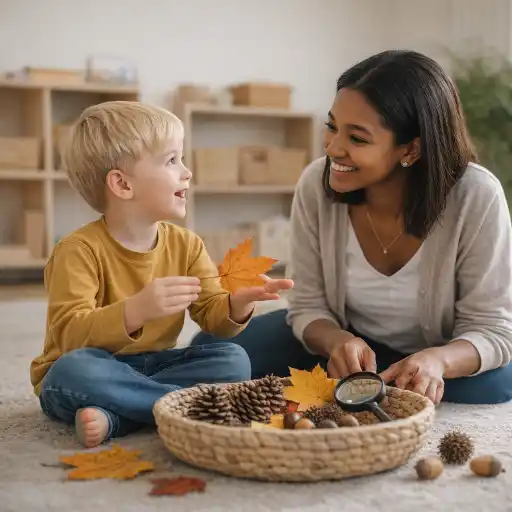
For example, offer a small collection of fallen leaves. Children might compare a dry leaf and a damp leaf, sort leaves by shape, or predict which one will tear more easily. Ask them to share what they think and what evidence they noticed. During a pinecone exploration, children can describe its texture and compare it after it has been in a dry or damp place. Keep the focus on observed changes; avoid presenting a simple activity as proof of a complex scientific cause.
Other invitations include:
- 🍂 Leaf detectives: Compare color, shape, edges, and texture; invite children to explain how they sorted their collection.
- What will happen? Predict whether large, safe fall objects will sink or float, then compare the results.
- Nature structures: Build a shelter for a toy animal and ask what makes the structure steady or protective.
- Weather watchers: Notice wind, clouds, or temperature and connect observations to clothing or outdoor conditions.
Keep materials limited and flexible, and let children’s questions guide the next step. Fall learning can extend across outdoor science adventures, bringing language, early math, movement, and collaboration into the same investigation.
How can “because” support every child’s language and participation?
Children do not all explain ideas in the same way, at the same pace, or in the same language. A child may be a careful observer but not yet ready to produce a long spoken sentence. Another may share an idea through gesture, drawing, play, a communication aid, or a home-language phrase. Accepting these forms of expression keeps the intellectual invitation open to everyone.
Give children adequate processing time after asking a question. Reduce competing noise when possible, offer a photograph or real object as a visual cue, and invite partner talk or a small-group response. Sentence starters can help without becoming a script: “I think ___ because ___,” “I noticed ___,” or “Maybe ___.” Model the phrase naturally, then allow the child to use as much or as little of it as works.
For children learning more than one language, home-language contributions are valuable evidence of thinking. Invite families to share relevant seasonal words, experiences, or stories, and use pictures or gestures to support shared meaning. A child can point to a leaf and explain in a familiar language while an educator adds a new English word. The priority is to understand and extend the child’s idea, not to require English-only explanations.
- Accept speech, signs, gestures, drawing, demonstration, and communication devices as meaningful responses.
- Offer a choice of two objects or images if an open prompt feels too broad.
- Rephrase or add vocabulary without implying that the child’s original expression was wrong.
- Notice whose ideas are heard and make space for quieter children and peer voices.
These practices build confidence as well as #language. A child who feels heard is more likely to keep wondering, communicating, and contributing to shared discovery.
How should teams document children’s reasoning and avoid common pitfalls?
Brief, objective documentation can help educators plan thoughtful follow-ups. Record the context, the child’s words or actions, and what happened next. For example: “During the leaf walk, Sam pointed to a curled leaf and said, ‘It’s dry because it breaks.’ He compared it with a flexible leaf.” This note captures an observation and explanation without making a broad judgment about the child’s ability. The article How Can Preschool Teachers Encourage Children to Explain Their Thinking? offers further ideas for listening, waiting, and extending children’s explanations.
Use documentation to revisit thinking: “What did you think before? What do you notice now?” Children may keep their original idea, add details, or change their minds. All are valuable outcomes of inquiry. A photo, drawing, child quote, or simple class chart can help children remember the investigation and see how explanations develop.
Common pitfalls are easy to adjust:
- Turning every exchange into a quiz: Ask questions you genuinely want to explore, then follow the child’s response.
- Rushing to correct: First reflect the idea and ask what evidence the child noticed.
- Demanding a spoken sentence: Accept demonstrations, drawings, gestures, and home languages.
- Asking several questions at once: Use one focused prompt and allow wait time.
- Overlooking safety: Inspect natural materials, avoid unknown plants and choking hazards, and supervise outdoor exploration actively.
Directors can support consistent practice by modeling open-ended conversation during coaching and giving staff time to reflect together. Keep activities responsive rather than overplanned, and remember: state requirements vary - check your state licensing agency.
Conclusion: How can “because” help preschoolers explain fall discoveries?
“Because” helps preschoolers connect an observation with an explanation, making their emerging reasoning easier to hear, revisit, and extend. Educators can foster that connection by asking authentic open-ended questions, pausing for responses, offering vocabulary in context, and welcoming many ways to communicate. Fall discoveries—leaves, pinecones, changing weather, and outdoor materials—give children concrete experiences worth describing and investigating.
- 45 Hour Child Growth and Development
- CDA Preschool Credential with Portfolio Review
- What Makes Me Special: An Overview of Autism and ADHD
- Children at the Wheel: Emergent Curriculum
- CDA Bridge Bundle: Family Child Care without Portfolio Review
- CDA Bridge Bundle: Infant/Toddler without Portfolio Review
- CDA Bridge Bundle: Preschool without Portfolio Review
- Lesson Planning for Preschoolers
- CDA Certification en Español: Recursos y Consejos para Educadores Bilingües
- Cómo Trabajar en el Cuidado Infantil en Carolina del Norte: Requisitos y Pasos
- Pumpkin, Leaves, and Apples: Fall Activities for Preschoolers
- Celebrando la amistad en el cuidado infantil durante el Día de los Mejores Amigos
- Rainy Fall Day? 12 Indoor Activities Preschoolers Won’t Want to Stop
- What’s Happening Outside? Fall Science Adventures for Preschoolers
- Go on a Fall Hunt! Outdoor Learning Challenges for Preschoolers
- Count It, Sort It, Find It! Fall Math Games for Preschoolers
- Fall Detectives: 10 Questions Pre-K Kids Can Investigate This Season
- How Can Outdoor Fall Activities Support Children’s Development?
- How Can Simple Fall Activities Support Kindergarten Readiness Through Play?
- How Can Preschool Teachers Use Fall Experiences to Support Individual Learning Needs?
- How Can You Plan Fall Activities for a Mixed-Age Family Child Care Group?
- What Can Preschoolers Build to Catch the Breeze?
- What Can Preschoolers Learn by Watching Trees Change Throughout the Fall?
- Why Can Observing the Same Tree Teach Preschoolers More Than a Nature Walk?
- How Can Families Share Fall Discoveries at Home Without Homework?
- How Can Preschoolers Revisit Fall Through Photos, Predictions, and Discoveries?
- What Disappeared from the Fall Tray? How Can Preschool Detective Games Build Memory?
- How Can “Because” Help Preschoolers Explain Their Fall Discoveries?
