A few fall objects, a tray, and a cloth can turn an ordinary small-group moment into a lively mystery—and give preschoolers a meaningful chance to look closely, remember, compare, and explain. Use the Observation Detective Handbook Buy Now $1.75 for ready-to-use missions, and explore Lesson Planning for Preschoolers  Buy Now $24.00 to strengthen your ability to plan developmentally appropriate experiences that connect playful investigations with intentional learning goals.
Why does a “What disappeared?” game matter for preschool learning?
In a “What disappeared?” game, children study a small arrangement, hold details in mind, and compare the scene after something changes. The sequence is simple, but the thinking is rich: children attend to colors and positions, recall what they saw, notice differences, and communicate a conclusion. These are useful opportunities to practice emerging #memory, attention, descriptive language, and reasoning through play—not a test of who remembers the most.
Keep the goal modest and child-centered. A child may remember an object’s name, point to its empty place, describe its color, or explain that “the little orange leaf is gone.” Each response offers a glimpse of how the child is approaching the puzzle. As NAEYC explains in its guidance on using observation to guide teaching, educators can use what they notice to adjust strategies and design responsive learning experiences.
Fall materials make the activity inviting because they are familiar, varied, and easy to discuss. Leaves, large pinecones, toy pumpkins, and sturdy classroom items can prompt comparisons such as smooth or rough, big or small, red or yellow. Select safe, age-appropriate objects, supervise closely, and avoid small items for children who may mouth them.
- Notice children’s strategies and language—not just whether they identify the missing object.
- Use the game as a playful observation opportunity, not a developmental diagnosis.
- Follow program safety procedures; state requirements vary - check your state licensing agency.
How can you set up a fall tray detective mission?
Choose three to five familiar, distinct objects for an initial round. A tray provides a clear viewing area, and a cloth makes the change easy to conceal. Arrange the objects with enough space between them that children can see each one. Before beginning, check that the materials are clean, intact, and safe for the children in your group.
Invite children to become detectives: “Let’s look carefully at our fall tray. What do you notice?” Give them unhurried time to scan the objects. You might name the objects together, invite children to describe a feature, or ask them to remember where an item sits. Then cover the tray, remove or move one object without showing the group, and reveal the arrangement again. Ask, “What changed?” or “What do you remember seeing before?”
Offer a visual or pointing response as well as spoken answers. Children can point to a place, choose from picture cards, gesture, use an assistive communication method, or describe the change in a home language. The Observation Detective Handbook Buy Now $1.75 includes structured missions and scene-recording cards that can help educators guide noticing, remembering, comparing, and describing.
- 🍂 Start with a few high-contrast objects, such as a large leaf, a toy pumpkin, and a pinecone.
- Keep the arrangement visible long enough for children to examine it without rushing.
- Let children take turns being the detective, arranging the objects, or choosing what changes.
Which prompts support remembering and descriptive language?
Open-ended prompts invite children to explain their thinking without making the activity feel like a quiz. Ask one question at a time, then pause. “What do you remember?” allows a range of responses; “What was beside the pumpkin?” draws attention to position; and “How is the tray different now?” encourages comparison. A child may need quiet thinking time before answering, especially in a group.
Model precise but accessible language. For example: “I remember a big yellow leaf near the edge. Now I see an empty space there.” This gives children useful words for size, color, and location while leaving the mystery for them to solve. If a child says, “The yellow thing,” you might extend gently: “Yes, the yellow leaf. It was beside the pinecone.” Avoid correcting every phrase or supplying the answer too quickly.
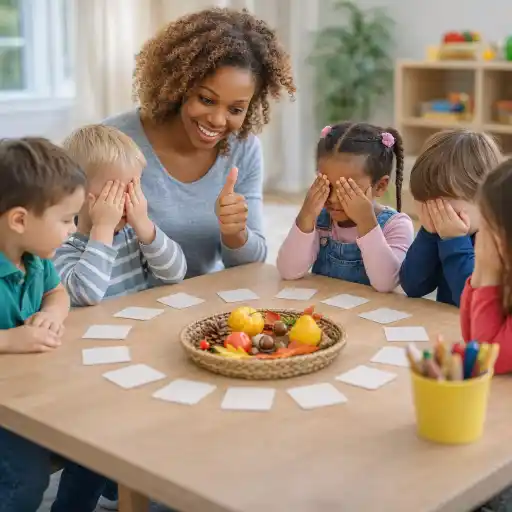
Prompts can also make children’s strategies visible: “What helped you remember?” “Would you like to point or tell us?” or “What detail did you look at first?” Accept different ways of communicating. A child may use a gesture, a word in another language, a drawing, or a careful look before joining verbally. The purpose is shared inquiry and confidence, not polished vocabulary or perfect recall.
- “What do you notice first? What else do you see?”
- “What was near the leaf before? What is near it now?”
- “Can you show or tell us what changed?”
- “What could help you remember where the objects are?”
How can you adjust the challenge for different children?
Children vary in familiarity with the game, interest, language, attention, and preferred ways of participating. Adjust one feature at a time so the puzzle stays inviting. If the task feels difficult, use fewer objects, keep the tray uncovered for a first matching round, allow a longer look, or remove an especially distinctive object. You can also make the change more visible by moving an object rather than removing it.
When children are ready for more complexity, add one object, change two positions, or invite them to remember both what moved and where it was. Keep the goal cooperative: the group can solve the case together, rather than compete over speed or the number of correct answers. A child who prefers to watch can be invited to observe before taking a turn; watching is a legitimate way to learn the routine.
Adapt access as thoughtfully as difficulty. Use larger objects and clear contrasts, reduce surrounding distractions, make sure the tray is within comfortable reach, and accept pointing, gestures, words, or communication tools. For multilingual children, welcome home-language descriptions and connect familiar vocabulary with the objects. These adjustments support participation without assuming that every child must respond in the same way.
- Simplify: reduce the number of objects, provide more viewing time, or offer a choice of two possibilities.
- Extend: change an object’s position, invite children to describe the arrangement, or let them create a mystery for peers.
- Include: provide accessible materials, flexible response options, and the choice to watch, participate, or take a break.
How can educators observe and extend the learning?
Use the activity to notice children’s approaches and plan what might help next. Record concrete evidence rather than broad judgments. For example: “After looking at four objects, Aria pointed to the empty space and said, ‘The pinecone was there.’” This note captures what happened and gives the team something useful to revisit. Avoid conclusions such as “has a good memory” or “cannot focus” based on one short game.
Consider documenting a brief quote, a drawing, or the supports that helped a child participate. Did the child name objects, track their positions, compare before and after, or rely on a visual cue? NAEYC’s observation guidance emphasizes using information gathered over time to adapt teaching and plan experiences. Revisit the game on another day or in a different context before interpreting a pattern.
Follow children’s discoveries into related play. If they are interested in leaf colors, invite them to sort leaves by color or size. If they focus on position, build a simple arrangement with blocks and describe what is beside, behind, or between. A short detective mission can connect to science, math, language, and social collaboration without requiring a formal worksheet.
- Write down observable actions or exact words, including the context and support offered.
- Use children’s interests to choose a manageable follow-up activity.
- Keep supervision active and materials appropriate to the children’s ages and needs.
How can you avoid common pitfalls in detective games?
A memory game can lose its playful quality if adults make it a race, increase difficulty too quickly, or treat a missed answer as failure. Preschoolers are still developing their ways of attending, remembering, and communicating; performance can also shift with fatigue, distractions, group size, and familiarity. Keep rounds brief, model the routine, and celebrate careful looking, trying again, and explaining a clue.
Another common pitfall is asking many questions before children have time to examine the tray. Too much adult talk can take attention away from the materials. Offer one genuine prompt, wait, and follow the children’s ideas. Avoid assuming that a quiet child is not engaged or that a child who responds nonverbally has not understood the challenge.
Safety and inclusion belong in the plan from the start. Use sturdy, clean objects and supervise closely, especially when natural materials or small pieces are involved. Provide more than one way to participate, and never require a child to touch an object to take part. If you document observations for program purposes, follow applicable procedures and protect children’s privacy.
- Do not turn the game into a speed contest or a judgment of ability.
- Do not add objects so quickly that children become frustrated.
- Do not overlook gestures, home-language responses, or careful observation as meaningful participation.
Conclusion: What does the fall tray mystery teach us?
“What disappeared from the fall tray?” offers a simple, flexible way for preschoolers to practice looking closely, remembering details, comparing scenes, and communicating ideas. Its educational value is not measured by how many objects a child recalls. The value is in a warm, accessible opportunity to explore a problem, try a strategy, and learn alongside peers and a responsive adult.
Start small, use safe and familiar materials, give children time to think, and adjust the challenge to their interest and needs. Observe specific actions and words, then use what you learn to plan a relevant next step. For educators who want practical activity guidance and structured missions, the Observation Detective Handbook Buy Now $1.75 can extend the classroom experience. The central question is not simply what disappeared—it is what children noticed, remembered, and discovered together.
Additional professional learning
- Lesson Planning for Preschoolers Buy Now $24.00 — supports purposeful, developmentally appropriate preschool planning.
- Role of Play in Learning Buy Now $16.00 — explores the relationship between play and child development.
- Preschool Assessments & Observations Buy Now $24.00 — covers observation and assessment practices for preschool settings.
- DAP for Preschool Buy Now $24.00 — focuses on developmentally appropriate practices and strategies for preschool classrooms.
- 45 Hour Child Growth and Development
- From Tantrums to Triumphs: Equipping Preschoolers with Self-Regulation Skills
- Children at the Wheel: Emergent Curriculum
- Pediatric RSV First Aid & CPR/AED
- Art from the Heart for Preschoolers: Open Ended Art Projects that Build Self-Esteem
- CDA Bridge Bundle: Preschool without Portfolio Review
- Lesson Planning for Preschoolers
- Texas Director Credential
- From Tantrums to Triumphs: Equipping Preschoolers with Self-Regulation Skills
- CDA Certification en Español: Recursos y Consejos para Educadores Bilingües
- 🥦✨ ¿Cómo apoyar a los niños selectivos a probar nuevos alimentos sin presión?
- 👶 ¿Cuáles son las proporciones y grupos requeridos en Dakota del Norte? 🏫
- 🍑📘 ¿Cada cuánto DECAL exige actualizar planes de emergencia en Georgia?
- Requisitos Para Ser Maestra Principal En Un Daycare: Lo Que Necesitas Para Empezar
- Recursos en Español sobre el Sueño Seguro del Bebé
- Apoyo en Español para Capacitaciones Grupales Presenciales y por Zoom en Cursos Selectos
- Cómo ser director de cuidado infantil en Maryland
- Actividades de Motricidad Gruesa que Desarrollan el Equilibrio, la Coordinación y la Fuerza
- 10 Ejemplos de Cómo la Cultura Influye en el Desarrollo Infantil
- ¿Qué preguntas aparecen en el examen CDA para preescolar?
- Regulaciones de Licenciamiento de Cuidado Infantil en California para Centros y Hogares de Cuidado Infantil Familiar
- Proporciones de Cuidado Infantil y Tamaños de Grupo por Edad en Maryland (Guía Rápida para Centros y Hogares)
- Proporciones de Cuidado Infantil y Tamaños de Grupo por Edad en Nueva Jersey (Guía Rápida para Centros y Hogares)
- Cómo Ser Maestra de Preescolar en Illinois
- Cómo Ser Maestra de Preescolar en Wisconsin
- Calabazas, hojas y manzanas: actividades de otoño para preescolares
- Celebrando la amistad en el cuidado infantil durante el Día de los Mejores Amigos
- Canciones, juegos y preguntas de círculo para niños
- What Disappeared from the Fall Tray? How Can Preschool Detective Games Build Memory?
