A breezy fall day can turn loose parts and simple craft materials into a lively engineering lab. Explore the ideas below to help preschoolers observe moving air, design something that responds to it, and learn through testing and revision; for a deeper guide to creating nature-rich learning spaces, consider Creating the Natural Outdoor Classroom  Buy Now $16.00. You can also build your inquiry practice with Basic Science in Early Childhood Buy Now $25.00, a focused training on planning meaningful exploration, investigation, and experimentation.
Why is a windy-day engineering challenge worth doing?
Wind is invisible, but its effects are all around children: leaves skitter, ribbons flutter, and a paper sail catches a gust. Asking preschoolers to build something that can catch or respond to the breeze gives them a concrete way to investigate force, motion, materials, and design. They are not simply making a craft; they are using an idea to solve a problem.
Engineering experiences also make room for children’s agency. A prototype that spins slowly, tips over, or barely moves is useful evidence—not a failed project. Children can decide what to change, test the new version, and talk about what they noticed. This iterative process—imagining, building, testing, and improving—is central to early design learning, as described in NAEYC’s preschool build-and-test activities.
The challenge is naturally interdisciplinary. Children compare sizes and shapes, notice cause and effect, practice descriptive language, negotiate roles, and persist through a problem. Research on early childhood engineering also emphasizes how building invites children to explore stability, balance, material properties, and spatial reasoning (Revealing the Work of Young Engineers in Early Childhood Education).
Fall offers an especially inviting context: seed pods, leaves, and changing weather can prompt questions about how wind moves things. The downloadable Fall Wind Investigation and Design Challenge Cards can help providers organize these explorations into clear, playful invitations.
What can preschoolers build to catch or respond to the breeze?
Start with a few safe, age-appropriate materials rather than a large, overwhelming collection. Invite children to explore how each one moves in the air before asking them to design. Some possibilities include:
- Wind streamers: Attach short ribbons or fabric strips to a sturdy stick and observe how they lift, twist, or point in different locations.
- Windsocks: Decorate a lightweight paper or fabric tube and add short streamers. Children can compare how it moves in sheltered and open areas.
- Wind catchers: Combine broad, lightweight shapes with securely fastened ribbons or leaves, then see what parts flutter or turn.
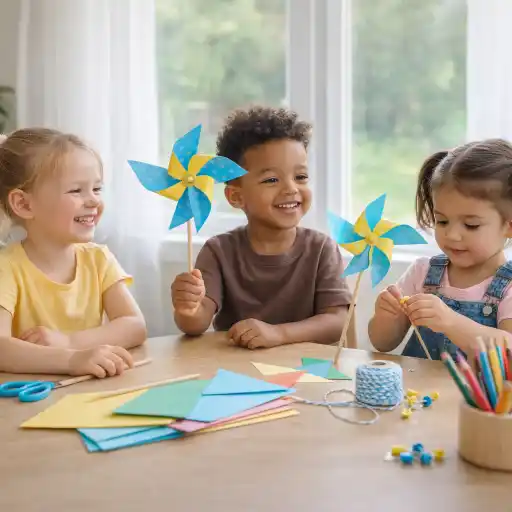
- Simple pinwheels: With adults handling any cutting or sharp fasteners, children can decorate and compare how different shapes respond to moving air.
- Wind-powered sailboats: Build small boats from stable, water-safe materials and add sails. Test them in a shallow, supervised tub using a hand fan or gentle outdoor breeze.
Invite children to use #looseparts such as fabric scraps, sturdy paper, large leaves, and reusable building materials, selecting items that fit your group’s ages and abilities. Ask, “Which parts might catch more air?” or “What could we attach so we can see the breeze?” There is no single best object to build; the value lies in noticing how design choices affect movement.
When using the Fall Wind Investigation and Design Challenge Cards, select one prompt at a time and leave space for children to add their own ideas. A card can launch the investigation, while children’s observations determine what happens next.
How can educators guide a fair design-and-test cycle?
Keep the process predictable without making it rigid. NAEYC’s design sequence offers a helpful frame: think and plan, build, try it, revise, and share. Preschoolers may move back and forth among these steps, and that flexibility is part of authentic problem-solving.
- Notice and wonder: Begin with a brief outdoor observation. Ask children what is moving and how they know the air is moving.
- Imagine and plan: Present a simple design question, such as, “Can we make something that catches the breeze and moves?” Children can draw, point to materials, or explain an idea.
- Build: Let children assemble prototypes, offering support with joining materials or tools when needed.
- Test: Choose a consistent way to create or find moving air. For example, test models at the same marked distance from a secured fan on the same setting, or observe them in one suitable outdoor location.
- Revise and share: Ask what children would change and why. Repeat the same test, then invite each group to describe what happened.
To compare designs thoughtfully, change one feature at a time when feasible—for example, the sail’s size or the number of streamers. Record a quick drawing, photograph, or child quote. A child might say, “The wide one moved more,” giving you a meaningful starting point for the next question.
- Use prompts such as “What do you predict?” “What did you notice?” and “What might we change?”
- 🌀 Celebrate an unexpected result or an inventive redesign—not only the prototype that moves the most.
This approach makes children’s #engineering thinking visible while keeping the emphasis on exploration rather than a perfect product.
How can the challenge support inclusion and fall learning?
Children can investigate the same question in different ways. One may assemble the prototype, another may choose materials, and another may observe or describe how the ribbons move. Offer picture cues, short steps, larger pieces, adapted grips, extra time, and opportunities to communicate through gesture, drawing, speech, or a home language. Watching from a comfortable distance is also a valid way to participate.
Connect the activity to fall by comparing how different leaves, seed pods, or lightweight natural objects move. Use only materials that are safe for the age group and appropriate to your setting. Check for allergies, choking hazards, sharp edges, and unknown plants; do not collect or handle mushrooms or unfamiliar berries. Children can also create a class observation chart with drawings or simple marks to show what moved, fluttered, or stayed still.
Offer multiple ways to document thinking, not just a written answer. A photograph of a design, a child’s dictated explanation, or a drawing of what happened can capture learning and help staff plan a follow-up. For inspiration on observing wind with streamers, bubbles, and other simple materials, see ChildCareEd’s outdoor wind exploration ideas.
For providers who want to strengthen how they arrange outdoor learning environments, CDA: Creating the Outdoor Classroom Buy Now $16.00 focuses on intentional design of nature-based spaces. The main goal is not to make every child produce the same structure; it is to give each child a meaningful way into the investigation.
How can providers keep windy-day building safe and manageable?
Before beginning, check weather and site conditions, follow program procedures, and make a clear decision about whether outdoor testing is appropriate. Move the investigation indoors or choose calm-day observations if gusts, storms, blowing debris, or other conditions create concern. State requirements vary - check your state licensing agency.
For indoor testing, secure the fan where children cannot reach the blades or cord, keep it away from water, use a low setting, and maintain direct adult supervision. Keep loose pieces small enough to manage but not so small that they present choking risks. Avoid long cords, string loops, plastic bags, or attachments that could entangle children. Adults should handle scissors, skewers, and any other tools that may be unsafe for children to use independently.
- Set clear boundaries for where children may stand and where materials can travel.
- Assign staff positions so sight-and-sound supervision is maintained throughout the test.
- Use brief turns or small groups to reduce crowding around fans or materials.
- Check prototypes for loose parts before and after each test.
- Do not install child-made designs as playground fixtures unless program leadership has assessed their safety and suitability.
Common pitfalls are easy to avoid: do not turn the challenge into a race for one “best” design, change multiple features at once if you want children to compare outcomes, or step in too quickly when a model does not work. Ask children what they noticed first. That pause protects their ownership of the problem and often reveals the next useful experiment.
For additional guidance on intentional nature-based learning, Creating the Natural Outdoor Classroom Buy Now $16.00 offers a more complete professional learning experience.
Conclusion: What can preschoolers build to catch the breeze?
Preschoolers can build streamers, windsocks, pinwheels, wind catchers, and sail-powered boats—and, just as importantly, they can investigate why one design responds differently from another. A meaningful challenge starts with observation, gives children open-ended materials, and makes room for planning, testing, and redesign.
Providers support the learning by asking curious questions, keeping comparisons reasonably fair, documenting children’s ideas, and adapting participation so every child can contribute. Safety and supervision remain essential, especially when working outdoors or using a fan. The #wind is not visible, but its effects make a compelling invitation to notice, build, test, and wonder together.
To carry the investigation into your planning, try the Fall Wind Investigation and Design Challenge Cards as a practical prompt for the next breezy day. Use the cards as a starting point—not a script—and let children’s discoveries guide the next design question.
Five relevant ChildCareEd courses
- 45 Hour Child Growth and Development
- CDA Preschool Credential with Portfolio Review
- 45 Hour Preschool Methods and Materials
- Birth to Five CDA Credential with Portfolio Review
- CDA Bridge Bundle: Preschool
- Pediatric RSV First Aid & CPR/AED
- CDA Bridge Bundle: Family Child Care without Portfolio Review
- Art from the Heart for Preschoolers: Open Ended Art Projects that Build Self-Esteem
- CDA Bridge Bundle: Preschool without Portfolio Review
- CDA Certification en Español: Recursos y Consejos para Educadores Bilingües
- 👶 ¿Cuáles son las proporciones y grupos requeridos en Dakota del Norte? 🏫
- Recursos en Español sobre el Sueño Seguro del Bebé
- Curso de Comunicación de 9 Horas de Maryland
- Apoyo en Español para Capacitaciones Grupales Presenciales y por Zoom en Cursos Selectos
- Actividades de Motricidad Gruesa que Desarrollan el Equilibrio, la Coordinación y la Fuerza
- 10 Ejemplos de Cómo la Cultura Influye en el Desarrollo Infantil
- ¿Cómo solicito la licencia para una guardería en California?
- Regulaciones de Licenciamiento de Cuidado Infantil en California para Centros y Hogares de Cuidado Infantil Familiar
- Proporciones de Cuidado Infantil y Tamaños de Grupo por Edad en Maryland (Guía Rápida para Centros y Hogares)
- Proporciones de Cuidado Infantil y Tamaños de Grupo por Edad en Nueva Jersey (Guía Rápida para Centros y Hogares)
- Proporciones de Cuidado Infantil y Tamaños de Grupo por Edad en Virginia (Guía Rápida para Centros y Hogares)
- Ejemplos de Crianza Respetuosa vs. Crianza Permisiva
- Cómo Ser Maestra de Preescolar en Virginia
- Celebrando la amistad en el cuidado infantil durante el Día de los Mejores Amigos
- Canciones, juegos y preguntas de círculo para niños
- How Can Children Design a Playground Sign That Stays Standing in the Wind?
- What Are Simple Ways to Build Observation and Prediction Skills in Early Childhood?
- How Can You Start a Classroom Weather Desk for Preschool Meteorologists?
- What Can Preschoolers Build to Catch the Breeze?
