When a preschooler says, “It just works,” the next few moments can turn a quick answer into rich learning. Thoughtful prompts and attentive listening help children make their ideas visible while strengthening language, reasoning, and confidence; the Teacher-Child Interactions for Stronger CLASS® Outcomes  Buy Now $24.00 course offers practical ways to extend children’s thinking and language in everyday interactions.
Why does explaining thinking matter in preschool?
When children explain an idea, they practice putting observations, memories, and guesses into words, gestures, drawings, or actions. That process helps teachers see how a child is making sense of an experience—not merely whether the child reached an expected answer. NAEYC describes this as making thinking visible: children can express ideas through speaking, drawing, and other forms of representation, while educators use those expressions to scaffold learning.
Conversation also supports communication and relationships. Back-and-forth exchanges give children opportunities to share interests and feelings, hear new vocabulary, and respond to another person’s ideas. Research on dialogic classroom talk has found benefits for children’s oral communicative competence, while evidence syntheses emphasize that children need opportunities to speak and receive meaningful feedback.
For teachers and directors, children’s explanations are useful information for planning. A child’s reasoning can reveal prior knowledge, a misconception, a developing theory, or a question worth exploring. The goal is not to make every playful moment feel like a formal lesson. It is to build a welcoming #classroom culture where children can take intellectual risks and know their ideas will be heard.
What kinds of questions invite children to explain?
Questions that invite more than one reasonable response are a good starting point. Instead of asking only “Is it tall?” or “Did it fall?”, invite children to describe what they notice and how they reached an idea. NAEYC’s guidance on stretching children’s thinking recommends prompts that help them describe, compare, infer, evaluate, and create—adjusted to the child and the moment.
- “What do you notice about the way you built it?”
- “What makes you think it might fall?”
- “How did you figure that out?”
- “What could you try if you wanted it to stand taller?”
- “What is another idea we could test?”
Follow the child’s lead. If a child says, “The big block makes it strong,” you might respond, “You think the wide block helps hold it up. What do you notice when we move it?” This acknowledges the child’s theory and opens a path to compare evidence rather than labeling the answer right or wrong. Open-ended prompts and responsive follow-ups help create extended exchanges; see the research synthesis Let Children Talk: Strategies to Foster Early Language and Vocabulary Development through Conversation.
How can teachers listen, wait, and build on a child’s response?
Strong thinking conversations depend as much on listening as on asking. After posing a question, pause long enough for the child to process it. Some children need extra time, a repeat of the prompt, a visual cue, or a chance to talk with a peer before answering. If a child responds briefly, resist the urge to fill the silence or ask several questions in quick succession.
Use the child’s response as the next step. Restate the idea in clear language, add a relevant word, and invite the child to continue. For example: “You noticed the cup tipped when you pushed the top. It lost its balance. What might help it stay steady?” This kind of linguistic and conceptual expansion affirms the child while offering language to express a more detailed explanation.
- Pause and show that you are listening with your attention and body language.
- Reflect the child’s idea without immediately evaluating it: “You think the water moved because the cup tilted.”
- Ask one purposeful follow-up: “What did you see that gave you that idea?”
- 🗣️ Invite peers to contribute: “What do you think about Maya’s idea?”
- Model your own uncertainty: “I’m not sure yet. Let’s look closely and find out.”
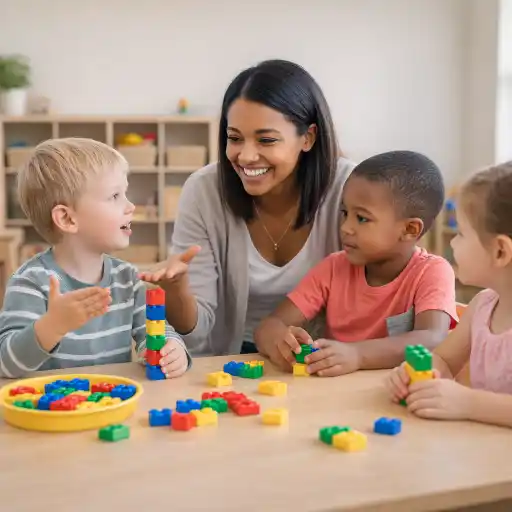
These responsive moves help children feel that their thoughts matter. They also give educators meaningful insight into children’s understanding, as discussed in the OECD’s guidance on fostering classroom interaction.
How can play and routines make reasoning visible?
Children do not need a special lesson to explain their thinking. Block play, art, dramatic play, outdoor exploration, snack, and transitions all offer authentic reasons to describe, plan, compare, or reconsider. During block play, ask what might keep a bridge from tipping. At the art table, invite a child to tell the story behind a choice of colors or materials. During a read-aloud, ask what a character might do next and what in the story led the child to that prediction.
A simple routine can help children become familiar with reflection. Try “Notice, Think, Share”: children name something they observed, offer an idea about it, and share what informed that idea. Keep the routine flexible. A child may explain by talking, demonstrating with materials, pointing to a picture, or drawing. Document meaningful examples—brief quotes, a sketch, or a photo when program permissions allow—and revisit them with children to recall earlier ideas and notice how their thinking changed.
Intentional planning can help staff follow children’s interests without losing sight of developmental aims. Children at the Wheel: Emergent Curriculum Buy Now $25.00 explores a cycle of inquiry for using children’s questions and observations to guide preschool planning. Treat the process as a shared investigation: children contribute theories, peers offer perspectives, and teachers provide materials and support for #inquiry.
How can every child participate, and what pitfalls should teachers avoid?
Children differ in expressive language, temperament, communication style, sensory needs, and familiarity with classroom language. An explanation does not have to be a long spoken answer. Invite children to show an idea through gesture, drawing, play, a communication aid, or their home language. Offer pictures, objects, partner talk, and smaller-group conversation; learn from families about words, stories, and experiences that can make classroom discussions more meaningful.
Common pitfalls are often easy to adjust:
- Turning conversation into a quiz: Ask a genuine question, listen, and follow the child’s idea rather than testing recall repeatedly.
- Answering too quickly: Allow processing time, then offer a cue or a choice if the child needs support.
- Insisting on one communication mode: Accept words, gestures, home languages, drawings, or demonstrations as meaningful contributions.
- Praising only correct answers: Notice effort and reasoning—“You tried another way and watched what happened.”
- Asking too many questions at once: Offer one clear prompt and leave room for the child to respond.
Directors can support consistent practice by modeling open-ended exchanges, protecting time for small-group conversation, and inviting staff to reflect on whose ideas are heard. When teaching science concepts, Basic Science in Early Childhood Buy Now $25.00 offers professional learning focused on developmentally appropriate investigation and scientific reasoning. State requirements vary - check your state licensing agency.
Conclusion: How can preschool teachers help children explain their thinking?
Preschool teachers encourage children to explain their thinking by treating ideas as worthy of attention, asking open-ended prompts, allowing time to respond, and building on children’s words and actions with thoughtful follow-ups. Play and everyday routines provide natural contexts for children to describe observations, test theories, and hear other perspectives.
Begin with one small change: replace a quick yes-or-no question with “What makes you think that?” Then listen closely and accept multiple ways of communicating. These practical moves help children grow as #thinkers and communicators while giving educators a clearer view of how to support each child’s learning. For a deeper professional learning experience, explore Language Development in Early Childhood Buy Now $16.00, which addresses strategies for supporting young children’s language and communication.
- Turning Behavior Around for Toddlers and Preschoolers
- Lesson Planning for Preschoolers
- 45 Hour Preschool Methods and Materials
- Birth to Five CDA Credential with Portfolio Review
- Children at the Wheel: Emergent Curriculum
- Emergent Learning & Development
- 45-Hour Infant and Toddler Curriculum
- Creating Environments that Nurture Growth and Community
- Texas Director Credential
- Every Moment Matters: Schedules and Transitions
- Preschool Arithmetic Activity
- Mathematical Skill Development
- CDA Certification en Español: Recursos y Consejos para Educadores Bilingües
- Proporciones de Cuidado Infantil y Tamaños de Grupo por Edad en Nueva Jersey (Guía Rápida para Centros y Hogares)
- Cómo Celebrar el Día Nacional del Kindergarten
- Celebrando la amistad en el cuidado infantil durante el Día de los Mejores Amigos
- Canciones, juegos y preguntas de círculo para niños
- How can we use play-based learning in preschool?
- STEM for Preschoolers: Fun Activities That Encourage Curiosity
- How Can Child Care Providers Create Low-Cost STEM Activities With Items They Already Have?
- How Can You Create Easy Preschool Math Centers with Print, Prep, and Start Learning?
- What Makes Task Cards a Great Tool for Mixed-Age Classrooms?
- How Can Living vs. Non-Living Sorting Spark Early Science Thinking?
- How Can Child Care Providers Encourage Children to Express Their Ideas?
- How Can Open-Ended Summer Art Encourage Planning and Creativity?
- How Can Camping Themes Expand Preschool Vocabulary?
- How Can Early Childhood Teachers Encourage Problem-Solving Without Giving the Answer?
- How Can Preschool Teachers Encourage Children to Explain Their Thinking?
