Strong preschool curriculum does more than fill a schedule—it connects children’s interests, developmental goals, play, relationships, and family knowledge. To strengthen planning across your program, explore ChildCareEd’s 45-Hour Preschool Curriculum course  Buy Now
 $399.00$275.00, which provides deeper preparation in curriculum design and implementation and may help eligible providers meet applicable training-hour requirements; state requirements vary, so check your state licensing agency.
A thoughtful curriculum gives educators a dependable framework without turning teaching into a script. It helps children investigate meaningful questions, build language and early mathematical thinking, develop self-regulation, and experience themselves as capable members of a learning community. For more targeted professional learning, ChildCareEd’s Roadmapping Preschool Curriculum course Buy Now $24.00 offers practical tools for individualized, goal-oriented planning.
Why does preschool curriculum matter?
Preschool curriculum is the organizing structure behind children’s daily learning experiences. It includes goals, content, materials, teaching strategies, activities, environments, routines, and assessment practices. When these elements work together, teachers can provide both intentional instruction and the flexibility young children need to explore, revisit ideas, and learn through play.
Research-informed guidance from Head Start emphasizes that high-quality curriculum should be research-based, aligned with learning outcomes and state standards, supported by staff training, and responsive to children’s strengths, interests, families, and communities. Similarly, NAEYC explains that developmentally appropriate curriculum must be culturally and linguistically responsive while addressing the whole child. Because curriculum is one part of a broader quality picture, educators may also find it useful to review the features of high-quality daycare, including relationships, environments, and staff qualifications.
This matters because preschoolers do not learn in isolated academic compartments. A child measuring water is developing mathematical reasoning, vocabulary, fine-motor control, cooperation, and scientific habits at the same time. A curriculum that recognizes these connections helps educators plan richer experiences and document learning more accurately.
What should a well-rounded preschool curriculum include?
A comprehensive curriculum addresses all major domains of development rather than concentrating narrowly on worksheets or early academic performance. Goals should be observable, meaningful, and connected to children’s real experiences.
- Language and literacy: storytelling, songs, rhymes, conversations, interactive read-alouds, dictation, drawing, and emergent writing.
- Mathematics and reasoning: counting, sorting, patterns, shapes, spatial relationships, measurement, comparison, and problem solving.
- Science and inquiry: observing, predicting, experimenting, classifying, recording, and discussing the natural and built world.
- Social-emotional learning: relationship building, self-regulation, empathy, cooperation, communication, and conflict resolution.
- Creative arts and movement: music, visual art, dramatic play, dance, fine-motor experiences, and gross-motor activity.
- Health and self-help: hygiene, nutrition, safety, independence, body awareness, and healthy routines.
ChildCareEd’s preschool curriculum guide describes these domains as interconnected components of a strong framework. A useful planning goal might be, “Children will compare quantities using more, fewer, and equal,” rather than the vague goal “Children will learn math.” Clear goals help teachers choose materials, pose purposeful questions, and recognize evidence of learning.
How can educators make curriculum developmentally appropriate?
Developmentally appropriate practice begins with knowledge of both preschool development and the individual children in the group. NAEYC’s guidance on planning and implementing curriculum emphasizes that curriculum should reflect what is known about young children generally and what educators learn about each child specifically.
Use a continuous planning cycle:
- Observe: notice children’s interests, language, strategies, relationships, and questions.
- Interpret: consider what children may be thinking, practicing, or attempting to understand.
- Plan: connect observations to learning goals, materials, prompts, and possible adaptations.
- Implement: offer the experience while remaining responsive to children’s ideas.
- Document: collect brief notes, photographs, conversations, and work samples.
- Reflect: decide what to extend, modify, revisit, or remove.
For example, repeated interest in puddles can become an integrated investigation involving weather books, water vocabulary, measurement, drawings, absorption experiments, and group discussion. The teacher remains intentional, but the curriculum grows from children’s authentic curiosity.
Offer multiple ways to participate. Children may demonstrate understanding through speech, home language, drawing, building, movement, dramatic play, gestures, or assistive communication. This approach supports #inclusion and maintains high expectations while respecting different developmental pathways.
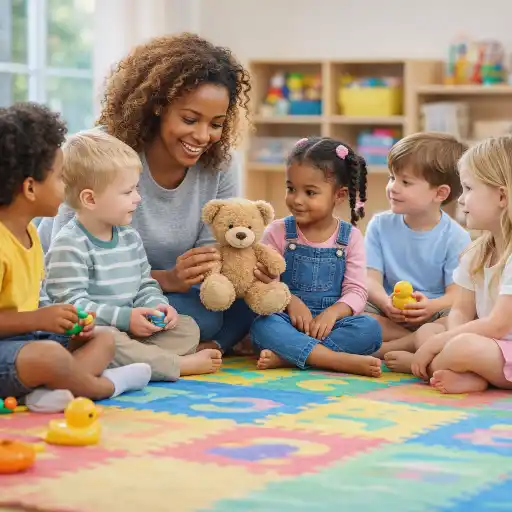
How should play, the environment, and teaching interactions work together?
Play is not a break from curriculum; it is one of preschoolers’ primary ways of learning. NAEYC notes that play supports self-regulation, language, cognitive development, social competence, and content knowledge. Effective curriculum therefore protects substantial periods of uninterrupted play while incorporating purposeful teacher guidance.
The environment should make learning visible and accessible. Arrange clearly defined centers for blocks, dramatic play, books, writing, art, sensory exploration, science, and mathematics. Provide open-ended materials that can be used in multiple ways, including recycled objects, loose parts, natural materials, manipulatives, puppets, and authentic tools.
- 🧸 Use picture labels and accessible storage so children can make independent choices.
- Include books, images, music, and dramatic-play materials that reflect children’s families and communities.
- Provide quiet spaces, varied seating, visual schedules, and adaptive tools as needed.
- Balance child-initiated play with brief, purposeful small-group experiences.
- Use open-ended questions such as “What do you notice?” and “How could we test that idea?”
Responsive interactions are equally important. Head Start describes effective teaching as nurturing, language-rich, supportive of critical thinking, and responsive to each child’s patterns of development and learning. A beautiful classroom cannot replace warm relationships, careful listening, and thoughtful scaffolding.
How can programs individualize curriculum for diverse learners and families?
Individualization should be built into planning rather than added only after a child experiences difficulty. Begin by learning about children’s languages, cultures, abilities, interests, relationships, and family routines. Then offer different entry points into the same learning goal.
For dual language learners, pair spoken language with gestures, visuals, objects, songs, home-language words, and opportunities for family vocabulary sharing. For children with disabilities, consider accessibility in advance: adjust materials, provide alternative communication methods, modify the physical arrangement, reduce unnecessary sensory demands, or offer additional processing time.
Cultural responsiveness also extends beyond special events. NAEYC’s “mirrors and windows” concept encourages classrooms to reflect children’s identities while introducing them to people, places, knowledge, and perspectives beyond their immediate experience. Review materials for stereotypes, tokenism, and missing voices.
Family partnerships strengthen curriculum relevance. Invite families to share children’s interests, languages, skills, traditions, and community knowledge. Communicate in accessible ways and treat families as knowledgeable partners rather than occasional recipients of information. ChildCareEd’s Inclusive Lessons for Preschoolers course Buy Now $16.00 can help providers adapt materials and lesson plans so every child can participate meaningfully.
How should teachers assess and improve preschool curriculum?
Assessment in preschool should inform teaching, not pressure children or interrupt relationships. Observation is most useful when it is objective, specific, and connected to curriculum goals. Record what the child said or did, the context, the strategies used, and possible next steps.
- Document specific evidence: write “Maya sorted eight shells by size and explained, ‘These are bigger,’” rather than “Maya understands math.”
- Use multiple sources: combine observations, conversations, photographs, work samples, checklists, portfolios, and family perspectives.
- Look for patterns: review documentation across settings, times of day, peers, languages, and materials.
- Plan a next challenge: adjust prompts, grouping, materials, environment, or adult support.
- Reflect as a team: ask which children are highly engaged, whose participation is limited, and what the curriculum may be communicating unintentionally.
Curriculum evaluation should examine more than children’s completed products. Directors can review whether the program offers all learning domains, protects play, includes culturally relevant materials, supports accessibility, aligns with standards, and gives staff time for planning and reflection. ChildCareEd’s Preschool Assessments & Observations course Buy Now $24.00 provides additional preparation in objective observation, assessment tools, individualized planning, and family partnerships.
What common curriculum mistakes should programs avoid?
Even well-intentioned programs can lose sight of children when curriculum becomes overly rigid. A published curriculum may provide valuable structure, but it should not override children’s needs, interests, cultures, or developmental differences. NAEYC specifically cautions against narrow, highly scripted curricula that leave no room for adaptation.
- Overplanning every minute: protect time for sustained play, conversation, and unfinished investigations.
- Equating readiness with worksheets: emphasize relationships, language, movement, inquiry, self-regulation, and meaningful application.
- Choosing a model by label alone: examine training, materials, staffing, schedules, assessment, coaching, and family fit.
- Planning for only the most verbal children: provide visual, physical, linguistic, and assistive ways to participate.
- Collecting documentation without using it: connect observations to weekly planning and instructional decisions.
- Treating culture as decoration: represent children and families authentically throughout the year.
A manageable improvement process is to pilot one change, define what success will look like, collect staff and family feedback, examine children’s engagement, and revise collaboratively. State requirements vary - check your state licensing agency before selecting curriculum materials, assigning staff responsibilities, or counting training hours.
Conclusion: What makes a preschool curriculum effective?
The strongest preschool curriculum answers a central question: how can educators provide purposeful learning without sacrificing joy? The answer is an intentional but flexible framework that connects developmental goals, play, inquiry, relationships, responsive environments, observation, inclusion, and family partnership.
Begin with children’s strengths and context. Plan across all developmental domains. Protect uninterrupted play. Make learning environments accessible and culturally meaningful. Use observation to individualize instruction, and use reflection to improve the program rather than to rank children.
For deeper professional learning, consider ChildCareEd’s From Play to Planning: Building Culturally Competent, Child-Centered Curriculum Buy Now $55.00. Thoughtful curriculum does not ask every child to follow one pathway; it creates multiple pathways toward belonging, competence, curiosity, and lifelong learning.
Sources and further reading
- CDA Preschool Credential with Portfolio Review
- 45 Hour Preschool Methods and Materials
- From Play to Planning: Building Culturally Competent, Child-Centered Curriculum
- Bienvenido! Welcoming All Families
- Children at the Wheel: Emergent Curriculum
- CDA Bridge Bundle: Preschool
- Pediatric RSV First Aid & CPR/AED
- CDA Bridge Bundle: Family Child Care without Portfolio Review
- CDA Bridge Bundle: Infant/Toddler without Portfolio Review
- CDA Bridge Bundle: Preschool without Portfolio Review
- 💛🧩 ¿Cómo puedo hacer que mi enseñanza sea inclusiva para los niños con autismo?
- Canciones, juegos y preguntas de círculo para niños
- Building a Better Head Start Lesson Plan: 7 Things Every Teacher Should Include
- Training for Preschool Teachers: What Should You Take After You Meet the Minimum Requirements?
- How Can Child Care Providers Support Gross Motor Development in Every Child?
- How Can Child Care Providers Build a Strong Preschool Curriculum?
- How Can Social Stories Prepare Children for New Experiences?
- How Can Child Care Providers Create a Positive Classroom Behavior Support Plan Through Curriculum and Play-Based Learning?
- How Can Developmentally Appropriate Practice Guide High-Quality Care and Learning?
- How Can Child Care Programs Make Nature-Based Learning Meaningful, Inclusive, and Safe?
- How Can Child Care Providers Make Outdoor Learning Meaningful, Safe, and Inclusive?
- How Can Child Care Providers Design Learning Centers That Support Play and Development?
- How Can Providers Bring Nature-Based Learning Into Any Program?
- Which Printable Activities Belong in Every Preschool Classroom?
- How Can Child Care Providers Build a Developmentally Appropriate Curriculum for Infants?
- What Makes a Preschool Curriculum Meaningful, Inclusive, and Effective?
- ¿Todos los niños deben participar en el tiempo de círculo?
- How Can Preschool Educators Encourage Learning Through Play?
- How Do You Create Effective Lesson Plans for Preschoolers?
- How Can You Choose a Community Visitor Who Adds More Than a Photo Opportunity?
