Simple, low-prep soccer games are an accessible and engaging way for child care teachers and directors to support whole-child development, including strength, balance, coordination, social skills, and self-regulation. Through playful, repeated practice and minimal equipment, educators can intentionally use #soccer activities to strengthen #grossmotor #skills for #preschoolers while also encouraging cooperation, confidence, and healthy movement. This article provides practical game ideas, inclusive adaptations, safety checks, observation and assessment tips, and family-engagement strategies that programs can use right away. Educators can strengthen these experiences through ChildCareEd’s self-paced online course Wellness in Action: Teaching Healthy Habits to Children  Buy Now $55.00, which supports the use of structured and unstructured physical activity, active play, and healthy daily routines. Together, intentional planning and age-appropriate soccer play can help children build physical skills while learning to participate, take turns, and enjoy being active.
Why do simple soccer games matter for gross motor development?
Why it matters: Gross motor competence supports classroom learning (posture, attention, handwriting readiness) and lifelong #play habits. Research and practice show motor-rich routines boost attention and calm children so learning follows—ChildCareEd outlines these links in Active Play to Support Learning and explains how movement supports social-emotional skills in multiple posts such as How Motor Skills Shape Child Development.
Three short reasons to add simple soccer games now:
- Build transferable movement patterns: dribbling and kicking develop balance, coordination, ion and bilateral control needed for classroom tasks (see Grss (Moor) Truth).
- Promote social skills: structured turns and small-team play teach sharing, waiting and cooperation—practices supported by ChildCareEd circle-time and team-building resources (World Cup Rug Ideas).
- Low barrier to entry: minimal gear and easy modifications make soccer games ideal indoors or out—refer to age-based activity guidance at Physical Activity Tips.
Which simple soccer games can you run with preschoolers?
Use short rounds (3–8 minutes) and repeat. Here are practical, developmentally friendly games you can set up quickly. Cite and adapt ideas from coaching and early childhood sources such as Best Beginning Soccer Drills for Kids and ChildCareEd activity collections.
- ⚽ Red Light / Green Light with a ball: kids dribble on green, slow dribble on yellow, and stop with foot on the ball on red. Targets balance, specontrol,ol and dribbling.
- 🥅 Hit the Coach (gentle): small group kicks toward a coach’s legs inside a marked box. Focus on controlled contact and foot placement.
- 🌀 Volcano Dribble: cones placed like "volcanoes"—dribble through without touching cones to practice close control.
- 🎯 Target Toss: kick into laundry baskets at varying distances to practice power and aim (adjust size/distance for ability).
- 🤝 Keep-Away (mini): 3 attackers vs. 1–2 defenders in a small grid promotes shielding, quick turns, and spatial awareness.
For quick scripts and activity ppacinging see ChildCareEd’s gross motor game lists and the practical drills in The Gross (Motor) Truth and meaningful coaching drills at Meaningful Mama.
How do you adapt soccer games for mixed abilities and inclusion?
Inclusion is both fair and feasible. Use small changes so every child experiences success and challenge. Start by identifying the objective (balance, kicking, turn-taking) and then design 2–3 difficulty levels.
- 🎯 Equipment choices: use larger, softer balls and wider goals for beginners; smaller balls for advanced practice.
- 🧭 Task grading: offer "walk + kick," "dribble slowly," or "dribble while counting to 5" options so kids self-select the right challenge.
- 🤝 Peer support: pair children as buddies (older-younger) so leadership and cooperation develop; rotate roles (passer, keeper, helper).
- 📋 Visual & verbal cues: show pictorial steps, use a timer, and keep language simple—ChildCareEd recommends visuals and short scripts in small-group planning (World Cup Rug Ideas).
- 🛠️ Sensory & motor supports: add brief heavy-work tasks (carrying a ball) or calm corners nearby for regulation breaks—see strategies in How Motor Skills Shape Child Development.
How do you run sessions safely and avoid common mistakes?
Safety and structure make for playable practice. Follow a brief routine: set the goal, demo, practice in small groups, and close with a reflection. Keep rounds short to maintain engagement—ChildCareEd recommends 5–12-minute whole-group slots for circle-style games (circle-time guidance).
- 🕒 Prep and timing: 1) Prep cones/balls, 2) Demo (1–2 min), 3) Two small groups (6–8 min each), 4) Quick wrap (1 min) and observation notes.
- 🔍 Supervision & space: maintain low child-to-adult ratios appropriate to the age and activity. Check equipment and clear tripping hazards (Physical Activity Tips).
- ⚠️ Common mistakes to avoid:
- ❌ Too long runs → ✅ Keep activities short and repeatable.
- ❌ No adaptations → ✅ Offer two-level tasks and visual supports.
- ❌ Teaching only during meltdowns → ✅ Practice scripts and routines when calm.
- 📣 Regulation note: state requirements vary - check your state licensing agency and site policies before implementing new equipment or program changes.
How do you measure progress, involve families, and plan next steps?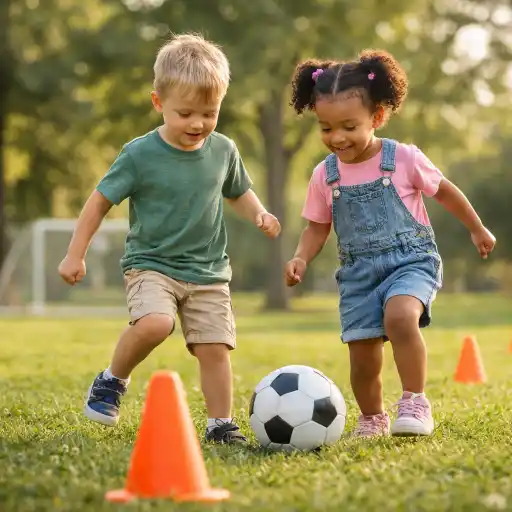
Practical progress tracking and family connections make gains visible. Use simple, reliable methods.
- 📝 Quick observation checklist: note one target skill per child weekly (e.g., controlled stop, 3 successful passes, waits turn). PE resources recommend observational checklists for early skill patterns (see PE Central FAQs).
- 📸 Share wins: send a short photo or 1-sentence note home about a child's success; families value concrete examples and ways to practice at home (School-Age Activities).
- 🔁 Progression plan: cycle through skills (dribbling → stopping → passing → simple teamwork) and revisit often—this spiraled repetition supports mastery (Gross Motor Truth).
- 👪 Family take-home tips: offer 1–2 simple at-home games (balloon volley, kicking to a laundry basket) and link to community resources for season-appropriate play. Remind families that practicing short, frequent activities is more effective than long sessions; public guidance from KidsHealth. For seasonal health, nutrition, and illness-prevention ideas you can share with families, consider the resource Keeping Kids Healthy: Tips and Tricks.
Conclusion and FAQ
Simple soccer games are high-impact, low-cost ways to build essential #grossmotor #skills in early childhood programs. Short rounds, clear goals, graded tasks, and family communication create measurable progress and joy. Use the practical games above, adapt for inclusion, and keep safety and licensing requirements in mind.
Quick FAQ
- Q: How long should a preschool soccer activity last? A: 5–12 minutes for whole-group demos; 6–8 minutes for small-group practice (circle-time guidance).
- Q: What equipment do I need? A: Soft size-appropriate balls, cones, laundry baskets, and a small timer. Keep backups and choose softer gear for indoor play.
- Q: How do I include a child who won’t participate? A: Offer helper roles, watcher jobs, or simplified tasks and practice scripts during calm times (see Gross Motor Truth).
- Q: How often should we practice? A: Short, frequent sessions (daily or several times a week) with repeated goals produce steady gains—embed into routine and transitions (Activity Tips).
Want lesson-ready templates and printable activity packs? ChildCareEd and other early-childhood resources listed above provide downloadable ideas and training. Start simple, celebrate small wins, and watch motor skills—and confidence—grow.
- 45-Hour School Age Curriculum
- CDA Home Visitor Subject Area 2 Part 3 Birth to 5
- Pediatric RSV First Aid & CPR/AED
- 45 Hour School Age Methods and Materials
- CDA Bridge Bundle: Family Child Care without Portfolio Review
- CDA Bridge Bundle: Infant/Toddler without Portfolio Review
- CDA Bridge Bundle: Preschool without Portfolio Review
- Texas Director Credential
- The Gross (Motor) Truth: 10 Gross Motor Games for Active Classroom Fun
- How motor skills shape child development and creative ways educators can foster them.
- CDA Certification en Español: Recursos y Consejos para Educadores Bilingües
- 🔍 ¿Qué ves cuando observas a un niño aprender?
- Juegos de Motricidad Gruesa
- Actividades de Motricidad Gruesa que Desarrollan el Equilibrio, la Coordinación y la Fuerza
- Gross Motor Games for Preschool and Kindergarten
- Can simple indoor movement games teach listening and cooperation to preschoolers in Oklahoma?
- Team-Building Activities for Daycare: Helping Children Learn Together
- Learning Through Creative Daycare Activities
- What age-appropriate learning activities should we use for infants, toddlers & preschoolers in New York?
- Canciones, juegos y preguntas de círculo para niños
- Superhero Activities for Preschoolers: Play, Create, and Learn
- How can we use team activities to help preschoolers learn and cooperate?
- How can Michigan preschool programs build strong fine and gross motor skills?
- How can I build gross motor skills indoors and outdoors for the children in my program?
- Can simple soccer games build gross motor skills in young children?
- Can Screen-Free Board and Movement Games Help Young Children Learn and Stay Calm?
- What fun, practical activities help build fine and gross motor skills in early childhood classrooms?
- How Can Child Care Providers Support Gross Motor Development in Every Child?
