Every day you guide little learners. This article helps directors and providers choose respectful ways to teach behavior. You will learn why teaching works better than punishing, how to use clear steps, and how to team with families and specialists. The ideas come from trusted sources like ChildCareEd: How Can Positive Guidance Improve Classroom Management? and other practical guides. This piece uses simple lists so your staff can try ideas tomorrow. You’ll also see quick notes about laws — state requirements vary - check your state licensing agency.
Why does this matter for our children and program?
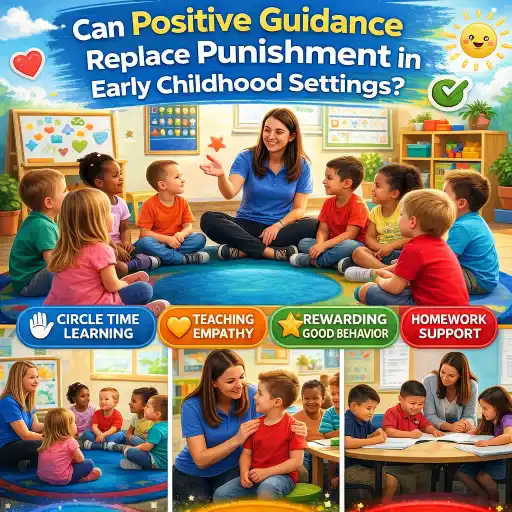
1. When adults teach skills, children learn how to make good choices. Teaching builds self-control and social skills for life. See ideas in ChildCareEd: Positive Discipline.
2. Calm, consistent guidance makes the #classroom safer and more joyful. Fewer fights and fewer power struggles help staff feel less stressed and keep children learning. The CSEFEL briefs show how teaching social skills prevents many problems.
3. Using punishments like yelling or hitting can hurt relationships and increase aggression over time. Research reviews warn against corporal punishment and show harm to #children long term (see summary research in physical punishment research).
Why this matters to leaders:
- Programs that teach behavior meet quality goals and support staff retention.
- Families want safe, respectful care for their children.
- Using positive strategies helps with licensing and accreditation efforts.
Tag these key ideas as you plan: #guidance #discipline #children #relationships #classroom.
How is positive guidance different from punishment?
2. Natural and logical consequences help children see cause and effect. A natural consequence happens without an adult (a marker dries out if the cap is off). A logical consequence is chosen by adults and is related to the action (a child helps clean spilled paint). For quick examples, see ChildCareEd: Natural Consequences vs Punishment and the CSEFEL explanation at CSEFEL.
3. Punishment often focuses on stopping behavior now. It may include yelling, scolding, or taking unrelated items. Studies link physical punishment to negative outcomes for children; professional guidance discourages corporal punishment (AAFP, and research review corporal punishment research).
4. Time-Outs and Time-Ins: Used well, a short, calm Time-Out can stop dangerous behavior. For toddlers, follow the simple CDC steps and keep time short and consistent (CDC Time-Out steps). Many programs prefer Time-Ins or calm coaching for teaching emotional skills; ChildCareEd describes how to make a cozy corner and teach co-regulation in Positive Discipline Strategies.
What practical steps can staff use tomorrow instead of punishment?
- 😊 Greet: Welcome each child by name. Connection reduces acting out (Positive Discipline).
- 📋 Predict: Post a simple picture schedule so children know what comes next (see Proactive Guidance).
- 🎯 Teach: Teach 3 simple rules and role-play them daily.
- 🏅 Notice: Give specific praise ("You waited your turn—thank you!").
- 🧘 Calm: Offer a cozy corner and teach breathing or a short calm routine.
More practical ideas:
- 🔁 Use redirection: Offer safe choices ("Blocks or paint?"), not just "No."
- 🛠️ Use logical consequences tied to the behavior (help clean up, lose a turn on that center for a short time).
- 🔎 Watch patterns using an ABC chart (Antecedent-Behavior-Consequence) — ChildCareEd and CSEFEL give simple tools for this (Viewing Guidance resources).
Common mistakes and how to avoid them:
- ⚠️ Expecting instant change — track small wins for weeks, not days.
- 😶 Inconsistency — make short scripts staff all use for common moments.
- 🚫 Public shaming — always correct privately or briefly and move to teaching.
For Time-Outs done well, follow CDC steps and keep them brief and calm (CDC) and review the science on best use in schools (Live Science).
How can we partner with families and specialists to support guidance?
1. Share the plan early and simply. Send one-page notes or photos showing the 3 classroom rules and the cozy corner tools. ChildCareEd suggests plain handouts in Staying Positive resources.
2. Use consistent words across home and school. If you call it a "Time-In" or a "Cozy Corner" at school, tell families that same name so children learn faster.
3. Communicate with data: Use a short ABC log for 1–2 weeks to spot patterns. When problems continue, bring families and a mental health or behavior specialist together. The Pyramid Model and PBIS frameworks recommend team plans — see the Pyramid Model overview at Nebraska Children: Pyramid Model and CSEFEL resources (CSEFEL).
4. Train staff and families: Offer short practice sessions, scripts, and role-play. ChildCareEd courses like Staying Positive  Buy Now $24.00 and Viewing Guidance in a Positive Light Buy Now $24.00 help teams learn together.
5. When to seek extra help: If behavior is intense, hurts learning, or risks safety, consult specialists early. Document, meet, plan, and review. And remember: state requirements vary - check your state licensing agency.
Conclusion
1. Positive guidance is about teaching, not controlling. It builds #relationships and lasting skills in children.
2. Start small: pick 1 rule, 1 script, and 1 cozy spot. Practice them for several weeks and celebrate small wins. For more step-by-step tools and printable aids, explore ChildCareEd resources linked above.
Quick FAQ:
- Q: How many rules? A: Teach 3 or fewer simple rules and practice daily.
- Q: Is Time-In better than Time-Out? A: For many young children, Time-Ins with co-regulation teach skills better; use Time-Outs sparingly and correctly for safety or strong noncompliance (CDC).
- Q: What if families disagree? A: Listen, share observations, and try one small idea for a week.
- Q: Where to learn more? A: ChildCareEd courses and CSEFEL briefs are practical and classroom-ready.
You and your team do important work. Choose teaching over punishment, partner with families, and ask for help when you need it. Small, steady steps help children grow into caring, capable learners.
1. Positive guidance teaches skills. It explains expected behavior, models it, practices it, and praises progress. For clear steps and classroom tips, read Proactive Behavior Guidance on ChildCareEd.Use short, repeatable steps that everyone on staff can remember. Try this 1–5 plan from ChildCareEd:- 45 Hour Child Growth and Development
- CDA Preschool Credential with Portfolio Review
- Professional Presence in Early Childhood
- 45 Hour Preschool Methods and Materials
- Power of Art: Bldg Self-Esteem & Positive Behavior for ALL Abilities
- Birth to Five CDA Credential with Portfolio Review
- CDA Infant/Toddler Credential with Portfolio Review
- Texas Director Credential
- History, Policy, and Practice in ECE
- Prevention and Solutions To Challenging Behaviors
- CDA Certification en Español: Recursos y Consejos para Educadores Bilingües
- ¿Cuál es la Diferencia Entre la Crianza Respetuosa y la Crianza Permisiva?
- Ejemplos de Crianza Respetuosa vs. Crianza Permisiva
- Cómo Trabajar en el Cuidado Infantil en Carolina del Norte: Requisitos y Pasos
- What Positive Behavior Guidance Techniques Work in Child Care?
- How can child care programs use gentle guidance and positive discipline effectively?
- Can Redirection Replace Punishment in Early Childhood Settings?
- How Can Child Care Providers Avoid Power Struggles with Young Children?
- Infant Toddler CDA Practice Test: What Should You Know Before Exam Day?
- Why Do Classroom Management Strategies Fail With 3-Year-Olds—and What Works Instead?
- Time-In or Time-Out? 7 Real Classroom Scenarios and What to Try
- Toddler Classroom Management Strategies for the 5 Hardest Parts of the Day
- How Can Positive Guidance Transform Early Childhood Classrooms?
- How Can Child Care Providers Help Children Calm Down Without Using Time-Out?
- What Is the Difference Between Positive Discipline and Punishment in Early Childhood Education?
- Why Is Social-Emotional Learning at the Heart of 2026 Classrooms?
- How Can Child Care Providers Support Children’s Mental Wellness?
- How Can “First, Then” Language Reduce Power Struggles in Early Childhood Classrooms?
