When children learn through movement, imagination, conversation, and meaningful choices, academic goals become connected to real understanding rather than task completion. Explore The Best Promotion is Play  Buy Now $24.00 to strengthen your knowledge of play’s role in development and gain practical strategies for creating engaging learning experiences. For a broader foundation in milestones and developmentally appropriate practice, consider Play, Learn, Grow Online Version Buy Now $16.00.
Worksheets can be useful for limited purposes, but they should not become the primary learning experience for young children. The central question is not whether a worksheet is always harmful or whether play is automatically effective. Rather, the question is which approach best matches young children’s developmental needs, preserves their agency, and allows educators to intentionally support growth across domains.
Why does the play-versus-worksheets debate matter?
Early childhood educators are often asked to demonstrate academic progress, respond to family expectations, and prepare children for kindergarten. Those responsibilities can make worksheets feel reassuring: they are familiar, easy to collect, and appear to provide visible evidence of learning. Yet a completed page may show compliance without revealing whether a child understands the concept, can apply it in another context, or feels motivated to continue learning.
Play-based learning places children in active relationships with materials, peers, ideas, and responsive adults. The Institute of Education Sciences overview of play-based learning describes play as a context for collaboration, communication, creativity, confidence, language, social-emotional development, and mathematics. This broader lens matters because school readiness is not a single skill; it includes approaches to learning, self-regulation, communication, physical development, and content knowledge.
For directors, the issue also concerns program quality. A classroom can be structured, intentional, and academically purposeful without requiring children to spend long periods completing paper tasks. A thoughtful #classroom gives teachers evidence of learning through conversation, construction, dramatic play, games, art, movement, and observation.
What can play-based learning offer that worksheets cannot?
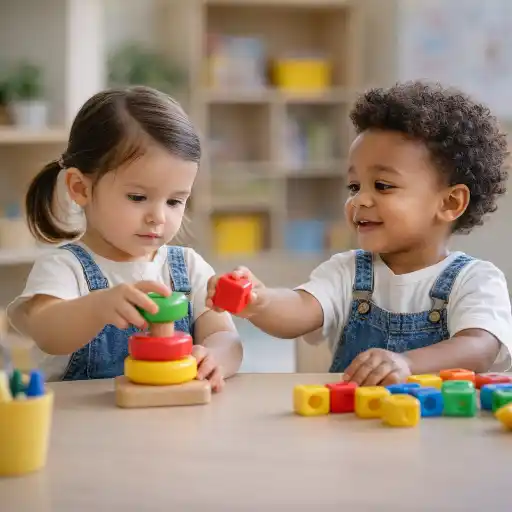
Play creates conditions in which children actively test ideas and receive immediate feedback from the environment. A child building a bridge discovers balance, measurement, spatial relationships, and persistence. A child operating a pretend restaurant practices vocabulary, sequencing, symbolic representation, social negotiation, and early numeracy. These experiences are integrated rather than divided into isolated skill sheets.
The National Association for the Education of Young Children’s discussion of playful learning emphasizes active, engaging, meaningful, socially interactive, and iterative learning. Those qualities help children remember concepts because they connect new information to action, emotion, prior knowledge, and relationships.
- 🧠 Cognitive development: Children plan, compare, predict, classify, solve problems, and revise their ideas.
- Language and literacy: Conversation, storytelling, labels, environmental print, and pretend writing expand communication.
- Social-emotional growth: Children practice cooperation, flexibility, empathy, self-regulation, and conflict resolution.
- Physical development: Manipulating tools, building, climbing, drawing, and moving strengthen fine- and gross-motor skills.
- Approaches to learning: Choice and meaningful challenge encourage curiosity, persistence, initiative, and confidence.
A worksheet may ask a child to trace a letter. Play can help a child recognize that letter in a name sign, find it on a pretend menu, form it with clay, hear its sound in a familiar word, and use it while communicating with peers. The learning is more observable, transferable, and personally meaningful.
Does research prove that worksheets are ineffective?
The evidence calls for balance rather than an absolute rule. Erin Wiskus’s action research comparing play-based strategies with worksheets found growth in both groups, but not enough data to conclude that one method produced greater academic growth. This finding is useful: it cautions educators against making claims that exceed the evidence and reminds us that effectiveness depends on the quality, duration, purpose, and implementation of an experience.
At the same time, a systematic review and meta-analysis of guided play found positive advantages over direct instruction for early mathematics, shape knowledge, task switching, and spatial vocabulary. The review also noted variation across studies and outcomes. In practice, this means guided play is not a magic formula, but it is a strong instructional option when adults establish a learning goal while protecting children’s choice and agency.
The systematic review of guidance during play identifies three important features: a clear learning goal, meaningful child choice, and flexible adult support through questions, prompts, modeling, and hints. Worksheets generally offer less opportunity for dialogue, movement, collaboration, and adaptive feedback. They may be appropriate for occasional documentation, brief individualized practice, or a specific fine-motor task, but they should not replace richer experiences.
Therefore, the professional question is: What is the learning goal, and which method gives this particular child the best opportunity to understand and use the skill?
How can teachers turn play into intentional learning?
Intentional play does not mean scripting every action. It means designing environments and interactions that make important learning possible while observing how children participate. The Head Start Early Learning Outcomes Framework organizes development across approaches to learning, social-emotional development, language and literacy, cognition, and physical development. These domains can guide observation and planning without turning play into a checklist.
- Begin with observation. Notice children’s interests, strategies, language, relationships, and points of difficulty.
- Select one or two learning goals. For example, children may compare quantities, use descriptive vocabulary, or negotiate roles with peers.
- Prepare the environment. Add open-ended materials, visual supports, books, tools, props, and enough space for collaboration.
- Join without taking over. Ask, “What is your plan?” “How could we make it stronger?” or “What do you notice?”
- Extend the experience. Introduce a new word, material, representation, or challenge when children are ready.
- Document evidence. Record the child’s words, actions, strategies, and next steps.
For example, if children are constructing a city, teachers can add clipboards, maps, signs, measuring tapes, recycled boxes, and books about buildings. Literacy, mathematics, science, social studies, and social-emotional goals can emerge naturally from one sustained project.
How should programs replace worksheets without losing structure?
Moving away from worksheets does not mean removing expectations, routines, or accountability. It means making the curriculum visible through experiences that are developmentally appropriate and easier to differentiate. The research on planning for play in early childhood classrooms emphasizes that play supports social-emotional, cognitive, language, computational thinking, self-regulation, and academic development when teachers plan intentionally.
Directors can support implementation by creating shared planning templates that include:
- the developmental or curriculum goal;
- the materials and environmental arrangement;
- possible teacher prompts and vocabulary;
- adaptations for individual children, dual-language learners, and disabilities;
- observable evidence of learning; and
- a possible next step based on observation.
Useful replacements for common worksheet goals include:
- Letter recognition: name puzzles, magnetic-letter hunts, message centers, and sensory writing.
- Counting: snack sorting, block inventories, movement games, and pretend-store purchases.
- Patterns: bead designs, rhythm sequences, nature collections, and repeated movements.
- Story comprehension: puppets, story stones, dramatic retelling, and child-created endings.
- Fine-motor development: play dough, tongs, lacing, construction materials, and process art.
Short, purposeful direct instruction may still be appropriate for phonological awareness, safety procedures, or introducing a game. The goal is a balanced, responsive program—not a new rigid formula. State requirements vary - check your state licensing agency.
How can educators explain the value of play to families and document progress?
Some families understandably associate paper with learning. Rather than dismissing that concern, invite families to see the evidence behind playful experiences. Share photographs with concise captions, children’s words, work samples from projects, and examples of how a play experience addressed a learning goal.
A useful documentation note includes:
- Context: what the children were doing;
- Evidence: what the child said or did;
- Interpretation: what skill or understanding was demonstrated; and
- Next step: how the teacher will extend learning.
For example: “During block construction, Maya counted eight units, compared two towers, and explained that the taller tower needed a wider base. Next, we will offer photographs of bridges and invite children to test different designs.” This communicates more than “completed a worksheet” because it shows thinking, language, strategy, and future planning.
Programs can also invite families to a play-and-learning evening, send home simple activity suggestions, or display learning stories in multiple languages. Explain that play is not an unplanned break from instruction; it is a context in which children practice content and transferable skills.
Use observation ethically and respectfully. Avoid labeling children based on one performance, and remember that the Framework is not a checklist for deciding whether a child has failed or is ready for kindergarten. Documentation should inform responsive teaching, not pressure children into premature academic performance.
What are the most common mistakes when shifting to play-based learning?
Programs sometimes move away from worksheets but unintentionally replace them with unstructured activity time. High-quality play-based learning requires preparation, observation, and responsive interaction. The following pitfalls are common and preventable:
- Removing goals entirely: Keep curriculum goals, but embed them in meaningful experiences.
- Over-directing play: Avoid turning every center into a teacher-led assignment. Offer choices and allow children to pursue ideas.
- Interrupting too frequently: Protect sustained play so children can develop complex plans and relationships.
- Using only novelty materials: Familiar blocks, dramatic-play props, books, art tools, and loose parts often support deeper learning than constantly changing toys.
- Documenting products instead of processes: Record children’s decisions, language, collaboration, persistence, and revisions.
- Excluding children through inaccessible design: Adapt tools, seating, sensory input, communication supports, and roles so every child can participate.
Teachers do not have to choose between being attentive and allowing independence. Effective guidance is often brief: observe, offer a prompt, wait, and follow the child’s response. When the adult’s contribution is responsive rather than controlling, play remains joyful while becoming more intellectually productive.
Conclusion: Why does play-based learning matter more than worksheets?
Play-based learning matters because it engages the whole child. It allows children to develop academic knowledge alongside language, self-regulation, creativity, collaboration, physical coordination, and problem-solving. Worksheets can have a limited supporting role, but they rarely provide the active, social, meaningful, and iterative conditions that make learning durable.
The strongest approach is intentional and balanced: establish clear goals, design inviting environments, protect child agency, use brief direct instruction when appropriate, and document learning through observation. When educators replace routine worksheets with purposeful play, they do not lower expectations. They create better opportunities for children to understand, apply, communicate, and enjoy what they are learning.
For additional professional development, explore Role of Play in Learning Buy Now $16.00, Early Mathematics Through Play Buy Now $24.00, and Lesson Planning for Preschoolers Buy Now $24.00. These courses can help providers translate research into daily practice and strengthen a joyful, purposeful #play environment.
- CDA Home Visitor Subject Area 3 Part 3 Birth to 5
- CDA Home Visitor Subject Area 2 Part 3 Birth to 5
- Bienvenido! Welcoming All Families
- From Play to Planning: Building Culturally Competent, Child-Centered Curriculum
- Family Voices Matter: Tools for Meaningful Collaboration
- Birth to Five CDA Credential with Portfolio Review
- The Best Promotion is Play
- Play with Purpose: Supporting Children with Autism
- Creating Engaging and Meaningful Learning Experiences
- Every Moment Matters: Schedules and Transitions
- ¿Cómo puedo usar escenarios de juego de roles de primeros auxilios en mi aula?
- Canciones, juegos y preguntas de círculo para niños
- What Kindergarten Readiness Skills Should My Program Build?
- Why Does Self-Regulation Matter More Than ABCs for Minnesota Kindergarten Readiness?
- Is Your Child Ready for Kindergarten? A Kindergarten Readiness Checklist
- What Makes a Great Home Daycare? 10 Things Parents Notice First
- More Than ABCs and 123s: The Real Importance of Early Childhood Education
- Common After School Activities Kids Get Bored With—and What to Try Instead
- How Can Child Care Programs Build Meaningful School Readiness?
- Which Low-Cost Printables Make the Biggest Classroom Impact?
- How Much Structured Learning Do Preschoolers Really Need?
- How Can Child Care Providers Support Early Writing Without Using Worksheets?
- What Is Purposeful Play—and Why Is It Replacing Worksheets?
- How Can Providers Show Families the Learning Behind Play?
- What Is Purposeful Play—and Why Is It Replacing Worksheets?
- What Makes Task Cards a Teacher’s Time-Saving Favorite?
- How Can Print-and-Play Resources Support Any Learning Center?
- Which Printable Activities Belong in Every Preschool Classroom?
- What Should a 3-Year-Old Be Learning at Preschool?
- What Should Child Care Providers Prioritize When Preschool Readiness Goals Compete for Time?
