When repeated directions, center confusion, and limited planning time compete for your attention, task cards can provide a practical reset. Explore Spicing Up the Classroom: Learning Centers  Buy Now $16.00 to strengthen center planning, support children’s independence, and connect everyday classroom systems with relevant professional learning.
Why do task cards save teachers time without replacing teaching?
Task cards save time because they make the first step visible. Instead of repeating the same directions to each child, educators can place a concise visual or verbal prompt beside familiar materials. Children still need modeling, encouragement, supervision, and conversation, but the card becomes a dependable reference when memory or attention shifts.
This distinction matters. A task card should not function as a worksheet disguised as play or as a substitute for responsive interaction. It is an environmental support that helps children enter a meaningful activity while the teacher spends more time observing language, problem-solving, persistence, and peer relationships.
Well-designed cards also reduce cognitive load during busy moments. A child can see what materials to gather, what action to try, and how to continue. This is especially useful for emerging readers, multilingual learners, children who benefit from visual information, and children who need predictable routines.
- Children gain a concrete entry point.
- Teachers repeat fewer directions.
- Centers become easier to organize and refresh.
- Educators gain time for purposeful observation and scaffolding.
The time-saving benefit is therefore relational, not merely logistical: less time spent managing preventable confusion creates more time for meaningful teaching.
How should educators design task cards that work the first time?
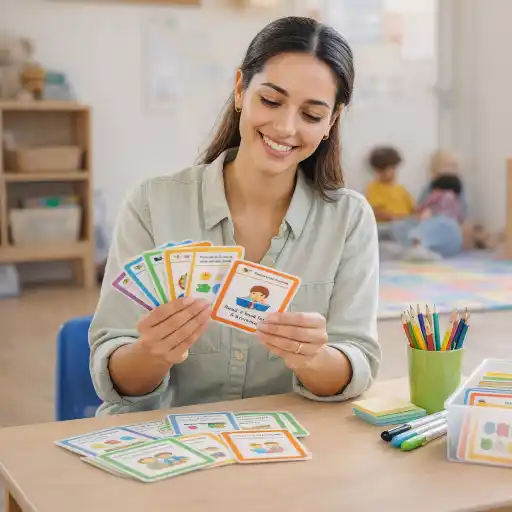
Begin with one observable action and one primary learning intention. “Build a bridge with three blocks” is more usable than “Explore engineering.” Use photographs of the actual classroom materials whenever possible, so the card reflects what children will find in the center.
Keep the visual field uncluttered. A short phrase, photograph, symbol, or two- to three-step sequence is usually more accessible than a paragraph. Cards can include text for adults and children, but the format should not require conventional reading unless reading is the intentional goal.
- State one clear challenge.
- Show or name the required materials.
- Use numbered images for multistep activities.
- Offer beginning, developing, and extending versions.
- Allow children to build, draw, explain, sort, act, or collaborate.
- Laminate cards or use protective sleeves for repeated use.
Use invitational language such as “Can you find three objects that feel rough?” or “What could you change?” This communicates curiosity rather than compliance. Write the adult-facing learning intention on the back so teachers can connect the prompt to planning and observation without turning children’s play into a test.
Before introducing a card, test it from a child’s perspective: Is the image recognizable? Are materials reachable? Can the activity be completed within the available time? A few minutes of preparation can prevent many minutes of troubleshooting.
Which classroom routines benefit most from task cards?
Task cards are flexible because they can support several parts of the day without requiring a completely new lesson. They work especially well when the classroom already has predictable routines and accessible materials.
- Learning centers: Invite children to build, sort, count, retell, classify, or investigate.
- Small groups: Anchor differentiated prompts while the teacher observes individual strategies.
- Transitions: Show “choose, work, share, clean up” or provide a brief movement challenge.
- Morning arrival: Offer a familiar prompt that helps children begin while adults complete essential tasks.
- Practice and review: Provide short, hands-on opportunities to revisit a previously introduced skill.
The ChildCareEd guidance on independent center time emphasizes that task cards are environmental supports, not miniature worksheets. That principle keeps the activity active and preserves children’s choices.
Use cards selectively rather than leaving every deck available. Two or three options can create clarity; an overflowing basket can create another management problem. Rotate prompts based on children’s interests, current goals, and observations.
For transitions, pair a card with the program’s established cues. NAEYC identifies predictable routines and transitions as important elements of a supportive classroom, and visual cards can reinforce the sequence without adding lengthy verbal explanations. State requirements vary—check your state licensing agency when cards involve small parts, sensory materials, tools, or specific supervision expectations.
How do task cards support differentiation and inclusion?
Task cards make differentiation manageable because educators can adjust the challenge without redesigning the whole center. Children may work with the same materials and broad concept while receiving different entry points.
- Beginning: “Find five objects and touch each one as you count.”
- Developing: “Make two groups. Which group has more?”
- Extending: “Make both groups equal and explain what changed.”
This structure supports #children with different developmental histories without publicly labeling anyone by level. Responses can include speaking, pointing, building, drawing, using home language, signing, or demonstrating with materials. For children who benefit from additional access, pair the card with object cues, gestures, communication boards, AAC, tactile symbols, or a teacher demonstration.
Representation matters as well. Use images of varied families, abilities, cultures, languages, and community experiences. Ask whether the examples feel familiar and respectful to the children and families in the program.
The course Tailoring Instruction to Children’s Needs Buy Now $24.00 offers a broader professional learning experience focused on differentiation and scaffolding. Educators can use those principles to decide when a card should simplify language, add materials, increase complexity, or provide an alternative response mode.
Inclusion does not mean every child uses the same card in the same way. It means every child has a meaningful way to participate, experience competence, and receive appropriate challenge.
How can task cards make assessment more efficient and useful?
Task cards can sharpen observation because each prompt is connected to an observable action. Rather than writing that a child “struggled with math,” a teacher might record, “Counted eight objects accurately but skipped one when recounting.” That brief note is more useful for planning.
Write the adult-facing goal on the back of the card. During the activity, notice how children interpret the prompt, select materials, communicate, persist, and respond to support. Avoid interrupting every attempt; children’s errors often reveal their strategies and misconceptions.
- Did the child understand the visual or verbal prompt?
- Could the child select and use the materials?
- Did the child demonstrate the target skill independently?
- What prompt or adaptation increased participation?
- What would be an appropriate next challenge?
Use evidence to reteach, extend, regroup flexibly, or revise the card. A self-checking card may provide immediate feedback, but it cannot explain every misconception. Adult observation and conversation remain essential.
The course Preschool Assessments & Observations Buy Now $24.00 can help providers strengthen objective observation and use evidence to individualize learning. State requirements vary—check your state licensing agency regarding documentation and training expectations.
Assessment becomes time-saving when it is embedded in authentic activity rather than postponed until a separate testing period. One well-recorded observation can guide tomorrow’s small group, material choice, or extension prompt.
What common mistakes reduce the time-saving value of task cards?
The most common mistake is assuming that posting cards automatically creates independence. Children need explicit instruction in how to choose a card, gather materials, attempt the first step, seek help, and clean up. Model the routine through “I do, we do, you do,” then gradually fade assistance.
- Too much text: Replace paragraphs with images, gestures, and concise phrases.
- Too many choices: Begin with two or three cards per center.
- One correct product: Focus on strategies, explanations, and revision.
- Unclear materials: Photograph the actual classroom items.
- Difficulty mismatch: Prepare discreetly differentiated versions.
- Cards replacing interaction: Continue asking questions and extending vocabulary.
- Insufficient supervision: Review choking, allergy, sensory, and tool-related risks.
Another pitfall is using cards only for early finishers. Their strongest value comes when they are connected to intentional instruction, guided play, partner learning, and observation. Rotate them so they remain purposeful rather than becoming background clutter.
Directors can support consistency by creating shared templates, storage systems, and expectations for staff. A labeled envelope or activity tub can contain the cards, materials list, learning intention, and brief observation prompts. This reduces preparation time across classrooms and makes coverage easier when another educator steps in.
How can a program start using task cards this week?
Start with one familiar center and one goal. Avoid redesigning the entire classroom. Choose materials children already know, then create three prompts that vary in complexity.
- Choose one center and one observable goal.
- Create two or three concise visual prompts.
- Model the routine with a small group.
- Place cards beside labeled, reachable materials.
- Observe without immediately correcting.
- Revise the card or environment based on children’s responses.
Use a short weekly review: Can children begin without repeated directions? Do they remain engaged? Do they communicate with peers? Can they request help and return materials? These questions reveal whether the issue is the card, the environment, the challenge, or the routine.
For additional support with classroom design, explore Environments That Inspire Independence and Exploration Buy Now $55.00. The course connects inclusive environmental design with independence, curiosity, and play-based learning.
🔔 Remember: the goal is not to make children manage everything alone. The goal is to create enough clarity that teachers can protect time for warm interactions, careful observation, and responsive teaching.
Conclusion: What makes task cards a teacher’s time-saving favorite?
Task cards become a time-saving favorite when they are concise, visual, developmentally appropriate, and embedded in a thoughtfully organized environment. They reduce repeated explanations, support smoother routines, make differentiation more practical, and create clearer opportunities for observation.
The most effective system starts small: one center, one goal, a few prompts, explicit modeling, and ongoing revision. Used as flexible invitations—not mandatory worksheets—task cards help children participate with growing confidence while educators reclaim time for the relational work that matters most.
- CDA Infants/Toddlers: Health and Safety
- Birth to Five CDA Credential with Portfolio Review
- CDA Infants/Toddlers: Abuse and Neglect Reporting Requisites
- 24 Hour Texas Pre-Service
- Texas Director Credential Renewal
- CDA Infants/Toddlers: Classroom Setup
- CDA Infants/Toddlers: Smart Nutrition & Feeding
- Spicing Up the Classroom: Learning Centers
- Shoo, Germs! Don't Bother Me!
- Strategies for Finding Budget-Friendly Deals, Discounts, and Promotions on Back to School Supplies
- Celebra El Cumpleaños de Dr. Seuss En Tu Guardería Con Actividades Fáciles y Divertidas!
- Cómo Trabajar en el Cuidado Infantil en Carolina del Norte: Requisitos y Pasos
- Cómo Trabajar en el Cuidado Infantil en California: Requisitos y Pasos
- Diversión fresca de verano: actividades del Día Nacional del Helado para niños
- Canciones, juegos y preguntas de círculo para niños
- Why Is Repeating Favorite Books So Valuable for Young Children?
- What Makes Task Cards Perfect for Small-Group Instruction?
- Why Are Self-Checking Clip Cards Great for Independent Practice?
- How Can Printable Activities Save Teachers Hours of Prep Time?
- When a Favorite Teacher Is Absent, How Can Child Care Providers Support Children Through the Change?
- What Makes Task Cards a Great Tool for Mixed-Age Classrooms?
- How Can Task Cards Turn Free Play Into Purposeful Learning?
- How Can Task Cards Encourage Independent Learning?
- How Can Printables Save Teachers Time Without Cutting Corners?
- What Makes Task Cards a Teacher’s Time-Saving Favorite?
- How Can “First, Then” Language Reduce Power Struggles in Early Childhood Classrooms?
- How Can “Almost Finished” Activities Encourage Young Children to Problem-Solve?
- “Save My Work!” How Can Child Care Providers Protect Unfinished Projects Between Days?
- How Can You Make a Classroom Cooking Activity Accessible to Children with Different Abilities?
