When children say, “This is boring,” they may be telling you that an activity is too predictable, too passive, or disconnected from their interests—not that they are unwilling to learn. Build a more responsive program with Supporting School Age Development ONLINE  Buy Now $24.00, which offers practical guidance on developmentally appropriate activities, adaptations, positive guidance, and school-age curriculum resources.
Why does boredom matter in an after-school program?
Boredom is not automatically a behavior problem. After a full school day, children may be tired, hungry, overstimulated, socially depleted, or ready for a different kind of challenge. A worksheet that felt manageable at 10 a.m. may feel unreasonable after dismissal. Similarly, a game that once energized the group may lose its appeal when children have mastered every rule and outcome.
Moderate boredom can also create space for #creativity, self-direction, and problem solving. The goal is not to eliminate every quiet moment, but to help children move from passive waiting toward meaningful choice. Providers can acknowledge the feeling without rushing to entertain: “You are not sure what you want to do yet. Let’s look at the choices and see what might fit.”
Quality after-school care balances restoration with enrichment. Children need calm options, active play, social connection, and hands-on projects. The CDC notes that outdoor play can support physical activity, attention, behavior, and developmental growth, while research on play-based programs links enjoyable movement with coordination and physical fitness.
- Notice boredom as information about the activity or the child’s current energy.
- Offer meaningful choices rather than an unlimited menu.
- Use short rotations and revisit successful activities with new challenges.
- Protect unstructured time without making children feel abandoned.
Which familiar activities do children commonly outgrow?
Several reliable activities become unengaging when programs use them repeatedly without changing the level of challenge. Coloring sheets, identical crafts, long board-game blocks, competitive sports, passive videos, and worksheets may all have a place, but they should not become the default response to every afternoon.
Children often disengage when the outcome is predetermined. If every child makes the same paper project, there is little room for identity, experimentation, or ownership. Younger school-age children may need concrete materials and movement; older children may need autonomy, complexity, and opportunities to lead. A single activity rarely serves a mixed-age group equally well.
Watch for signs that an activity needs redesign:
- Children finish quickly and wander without purpose.
- Only one or two children participate while others watch.
- Arguments focus on winning rather than enjoyment or teamwork.
- Children ask for screens immediately after the activity ends.
- Staff spend more time correcting behavior than facilitating learning.
These signs do not mean the activity is permanently unsuccessful. Try modifying one variable at a time: materials, roles, time limit, group size, environment, or challenge. For example, replace a worksheet with a real-world design problem, or turn a familiar sport into a cooperative mission. The purpose is not novelty for its own sake; it is to restore agency and meaningful participation.
What can providers try instead of repetitive crafts and worksheets?
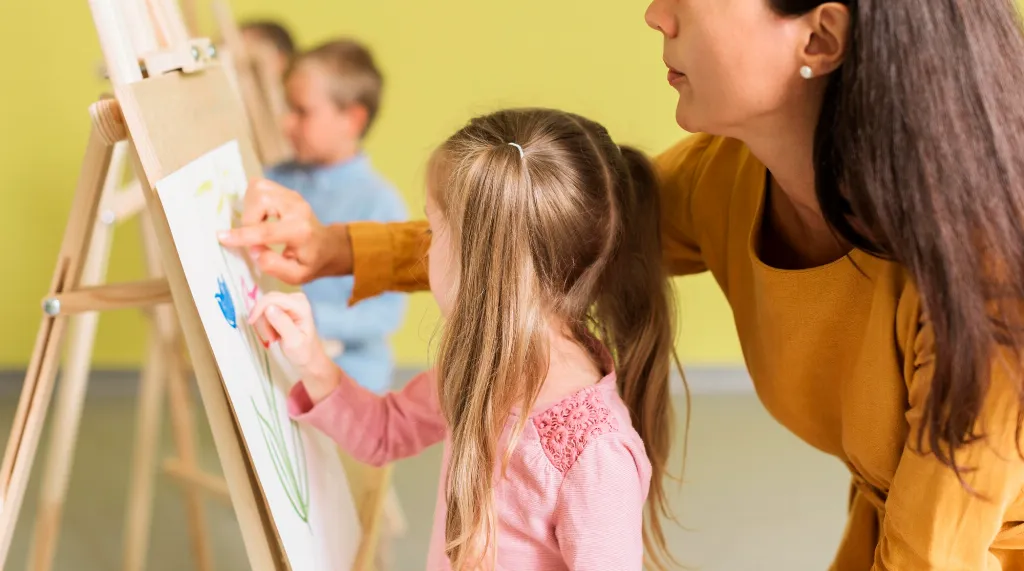
Replace product-focused tasks with open-ended invitations that allow children to make decisions, test ideas, and explain their thinking. A recycled-material maker station can become a bridge-building challenge, a marble maze, a cardboard arcade, or an invention designed to solve a program problem.
- 🎨 Creative studio: Offer collage, zines, puppets, comic strips, photography, music, or process art. Display drafts and revisions, not only polished products.
- Design challenge: Ask children to build the tallest structure, strongest bridge, or most efficient paper airplane, then redesign it after testing.
- Story laboratory: Invite children to create a mystery, podcast script, short play, or alternate ending to a familiar story.
- Community project: Map neighborhood resources, plan a kindness campaign, make appreciation cards, or design improvements for the classroom.
- Interest clubs: Rotate cooking, gardening, nature study, drama, strategy games, or cultural exploration based on children’s suggestions.
Use a three-level structure: try, improve, design. One child might build a simple tower, another might test its stability, and an older child might create criteria for comparing designs. This keeps the group connected while preserving different entry points.
Ask questions that invite thinking rather than evaluate correctness: “What did you notice?” “What could you change?” and “How did your group decide?” Children may demonstrate learning through drawing, building, speaking, movement, writing, or home language. This flexibility supports inclusion and makes participation feel less like another school assignment.
How can movement and outdoor experiences replace passive choices?
Children who appear bored may need movement before they can engage in conversation, reading, or project work. Active play does not need to be highly competitive or equipment-heavy. Short, accessible experiences can reset attention while building coordination, confidence, and cooperation.
- Use tape pathways for balance, hopping, directional movement, or math prompts.
- Try cooperative obstacle courses in which the group improves a shared score.
- Offer freeze dance, balloon keep-up, yoga, animal walks, or rhythm games.
- Plan scavenger hunts based on color, shape, texture, sound, or evidence of living things.
- Start a garden, weather log, nature journal, bird count, or outdoor art collection.
- Adapt team games with smaller fields, softer equipment, varied roles, and noncompetitive goals.
Outdoor learning can combine physical, academic, and social development. Children can measure shadows, graph observations, sketch plants, write field notes, or create a nature-inspired performance. These experiences are especially useful for children who resist table work but enjoy doing, exploring, and collaborating.
Safety must remain central. The CDC recommends checking equipment and surfaces, providing shade and hydration, considering heat and air quality, and using appropriate protection from sun and insects. Water activities require constant supervision and careful attention to drowning and illness risks. Active supervision means positioning adults strategically, scanning continuously, listening, counting during transitions, and anticipating hazards. State requirements vary - check your state licensing agency.
How should programs redesign activities for choice, challenge, and inclusion?
Engagement improves when children experience both autonomy and structure. Offer two or three clearly explained options rather than an overwhelming number of choices. A visual menu might include a calm station, a creative project, and an active challenge. Children can choose where to begin, while adults maintain predictable timing and safety expectations.
Design each activity with multiple entry points:
- Provide easier and more complex versions of the same challenge.
- Offer seated, standing, quiet, and movement-based participation options.
- Assign varied roles such as builder, planner, recorder, presenter, materials manager, or encourager.
- Use picture directions and model the first step before children begin.
- Invite older children to mentor or lead, without making them responsible for supervision.
- Provide a calm space for children who need reduced stimulation or a pause.
A practical afternoon rhythm might include arrival, snack, a brief decompression choice, homework support when needed, two activity rotations, free choice, cleanup, and reflection. Give five-minute and two-minute warnings, then use one consistent signal. Predictability reduces conflict because children know what is happening next.
Directors can strengthen implementation through short staff huddles. Review the energy plan, identify likely barriers, assign supervision positions, and clarify adaptations. Designing Your School Age Classroom Buy Now $35.00 can support professional learning related to classroom design, daily schedules, lesson planning, multi-age groups, and accommodations.
What common mistakes should providers avoid when refreshing activities?
The first mistake is assuming that “new” automatically means engaging. A complicated activity with unclear directions may create more frustration than interest. Begin with children’s observations and interests, then change one feature of a familiar activity. A beloved card game might become a strategy-design challenge; a sports game might become a cooperative engineering task.
- Mistake: Filling every minute. Better: Protect brief periods of child-led exploration and quiet recovery.
- Mistake: Treating calm time as punishment. Better: Make books, puzzles, drawing, and sensory tools available to everyone.
- Mistake: Offering only competition. Better: Include cooperative goals and flexible roles.
- Mistake: Requiring identical products. Better: Evaluate process, persistence, communication, and problem solving.
- Mistake: Giving lengthy directions. Better: Use three to five visual steps and demonstrate the opening move.
- Mistake: Changing activities before children can develop skill. Better: Keep a dependable routine while varying materials or challenges.
Observe engagement broadly. A child may be deeply involved while watching, planning, revising, or working independently. Track one brief observation: “Maya negotiated roles,” “Jordan returned to the bridge after it collapsed,” or “Sam chose the quiet station and later joined the group.” These notes help staff determine whether boredom reflects lack of challenge, excessive difficulty, fatigue, social stress, or a need for connection.
Family communication can add valuable information. Ask what children enjoy at home, invite optional expertise, and share one weekly strength-based observation. Keep participation voluntary and respect families’ time. For staff who want a focused review of supervision during active play, transportation, and field trips, Safe Supervision in Child Care: Birth to School Age Buy Now $24.00 is a relevant professional-learning option.
What five-course learning path can strengthen an engaging program?
Providers and directors can use professional learning to move beyond a collection of activity ideas toward a coherent, responsive program. Consider these five English-language ChildCareEd courses:
- Supporting School Age Development ONLINE Buy Now $24.00 — focuses on developmentally appropriate practice, positive guidance, adaptations, and school-age curriculum resources.
- Designing Your School Age Classroom Buy Now $35.00 — addresses environmental design, daily schedules, lesson planning, multi-age groups, and accommodations.
- Key Elements of an After School Age Program ONLINE Buy Now $24.00 — explores integrated curriculum, learning styles, field trips, and program operations.
- Safe Supervision in Child Care: Birth to School Age Buy Now $24.00 — supports supervision planning across classroom, outdoor, transportation, and field-trip settings.
- Lesson Planning to Meet School Age Needs Buy Now $16.00 — offers strategies for relevant content, differentiated instruction, and activities that address varied learners.
Course completion may support professional-learning goals, but licensing acceptance and required hours depend on jurisdiction. State requirements vary - check your state licensing agency before relying on any course for a specific requirement.
Conclusion: How can after-school programs turn boredom into engagement?
Children get bored with activities that are overly repetitive, passive, predictable, competitive, or disconnected from their interests. The answer is not constant entertainment. Instead, create a balanced rhythm that includes calm recovery, movement, hands-on creativity, social connection, outdoor exploration, and meaningful choice.
Start this week with one small redesign: replace a worksheet with a design challenge, turn a competitive game into a cooperative mission, or invite children to help choose the next project. Use layered challenges, visual directions, flexible roles, and active supervision. When providers treat boredom as useful information, children gain more than something to do—they gain opportunities to direct, create, collaborate, persist, and discover what genuinely interests them.
- 45 Hour Child Growth and Development
- Birth to Five CDA Credential with Portfolio Review
- CDA Bridge Bundle: Preschool
- Pediatric RSV First Aid & CPR/AED
- 45 Hour School Age Methods and Materials
- CDA Bridge Bundle: Family Child Care
- CDA Bridge Bundle: Infant/Toddler
- Every Moment Matters: Schedules and Transitions
- CDA Certification en Español: Recursos y Consejos para Educadores Bilingües
- Requisitos Para Ser Maestra Principal En Un Daycare: Lo Que Necesitas Para Empezar
- ¡Obtén Tu Certificación de Cuidado Infantil de 90 Horas En Línea!
- Cómo ser director de cuidado infantil en Maryland
- Que es Título 22 en California?
- ¿Cuál es la diferencia entre un certificado CDA y la credencial CDA?
- ¿Cómo puedo usar escenarios de juego de roles de primeros auxilios en mi aula?
- ¿Cómo puedo enseñar habilidades de primeros auxilios con escenarios de juego de roles?
- ¿Cómo afecta la dopamina a los niños: señales, efectos e influencias diarias?
- Actividades de Motricidad Gruesa que Desarrollan el Equilibrio, la Coordinación y la Fuerza
- Actividades de Fiesta para Niños de Preescolar y Primaria
- Cómo Solicitar una Licencia de Guardería en Texas
- ¿Cómo solicito la licencia para una guardería en California?
- Lista para Guardería en Casa en Illinois: Cómo Iniciar una Guardería en el Hogar
- Lista para Guardería en Casa en Texas: Cómo Iniciar una Guardería en el Hogar
- Cómo Trabajar en el Cuidado Infantil en California: Requisitos y Pasos
- Capacitación Previa al Servicio para Proveedores de Cuidado Infantil en Dakota del Norte
- What indoor activities work best for school-age children in daycare?
- Common After School Activities Kids Get Bored With—and What to Try Instead
