Early childhood education is not a rehearsal for “real school”—it is where children begin building the relationships, dispositions, and skills that make lifelong learning possible. Providers who want to strengthen whole-child practice can explore ChildCareEd’s Early Childhood Education course  Buy Now
 $99.00$84.00, a 30-hour training focused on responsive interactions, curriculum, observation, documentation, and family partnerships.
That broader view matters because children do not experience development in isolated subjects. A child counting buttons is also practicing language, attention, fine-motor coordination, persistence, and social participation. A child comforting a friend is developing empathy, communication, emotional regulation, and a sense of belonging. High-quality early education makes these connections intentional without reducing childhood to worksheets or performance scores.
Why does early childhood education matter beyond academic preparation?
The first years of life are a period of extraordinary growth and developmental sensitivity. The OECD describes ages birth through five as a continuing window in which experiences, relationships, and environments shape later learning, health, and well-being. This does not mean that every early experience determines a child’s future; rather, it means that responsive adults and enriching environments can strengthen developmental pathways while adversity can create additional barriers.
Research summarized by the Administration for Children and Families connects high-quality early care and education with gains across cognitive, language, social-emotional, and physical domains. The CDC likewise identifies improvements in academic achievement, self-regulation, cognitive development, and social-emotional development among the benefits associated with evidence-based programs.
For providers, the practical message is encouraging: ordinary moments have educational value when adults are attentive and intentional.
- Arrival routines can build trust, communication, and independence.
- Snack can support nutrition, conversation, counting, and self-help skills.
- Outdoor play can strengthen motor development, cooperation, risk assessment, and problem-solving.
- Conflict repair can teach empathy, perspective-taking, and language for emotions.
These experiences are not extras added after “instruction.” They are the curriculum of whole-child development.
How does early education support the whole child?
Whole-child education recognizes that cognitive, physical, social, emotional, and language development are interdependent. Children learn more effectively when they feel safe, connected, physically well, and able to participate. A high-quality classroom therefore balances planned experiences with responsive teaching based on children’s interests, strengths, cultures, and developmental needs.
Language is a particularly powerful connector. Rich conversations, shared reading, songs, storytelling, and meaningful questions help children explain ideas, organize thinking, and participate in relationships. Supporting home languages is equally valuable; bilingualism is an asset, and families’ linguistic knowledge can enrich the classroom community.
Social-emotional learning is also inseparable from academics. Children need opportunities to practice waiting, shifting attention, remembering directions, managing frustration, and asking for help. These executive-function skills support participation in every learning area. Movement further contributes by strengthening coordination, attention, mood, and self-regulation.
Providers can plan for integration by asking:
- What developmental domains are involved in this experience?
- How can I make the activity accessible to children with different abilities?
- Which words, gestures, or visual supports will help children participate?
- Where can children make choices, investigate, and express their thinking?
The goal is not to make every activity accomplish everything. It is to notice the many forms of learning already occurring and respond thoughtfully.
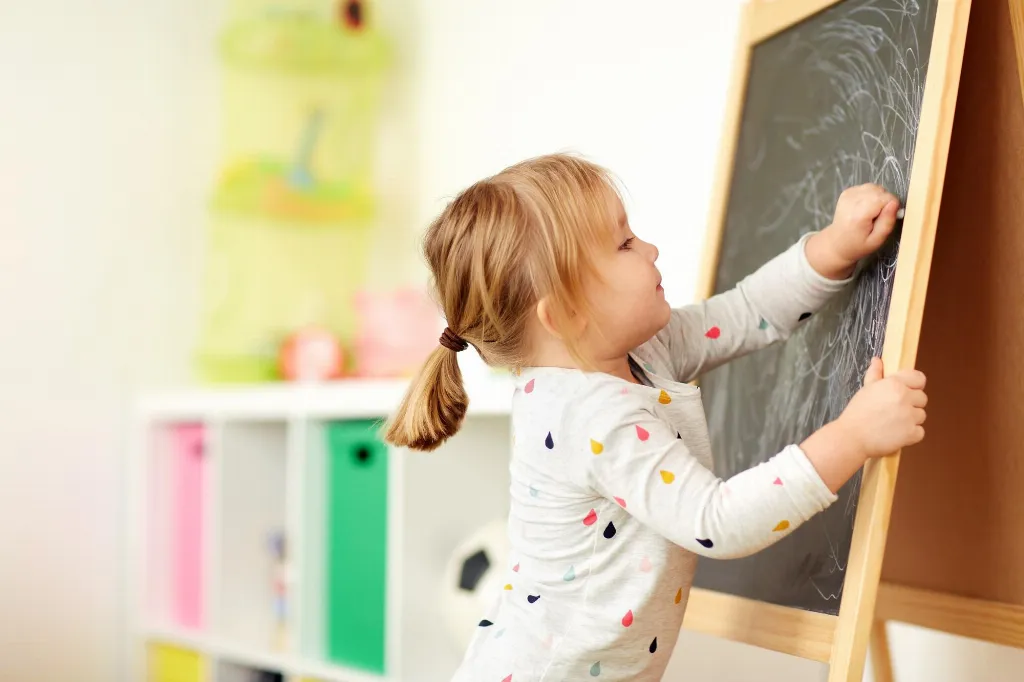
Why is play a central form of early learning?
Play is children’s active way of making meaning. In play, children explore materials, test theories, rehearse social roles, negotiate rules, and revise ideas. The Cambridge guidance on play-based learning emphasizes that play supports curiosity, engagement, creativity, relationships, self-regulation, and problem-solving. Research on pretend play similarly links high-quality dramatic play with perspective-taking, language, social competence, and later abstract thought, while recognizing that the precise causal relationships remain an area of study.
Play-based learning is not the absence of teaching. Skilled educators design environments, observe closely, introduce vocabulary, model strategies, and offer just enough challenge to extend thinking. A block area can become a setting for spatial reasoning and early mathematics. A pretend clinic can support narrative language, empathy, writing, and cooperation. Water play can invite prediction, measurement, sensory exploration, and scientific inquiry.
Consider using:
- Open-ended materials such as blocks, fabric, boxes, natural objects, and loose parts.
- Long, uninterrupted periods that allow children to develop complex play.
- Guided questions such as “What do you notice?” or “What could we try next?”
- Documentation that captures children’s words, strategies, decisions, and relationships.
- Materials that reflect children’s families, cultures, languages, and abilities.
😃 Play should feel joyful, but joy does not make it less rigorous. It gives children a meaningful reason to think deeply.
What long-term outcomes can high-quality early education influence?
Early education should never be presented as a guarantee of a particular life outcome. Children’s development is shaped by families, communities, schools, health, economic conditions, policy, and many other factors. Still, a substantial evidence base indicates that well-designed and well-implemented early education can have lasting benefits.
A meta-analysis of 22 rigorous studies found that early childhood education was associated with lower rates of special education placement and grade retention and higher high school graduation rates. The Community Preventive Services Task Force similarly recommends center-based early childhood education to improve educational outcomes connected with long-term health and social outcomes. These findings support the idea that early education can strengthen trajectories—not by accelerating children through childhood, but by giving them stronger foundations and more equitable opportunities.
Quality is essential. RAND reports that better-trained caregivers, smaller child-to-staff ratios, and sufficient program intensity are associated with stronger results. The CDC distinguishes structural quality, such as ratios and curriculum supports, from process quality, including emotional responsiveness and the quality of adult-child interactions. For directors, this means investments in staff preparation, coaching, stable relationships, and reflective supervision are central—not peripheral—to educational quality. Educators exploring a credential pathway can learn how the CDA Birth-to-5 Credential supports children’s social-emotional growth.
Programs should also examine who has access. The CDC reports that many low-income preschool-aged children do not participate in early childhood education, even though they may benefit substantially. Equity requires more than offering the same activity to everyone; it requires removing barriers, adapting practice, honoring culture, and ensuring that children with disabilities and dual language learners are fully included.
How can providers translate this broader purpose into daily practice?
Moving beyond ABCs and 123s does not mean abandoning language, literacy, mathematics, or school readiness. It means teaching those areas through relationships, meaningful contexts, play, inquiry, movement, and responsive observation. A practical improvement cycle can help teams begin without overwhelming staff.
- Observe. Notice children’s interests, strategies, relationships, communication, and emerging skills.
- Interpret. Ask what the observation suggests about development, strengths, needs, and possible barriers.
- Plan. Offer materials, questions, routines, or environmental changes that extend learning.
- Interact. Use warm language, modeling, co-regulation, and scaffolding rather than unnecessary correction.
- Document. Record brief, objective examples and connect them to developmental goals.
- Reflect. Discuss what worked, whose voices were included, and what should change next.
Directors can support consistency by protecting planning time, using coaching rather than compliance-focused feedback, and selecting professional learning tied to classroom priorities. Family partnerships are also essential. Share specific observations, invite families’ interpretations, and offer simple ways to continue learning at home. For additional strategies, explore how to build productive relationships with families. State requirements vary - check your state licensing agency before using training hours, curriculum materials, or documentation procedures for compliance purposes.
Common mistakes include treating play as a reward, over-scheduling adult-directed activities, using developmental milestones as rigid labels, and measuring quality only through visible academic products. Avoid these pitfalls by valuing process, considering context, and asking what children are learning—not merely what they produce.
Conclusion: What is the real importance of early childhood education?
Early childhood education is more than teaching ABCs and 123s because it develops the whole person who will use language, mathematics, relationships, curiosity, self-regulation, creativity, and physical competence throughout life. High-quality programs create safe, inclusive environments where children can explore, belong, communicate, persist, and learn through play and purposeful interaction.
The strongest practice combines evidence with humility: use research to guide decisions, observe each child carefully, partner with families, and recognize that quality depends on implementation and context. When providers protect relationships, integrate developmental domains, and make learning meaningful, everyday routines become powerful opportunities for growth.
For continued professional learning, consider these relevant ChildCareEd options:
- Play, Learn, Grow Buy Now $25.00 for developmentally appropriate, individualized learning experiences.
- The Best Promotion is Play Buy Now $24.00 for using play to support cognitive, physical, social, and emotional development.
- Theory of Learning Buy Now $24.00 for connecting major learning theories with play and classroom practice.
- Bridging Cultures: Family Communication & Collaboration Buy Now $55.00 for culturally and linguistically responsive family partnerships.
Frequently asked questions
Does whole-child education replace academic learning?
No. It strengthens literacy, mathematics, science, and other learning by embedding them in meaningful relationships and experiences.
How can play be rigorous?
Play requires planning, language, reasoning, self-regulation, collaboration, and problem-solving. Educators make learning visible through observation and intentional scaffolding.
What should directors prioritize first?
Begin with staff-child relationships, protected planning time, inclusive materials, manageable routines, and coaching connected to observable classroom practice.
How can families understand the value of play?
Share concrete examples: explain how building supports spatial reasoning, dramatic play supports language and perspective-taking, and games support memory and self-control.
Can early education eliminate achievement gaps?
No single program can eliminate inequity alone. High-quality early education can reduce barriers and strengthen opportunities, especially when paired with family supports, health resources, equitable access, and sustained quality.
- Emergent Learning & Development
- From Play to Planning: Building Culturally Competent, Child-Centered Curriculum
- 24 Hour Texas Pre-Service
- CDA Bridge Bundle: Family Child Care without Portfolio Review
- CDA Bridge Bundle: Infant/Toddler without Portfolio Review
- CDA Bridge Bundle: Preschool without Portfolio Review
- Early Childhood Education
- Texas Director Credential
- Building a Healthier Tomorrow: Preventing Childhood Obesity
- CDA Certification en Español: Recursos y Consejos para Educadores Bilingües
- Cuáles Son las Señales de Alerta en el Desarrollo Infantil que Todo Educador Debe Conocer?
- 😫🧸 ¿Qué hacer cuando un bebé no quiere dormir la siesta en el aula?
- Cursos De Daycare En Español
- Curso Para Trabajar En Daycare:Qué Necesitas Para Empezar
- Cómo Abrir Una Quardería En Casa Sin Dinero?
- Recursos en Español sobre el Sueño Seguro del Bebé
- ¿Cómo pueden los equipos de cuidado infantil practicar habilidades rápidas de primeros auxilios en situaciones reales?
- Ejemplos de Crianza Respetuosa vs. Crianza Permisiva
- Consejos de Supervisión Activa para Salones de Preescolar y el Juego al Aire Libre
- Retraso del Habla en la Guardería: Cómo Pueden Ayudar los Proveedores
- Cómo Trabajar en el Cuidado Infantil en Carolina del Norte: Requisitos y Pasos
- Cómo Ser Maestra de Preescolar en Illinois
- Cómo Ser Maestra de Preescolar en California
- Cómo Ser Maestra de Preescolar en Maryland
- Capacitación CDA gratuita en Illinois
- More Than ABCs and 123s: The Real Importance of Early Childhood Education
- Is My Preschooler Ready for Kindergarten? Milestones Beyond ABCs and 123s
- ¿Todos los niños deben participar en el tiempo de círculo?
