A child asking for the same Halloween story again and again is not stuck—they may be finding comfort, mastering language, and noticing something new with each reading. You can honor that enthusiasm while making story time purposeful; the ChildCareEd course Reading Aloud and Storytelling  Buy Now $16.00 offers practical ways to build vocabulary, comprehension, and engagement through shared reading. For classroom-ready literacy ideas that extend the book into play and conversation, explore Classroom Tools for Emergent Literacy Buy Now $25.00 as a complementary next step.
Why is repeating a favorite Halloween story meaningful?
When a child requests the same story daily, the familiar plot and language can make the experience feel safe and enjoyable. That security gives the child room to participate: anticipating a refrain, naming a character, recalling what happens next, or noticing a detail in an illustration. Repetition is not merely hearing the same words; it creates opportunities to remember, understand, and use them.
Repeated readings can also support vocabulary and narrative knowledge. As the story becomes familiar, children may have more attention available for new ideas—such as why a character feels nervous, how a problem is resolved, or what a descriptive word means. Research on repeated interactive read-alouds emphasizes that the educator’s approach matters: thoughtful prompts and opportunities for children to explain or retell can deepen engagement and comprehension.
Seasonal books are especially likely to become favorites because they connect with costumes, pumpkins, decorations, and classroom conversations. A Halloween story can be a shared reference point for children’s questions and imaginative play. As one educator resource notes, children may continue requesting holiday books well beyond the holiday itself (Halloween books for preschoolers).
- Respect the child’s choice and enjoyment; familiarity can support confidence.
- Notice what draws the child in: repeated words, pictures, humor, characters, or a reassuring ending.
- Use the familiar #story as a bridge to new words, ideas, and connections.
How can providers keep rereading purposeful without making it feel like a lesson?
Keep the pleasure of the book at the center. You do not need to ask a question on every page or turn each reading into a test. Instead, choose one small focus for a particular rereading and let the story flow. One day, simply enjoy the complete story. On another, pause once to invite a prediction. Later, encourage the child to retell a favorite scene or join a familiar phrase.
A useful approach is to vary the invitation while keeping the text steady. During the first reading, introduce the story and notice what interests the child. On a later reading, use a few open prompts such as, “What do you notice?” or “What might happen next?” When the child knows the story well, invite them to narrate a page, act out a character, or make a new ending. Repeated interactive read-alouds can gradually move from educator modeling toward children’s explanation and guided reconstruction.
Follow the child’s cues. If they want to listen quietly, let them. If they interrupt to comment on the friendly ghost’s hat, respond to that observation rather than steering immediately back to your planned question. A warm, responsive exchange helps preserve the relationship and keeps reading pleasurable.
- Choose one modest focus: a word, a character’s feeling, story order, or prediction.
- Allow time after a prompt; children may need a pause to think or respond.
- Welcome speech, gestures, pointing, sound effects, and home-language contributions.
What can children learn from the same story over several readings?
Familiarity allows children to move from following the basic plot to engaging more deeply with language and meaning. They may begin anticipating repeated phrases, using new words, identifying patterns, recalling events, or making predictions. Each of these is a chance to strengthen #language and comprehension in a meaningful context.
To support growth, choose just one or two useful words from the story—perhaps “costume,” “lantern,” “startled,” or “glimmer.” Briefly connect each word to the illustration, a gesture, or an object. Then revisit it in conversation or play later in the day. Children can also explore sequence with simple prompts: “What happened first?” “What did the character do next?” or “How did the story end?” Avoid expecting every child to produce a complete spoken answer; a point, gesture, or selected prop may demonstrate understanding.
Rereading can also help children notice how stories work: characters have feelings, events connect, and problems may have solutions. A teacher can model thinking aloud—“The character is looking behind the door. I wonder if they heard a sound”—to make inference visible without requiring children to supply the idea independently. The goal is a growing conversation, not perfect recall.
- Revisit a small set of vocabulary words in the story and during play.
- Invite predictions or retelling when the child seems ready, not as a required performance.
- Observe whether the child begins to use a story word, phrase, or idea in another context.
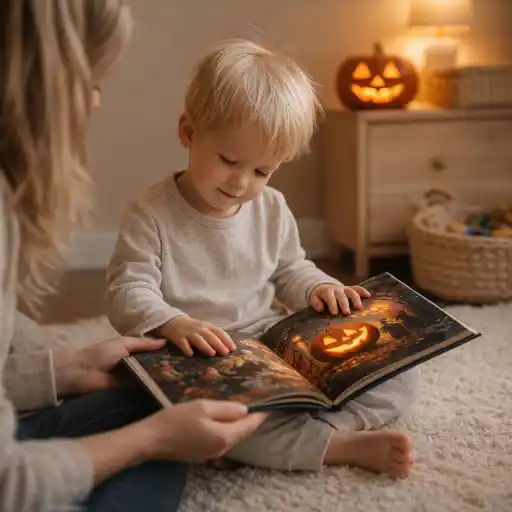
How can you extend the Halloween story into play and classroom routines?
After reading, offer a simple way to carry the story into play. A few props can help children represent the plot, explore a character’s perspective, and tell the story in their own way. For instance, provide a small basket with a paper pumpkin, a soft toy, a scarf, and a few picture cards related to the book. Children might stage a scene, invent a new character, or create an alternate ending.
Seasonal themes can connect literacy with art, movement, sensory exploration, and dramatic play. The key is to keep activities age-appropriate and responsive to the children rather than piling on materials. Fall planning resources suggest possibilities such as story retelling, character puppets, vocabulary games, and seasonal art (preschool Halloween lesson planning ideas).
- 📚 Place the book and a few story props in an accessible literacy or dramatic-play area.
- Invite children to draw a favorite scene and dictate a caption in their own words.
- Use puppets or simple movements to act out one part of the story.
- Compare a story pumpkin or costume with real objects or classroom materials.
Some children may prefer to revisit the book independently or with a peer. Keep it available when possible, and allow children to use pretend reading, pictures, movement, or storytelling as ways to engage. Family connections can extend the experience, too: invite caregivers to share favorite seasonal stories or tell you what the child enjoys discussing at home.
How can you respond when the story feels spooky or a child’s interest changes?
Halloween stories differ in tone, and children have different comfort levels. A book that seems playful to one child may feel unsettling to another. Preview new stories when practical, watch children’s expressions and behavior, and offer reassurance without dismissing a concern. You might say, “That part felt surprising. The character is safe now,” or remind the child that costumes and pretend creatures are make-believe if that fits the story and the child’s question.
Keep choices open. Offer a gentler version, a funny seasonal book, or a non-Halloween fall story if a child seems uncomfortable. Scholastic’s guidance on Halloween picture books recommends considering children’s individual comfort, choosing playful rather than frightening illustrations, and inviting children to share what feels fun versus too scary (not-too-scary Halloween picture books).
Also avoid assuming that repeated requests signal a concern. A familiar story may simply be a favorite. If the child’s interests shift, follow their lead and offer other stories without taking the beloved book away abruptly. For ongoing questions about a child’s development or emotional response, communicate respectfully with the family and follow program procedures. State requirements vary - check your state licensing agency when reviewing training expectations or program policies.
- Offer children a choice to listen, look at pictures, act, or take a break.
- Use calm, factual language about pretend characters and costumes when helpful.
- Respect children who enjoy spooky themes and those who prefer gentler stories.
How can providers make repeated reading inclusive and responsive?
Children participate in different ways, and spoken answers are only one form of engagement. Some children may point to an illustration, use a sign or communication device, make a sound, move like a character, or respond in a home language. Treat these as meaningful contributions. Pair spoken words with gestures, pictures, and objects so that children have more than one way to understand and express an idea.
For children learning English alongside another language, a repeated story can offer a predictable, low-pressure opportunity to participate. Invite families to share a familiar word, phrase, or version of a seasonal story if they wish. A child’s home language and prior experiences are valuable resources for making meaning; educators can acknowledge the child’s contribution and model related classroom vocabulary naturally.
Directors can support inclusive practice by ensuring books are accessible, varied, and reflective of children’s interests and families, and by giving staff time to plan and share observations. Keep notes brief and strengths-based: a child joined a refrain, pointed to the character on request, or used “glimmer” during block play. Such observations can guide the next invitation without turning read-alouds into formal assessments.
- Offer alternatives such as pointing, drawing, selecting a prop, or listening.
- Use accessible seating, clear illustrations, and tactile materials where helpful.
- Share favorite-book observations with families and invite their perspective.
Conclusion: What should you do when a child wants the same Halloween story every day?
Welcome the request. Repeated reading can offer comfort, strengthen familiarity with story language, and open up fresh opportunities for vocabulary, prediction, retelling, and play. Keep the experience enjoyable by varying your approach gently: read for pleasure, pause for one thoughtful question, or extend the story with a prop or drawing when the child is interested.
Choose a small learning focus, honor different communication styles, and pay attention to each child’s comfort with seasonal themes. The main goal is not to move on from a favorite as quickly as possible, but to use that connection as a supportive starting point for learning and belonging. To deepen your read-aloud practice, consider Reading Aloud and Storytelling Buy Now $16.00. For more classroom strategies and literacy materials, explore Classroom Tools for Emergent Literacy Buy Now $25.00, Building Vocabulary Buy Now $16.00, Language Development in Early Childhood Buy Now $16.00, and Science of Reading Foundations in the Pre-K Classroom Buy Now $16.00.
- 45 Hour Child Growth and Development
- Many Colors, One Canvas: MD ECE Conference
- Setting the Stage: Story Time
- Pediatric RSV First Aid & CPR/AED
- CDA Bridge Bundle: Family Child Care without Portfolio Review
- CDA Bridge Bundle: Infant/Toddler without Portfolio Review
- CDA Bridge Bundle: Preschool without Portfolio Review
- Lesson Planning for Preschoolers
- Texas Director Credential
- Halloween Classroom Activities Kids Will Go Batty For
- ¿Cuáles son las mejores actividades del Día de la Tierra para niños en casa o en el aula?
- Normas de Licenciamiento de Cuidado Infantil en Virginia para Centros Diurnos Infantiles y Hogares Diurnos Familiares
- Lista para Abrir una Guardería en Casa en Virginia: Cómo Empezar
- What are safe, engaging non-candy Halloween ideas for daycares?
- How Can Halloween Fine-Motor Activities Be Fun Without Being Scary?
- How Can You Plan October Classroom Activities for Children Who Do Not Celebrate Halloween?
- What Should You Do When a Child Finds a Halloween Activity Frightening?
- How Can Teachers Support Children’s Emotional Development During Halloween?
- How Can Preschool Teachers Encourage Sharing and Cooperation During Halloween?
- How Can Child Care Providers Use Positive Guidance During Halloween?
- How Can Child Care Providers Help Young Children Feel Safe Around Costumes and Masks?
- How Can Child Care Providers Keep Classroom Routines Predictable When Halloween Excitement Takes Over?
- How Can Preschool Providers Explore Light and Shadows Without the Scare?
- How Can Child Care Programs Plan a Halloween Celebration Where Food Is Optional?
- How Can Halloween Pretend Play Teach Children to Say “Stop” and “Ask First”?
- How Can You Help Children Return to Classroom Routines the Morning After Halloween?
- Why Does a Child Want the Same Halloween Story Every Day?
- How Can Child Care Providers Build Halloween Math Around Children’s Play—Without Candy?
- How Can a Halloween Staff Debrief Improve Your Child Care Program?
