Halloween’s excitement can turn shared materials, costumes, and games into real moments of conflict—but those moments also offer valuable practice in friendship skills. With predictable routines and playful teamwork, you can help preschoolers take turns, solve small problems, and feel included; Social Foundations and Responsive Classrooms Buy Now $24.00 offers further practical learning on social-emotional development, guidance, and conflict resolution.
For a broader foundation in how play supports children’s cooperation and problem-solving, explore ChildCareEd’s The Best Promotion is Play  Buy Now $24.00. These courses can help you strengthen everyday classroom practices while you discover simple, Halloween-ready ways to build a more cooperative classroom community.
Why does Halloween offer meaningful practice in cooperation?
Seasonal activities naturally invite children to negotiate: Who gets the orange marker? Who stirs the pretend potion? How will the group decorate one large pumpkin? These are not distractions from learning. They are authentic opportunities to practice communication, flexibility, waiting, and shared decision-making. Play supports social competencies and self-regulation, as the National Association for the Education of Young Children’s guidance on play emphasizes.
At the same time, preschoolers are still developing the perspective-taking and emotional regulation that sharing requires. A child’s reluctance to hand over a favorite prop does not mean the child is unkind or that your guidance has failed. ZERO TO THREE notes that sharing and turn-taking develop over time; calm adult support can make the learning manageable. See Helping Young Children With Sharing.
Halloween can heighten the stakes because the room is more stimulating than usual. A few clear expectations, smaller groups, and familiar routines help children focus on one another rather than feeling overwhelmed. Keep the goal realistic: not a conflict-free party, but a safe space where children can practice and repair interactions.
How can teachers prepare activities that invite teamwork?
Choose activities where children have a shared purpose rather than competing for a single winner. Small groups allow adults to notice early signs of frustration and offer support before disagreements escalate. Keep instructions short, demonstrate the steps, and prepare materials before children arrive.
- Make a collaborative Halloween mural: children contribute different parts to one large picture and share a limited set of crayons or stamps.
- Build a friendly monster together using large paper shapes; invite children to decide where each feature goes.
- Try pumpkin bowling as a team challenge, celebrating group turns and encouragement rather than the highest score.
- Set up a pretend pumpkin patch or trick-or-treat route, with flexible roles such as picker, helper, cashier, and customer.
- Use a shared sensory or art station with duplicate, accessible tools where possible.
Collaborative art and group games give children a reason to communicate and plan together; the process matters more than a polished final product. Edutopia’s guide to cooperative play in prekindergarten offers examples such as collaborative art and parachute games. Keep groups small, rotations brief, and walkways clear—practical planning can lower stress for children and staff. For more seasonal activity ideas, see Halloween classroom activities kids will go batty for.
What language helps children share and take turns?
“Share nicely” is well intentioned, but it may not tell a preschooler what to do. Offer concrete words and explain the sequence: “You’re using the purple marker. When you’re finished, Maya can have a turn.” Use a sand timer or visual cue when it will help make waiting more predictable. Avoid rushing a child to give up an item they have only just begun using; an adequate play turn can make taking turns feel fairer.
When conflict arises, move close, ensure safety, and describe what you see without blame. For example: “You both want the same spider. Leo is holding it, and Sam is reaching for it. I won’t let anyone grab.” Acknowledge each child’s feeling, then guide them toward a workable choice:
- “Would you like to wait for the timer or choose another spider while you wait?”
- “What could we do so both of you can help decorate?”
- “Would you like to take turns placing the eyes, or choose a different job?”
These approaches treat cooperation as a skill to learn, not unquestioning compliance. Penn State Better Kid Care explains that cooperation balances people’s needs and involves give-and-take; see Teaching children to cooperate. After a successful moment, name the specific behavior: “You waited, then passed the bowl to your friend. That helped the group finish the potion.”
How can Halloween activities include every child?
Children experience seasonal themes differently. Some love costumes and lively music; others may dislike masks, noise, unfamiliar decorations, or close group play. Offer welcoming alternatives: friendly pumpkins and animals instead of frightening characters, a quiet activity area, and the option to observe before joining. A calm break is a support, not a consequence.
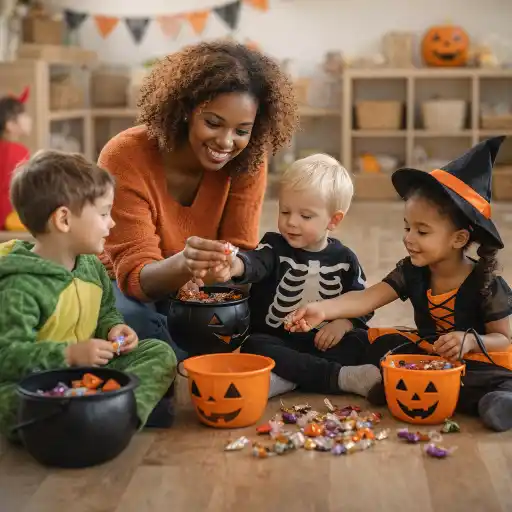
Build cooperation around varied ways to participate. A child might choose materials, point to a picture, hand out large supplies, dictate an idea, or watch the group before taking a role. Use visual turn cues, simple language, and props that are comfortable and accessible. Avoid assuming that every child celebrates Halloween; harvest, fall, or nature themes can preserve seasonal play without requiring participation in a holiday tradition.
Plan thoughtfully for safety and sensory comfort. Keep group sizes manageable, establish clear boundaries, and check that costumes allow children to move and see safely. For activities involving small objects, water, or movement, assess materials and supervise actively. ChildCareEd’s Halloween activity guidance recommends calm choices and clear safety routines. State requirements vary - check your state licensing agency.
How should teachers respond when sharing breaks down?
Even with thoughtful planning, a child may grab a prop, refuse a turn, or become upset when a game changes. These moments are common in early childhood; they call for calm teaching rather than shame. First stop unsafe actions with a clear, brief limit: “I can’t let you hit. I’ll help keep everyone safe.” Give children time to settle before expecting them to explain or solve the problem.
Once calm, describe the issue neutrally and invite both children to contribute. “You both want to hold the pumpkin basket. What are some ways to work it out?” If they need support, offer two acceptable options: alternating turns, sharing a joint task, or using another basket. Check that the solution feels workable to both children. A short, supported problem-solving process is more useful than forcing an apology before a child is ready to understand what happened.
Common pitfalls include expecting every preschooler to share immediately, relying on “be nice” without teaching what that means, and turning every activity into a contest. Instead, use duplicate materials where practical, set up clear roles, and notice cooperative attempts—even small ones. ChildCareEd’s SEL strategies in early childhood education discusses modeling, emotional vocabulary, and embedding social-emotional learning in everyday routines.
How can teachers carry these skills beyond Halloween?
Children are more likely to use social skills when they encounter them regularly, not only during a special event. Carry the same helpful phrases into block play, meals, outdoor time, and cleanup: “Can I have a turn when you’re finished?” and “How can we do this together?” Consistent language makes the expectations familiar and gives children repeated chances to practice.
Notice progress in specific, encouraging ways. “You asked for a turn instead of taking the pumpkin” identifies a strategy the child can use again. Invite children to reflect briefly after a group activity: What worked well? How did the group decide who went first? What could we try next time? These conversations build awareness without turning play into a lecture.
Providers can also share the classroom’s approach with families: describe the turn-taking phrases, explain that learning to share takes time, and invite families to use similar language at home if it fits. A social-skills activity can provide additional ideas; see ChildCareEd’s Social Skills Lesson Plan for Preschoolers Buy Now $0.00. Cooperation grows through responsive relationships, meaningful play, and patient repetition—not one perfect Halloween party.
Conclusion: What is the key to encouraging Halloween cooperation?
Preschool teachers encourage sharing and cooperation during Halloween by planning shared, low-pressure activities, modeling specific turn-taking language, and helping children solve conflicts with empathy. Make participation flexible, expectations clear, and safety and sensory needs part of the plan. Most of all, treat disagreements as opportunities to teach—not evidence that children should already know how to share.
With warm guidance and repeated practice, a collaborative mural, pumpkin game, or pretend patch can become a joyful setting for children to build communication, patience, and belonging. The goal is not perfect sharing; it is helping each child take a next step toward working well with others.
Further ChildCareEd learning:
- Turning Behavior Around for Toddlers and Preschoolers
- Moving About the Classroom: Effective Transitions for Everyday
- Lesson Planning for Preschoolers
- From Tantrums to Triumphs: Equipping Preschoolers with Self-Regulation Skills
- The ABCs of Behavior: Turning Challenges into Learning Opportunities
- CDA Bridge Bundle: Family Child Care without Portfolio Review
- CDA Bridge Bundle: Infant/Toddler without Portfolio Review
- CDA Bridge Bundle: Preschool without Portfolio Review
- Texas Director Credential
- Every Moment Matters: Schedules and Transitions
- Mummy Races & Zombie Tag: Halloween-themed Gross Motor Games
- CDA Certification en Español: Recursos y Consejos para Educadores Bilingües
- Halloween Classroom Activities Kids Will Go Batty For
- Proporciones de Cuidado Infantil y Tamaños de Grupo por Edad en Virginia (Guía Rápida para Centros y Hogares)
- How can rainy day indoor activities help preschoolers learn kindness and cooperation in Georgia?
- How can we encourage teamwork and cooperation in early childhood programs?
- Celebrando la amistad en el cuidado infantil durante el Día de los Mejores Amigos
- Canciones, juegos y preguntas de círculo para niños
- How can providers and families keep children safe while trick-or-treating?
- What are safe, engaging non-candy Halloween ideas for daycares?
- Daycare Team-Building Activities That Encourage Cooperation
- How Can Teachers Encourage Sharing Without Forcing It?
- How Can Halloween Fine-Motor Activities Be Fun Without Being Scary?
- How Can You Plan October Classroom Activities for Children Who Do Not Celebrate Halloween?
- What Should You Do When a Child Finds a Halloween Activity Frightening?
- How Can Fall Classroom Activities Teach Positive Behavior?
- How Can Teachers Support Children’s Emotional Development During Halloween?
- How Can Preschool Teachers Encourage Sharing and Cooperation During Halloween?
- How Can Child Care Providers Use Positive Guidance During Halloween?
