A flashlight, a friendly shape, and a little curiosity can turn Halloween into a gentle science adventure—not a frightening one. Explore ways to help preschoolers investigate how shadows form, change, and inspire stories, while making the activity purposeful and developmentally appropriate. For a practical foundation in planning engaging preschool experiences, explore Lesson Planning for Preschoolers  Buy Now $24.00; it can help you connect playful investigations with clear goals and responsive teaching.
Why is friendly shadow play a valuable seasonal investigation?
Halloween imagery can be exciting, but children do not all experience spooky themes in the same way. Friendly, familiar shapes—like a pumpkin, a smiling ghost, a leaf, or an animal—offer seasonal interest without requiring frightening characters or a darkened room. Providers can invite children to decide which shapes feel comfortable and whether they would rather watch, handle a puppet, draw, or tell a story. This choice-centered approach respects children’s different temperaments and experiences.
Shadow play is also more than a themed craft. When children notice that an object blocks light, predict what might happen, and move a flashlight to test an idea, they are practicing early scientific inquiry. They compare size, shape, position, and movement while building descriptive vocabulary and spatial awareness. Collaborative puppet play adds opportunities for turn-taking, listening, storytelling, and imagination. These rich connections are one reason a simple light source can support #STEM learning alongside art and language.
For providers, the activity is adaptable: it can be a brief small-group exploration, a learning-center invitation, or part of a longer investigation. The aim is not to deliver a perfect explanation on the first try, but to make children’s observations visible and worth revisiting.
How do shadows form, and what can children discover?
A shadow appears when an object blocks some of the light traveling toward a surface. The shape and appearance of the shadow depend on the object, the light’s position, and the distance between the light, object, and surface. Moving a flashlight or puppet can make a shadow shift, grow, or shrink. Children do not need a technical lecture to begin exploring these ideas; they can discover patterns through play and conversation.
Start with a predictable setup: a battery-powered flashlight, a pale wall or sheet, and large, solid shapes. Invite children to predict what a friendly ghost silhouette or pumpkin shape might look like before shining the light. Then let them try moving the puppet closer to the light or closer to the screen. Ask, “What changed?” and “How could we make the shadow bigger?” Give children time to test their own theories.
- Use descriptive words such as bright, dim, outline, near, far, large, small, and shape.
- Offer different opaque objects and compare their silhouettes.
- Invite children to match an object or picture to its shadow, then explain what details helped them decide.
- Connect the experience to outdoor observations: where do children notice shadows during the day?
Visual comparison can be especially engaging for preschoolers. ChildCareEd’s Halloween shadow-matching printable Buy Now $1.50 offers a seasonal way to compare pictures with silhouettes, while the Moonlight Shadows activity kit Buy Now $2.99 includes guided investigations and recording activities for children ready to explore further.
How can providers set up a playful, reassuring shadow station?
A calm, predictable environment helps children approach shadows with confidence. Keep some room lighting on rather than making the room fully dark, and introduce the flashlight and shapes before projecting them. Show children how the object creates a shadow and remind them that the silhouette is simply the shape of something blocking light. For children who are unsure, let them observe from a comfortable distance, stay with a trusted adult, or choose a non-Halloween object instead.
Set up a small station with a clear screen, a stable light source, and a few large, sturdy puppets. Use paper or card-stock figures with broad, recognizable outlines—such as a smiling moon, a friendly bat, a cat, or a leaf. Keep materials organized in a labeled tray and provide space for children to take turns. Children can participate by holding a puppet, moving it with support, naming what they see, drawing a shadow, or dictating a story.
- Preview the materials and invite children to choose which shapes they want to explore.
- Keep the flashlight aimed at the screen, never at anyone’s eyes.
- Use battery-powered lights and supervise materials closely; avoid hot lamps and accessible cords.
- Offer alternatives, such as matching cards or tracing a shadow in a brighter area.
- 🧡 Let children help name the characters and decide whether the story should be silly, gentle, or adventurous.
Preparation does not need to be elaborate. The ChildCareEd guide to preschool lesson planning emphasizes clear objectives, varied ways to participate, and flexibility—useful principles when planning a seasonal station for a group with different interests and comfort levels.
How can you guide inquiry without taking over the play?
Children learn through trying, noticing, and trying again. Rather than explaining every effect immediately, observe what children do and use open-ended prompts to extend their thinking. “What do you notice about this shadow?” invites description; “What could we move to change it?” encourages experimentation. Wait after asking, and accept responses through speech, gestures, home languages, drawings, or actions. Children’s informal explanations are meaningful starting points, even when their ideas are still developing.
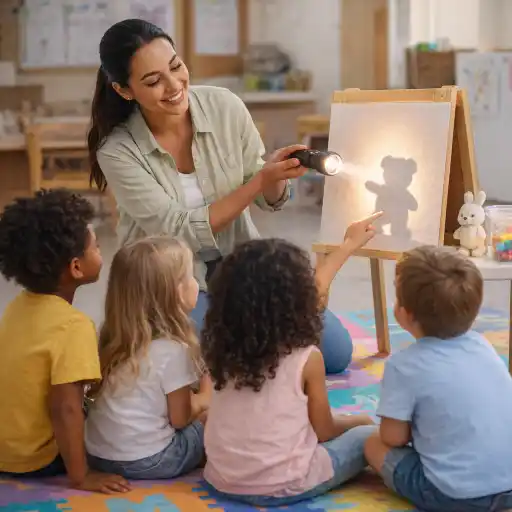
Keep the investigation manageable by changing one feature at a time. Hold the screen steady while a child moves the puppet, then keep the puppet still while the flashlight moves. This makes it easier for children to notice what seems connected to a change in the shadow. Invite them to compare two silhouettes or repeat an experiment with a different shape. If the result is unexpected, treat it as a reason to investigate further—not as a mistake.
- “What do you think will happen if we move the puppet closer?”
- “What changed when the flashlight moved?”
- “Which details can you see in the shadow? Which details are missing?”
- “How could we make this character look taller or smaller?”
Document one useful observation with a photo, drawing, or child quote, following program privacy procedures. Later, revisit the evidence together: “You predicted the shadow would grow. What did you notice when you moved the puppet?” This simple reflection supports reasoning and language while helping educators plan a relevant next step. For additional professional learning, Basic Science in Early Childhood Buy Now $25.00 focuses on planning meaningful science experiences and supporting children’s scientific reasoning.
How can shadow play support different learners and avoid common pitfalls?
There is no single right way to participate in a shadow investigation. Some children may enjoy moving puppets and narrating a story; others may prefer matching silhouettes, watching quietly, or drawing what they see. Offer large, easy-to-grip shapes, stable supports, visual choices, and extra time. Children can communicate their thinking by pointing, gesturing, speaking, drawing, or using their home language. If a child is uncomfortable with projected images, keep the lights brighter, use shadows on a tabletop, or switch to matching cards.
A frequent pitfall is making the activity more frightening than intended through sudden darkness, loud surprises, or intense Halloween images. Preview materials and let children opt for friendly characters. Another is rushing to provide the “correct” explanation before children have had time to explore. Slow down, notice their ideas, and let questions guide the next test. If shadows are difficult to see, adjust the angle, reduce competing light, or move the screen closer instead of assuming the children are not engaged.
- Keep the activity optional and avoid pressuring children to handle a shape that worries them.
- Do not shine flashlights toward eyes or leave young children unsupervised with equipment.
- Choose age-appropriate, large materials and check them for damage or small detachable pieces.
- Make room for movement and clear turn-taking so children can explore without crowding the light station.
Safety and participation expectations depend on the materials and setting; state requirements vary - check your state licensing agency. A responsive provider can preserve the wonder of the investigation while making the experience emotionally comfortable and physically safe for every child.
Conclusion: How can you make Halloween shadow play welcoming and meaningful?
Preschool shadow play can make Halloween season a friendly invitation to explore light, shapes, and storytelling. Begin with familiar, non-scary objects; explain the setup through demonstration; and give children choices about how they participate. Then encourage them to predict, move a light or object, observe the result, and share what they noticed. These simple steps nurture #curiosity, early reasoning, vocabulary, creativity, and cooperation.
Keep the experience flexible: a brief matching game may be enough for one child, while another group may be ready to build a shadow-puppet story or compare how silhouettes change. Document a meaningful observation and use it to plan what comes next. With thoughtful preparation and a reassuring tone, providers can help children see shadows not as something to fear, but as a playful phenomenon they can investigate together.
To strengthen the planning behind activities like this, explore Lesson Planning for Preschoolers Buy Now $24.00. For more focused science strategies, consider Basic Science in Early Childhood Buy Now $25.00, Facilitating Learning in the Preschool Classroom Buy Now $35.00, and DAP for Preschool Buy Now $24.00. Each offers a different way to deepen your approach to developmentally appropriate, engaging learning experiences.
- 45 Hour Child Growth and Development
- CDA Bridge Bundle: Family Child Care without Portfolio Review
- CDA Bridge Bundle: Infant/Toddler without Portfolio Review
- CDA Bridge Bundle: Preschool without Portfolio Review
- Lesson Planning for Preschoolers
- Texas Director Credential
- Building Early Science Foundations
- Montessori Cultural Activities: Exploring the World Through Play and Learning
- Environments That Inspire Independence and Exploration
- CDA Certification en Español: Recursos y Consejos para Educadores Bilingües
- Recursos en Español sobre el Sueño Seguro del Bebé
- Cómo usar tu certificación de 90 horas en Maryland para completar tu CDA
- Cómo ser director de cuidado infantil en Maryland
- 10 Ejemplos de Cómo la Cultura Influye en el Desarrollo Infantil
- Capacitación en Salud y Seguridad Preventiva en Línea para Proveedores de Cuidado Infantil
- Regulaciones de Licenciamiento de Cuidado Infantil en California para Centros y Hogares de Cuidado Infantil Familiar
- Proporciones de Cuidado Infantil y Tamaños de Grupo por Edad en Maryland (Guía Rápida para Centros y Hogares)
- Proporciones de Cuidado Infantil y Tamaños de Grupo por Edad en Nueva Jersey (Guía Rápida para Centros y Hogares)
- Proporciones de Cuidado Infantil y Tamaños de Grupo por Edad en Virginia (Guía Rápida para Centros y Hogares)
- ¿Cuál es la Diferencia Entre la Crianza Respetuosa y la Crianza Permisiva?
- Cómo Ser Maestra de Preescolar en Illinois
- Cómo Ser Maestra de Preescolar en Maryland
- Celebrando la amistad en el cuidado infantil durante el Día de los Mejores Amigos
- Canciones, juegos y preguntas de círculo para niños
- Cómo simplificar la capacitación para sus empleados de daycare
- How Can Providers Bring Nature-Based Learning Into Any Program?
- Where Did Our Shadows Go on a Cloudy Day—and How Can We Revisit Yesterday’s Prediction?
- Can One Object Make Two Different Shadows at the Same Time?
- How Can Preschool Providers Explore Light and Shadows Without the Scare?
