Halloween in a child care setting can be festive, memorable, and exciting without relying on candy. Thoughtfully planned non-food activities help protect children with allergies, promote #inclusion, reduce overstimulation, and keep celebrations developmentally appropriate. This guide provides child care providers and directors with classroom-ready ideas, including creative learning centers, simple non-food prizes, costume and movement games, sensory-friendly activities, family communication strategies, and common safety concerns to avoid. By centering play, learning, and community, programs can create a calm and welcoming celebration in which every child can participate.
To strengthen allergy-safe planning, explore ChildCareEd’s self-paced online course Elijah’s Law: Allergy Awareness Training  Buy Now $16.00. The training helps providers prevent and respond to food and other allergies and support children with allergy-related concerns. Educators can also take Inclusive Lessons for Preschoolers Buy Now $16.00 for practical guidance on selecting materials, adapting activities, and creating engaging lessons that welcome children with different abilities and needs. State requirements vary, so always check with your state licensing agency.
1. What non-candy treats actually work in a daycare setting?
- Practical school supplies: pencils with toppers, novelty erasers, stickers, Halloween-themed crayons. Example: pumpkin pencil toppers—easy, washable, and loved by preschoolers (see creative ideas like the pumpkin pencil topper).
- Small toys and manipulatives: mini rubber ducks, slinky-type springs, spider rings, bubbles (non-aerosol). Parents report huge wins handing out tiny toys to daycare friends (daycare toy ideas).
- Activity-based tokens: sticker sheets, temporary tattoos, craft packs for home (glue stick + pre-cut shapes).
- Food-free sensory items: play dough tubs, stretch toys, finger puppet sets. Allergic Living and food-allergy resources offer curated non-food ideas for teal pumpkin giveaways (Allergic Living).
- Swap-and-trade approach: let families donate allergy-safe treats or toys and offer a supervised swap so children with restrictions can still participate (food allergy strategies).
Quick tip: label containers with age-appropriateness and choking warnings. When communicating with families, mention safe alternatives and invite donations of non-food prizes (refer to local licensing and health rules).
2. How do I plan low-cost, high-learning Halloween centers for mixed-ability groups?
- 🎨 Art Center (prep ahead): pre-cut shapes for jack-o’-lantern faces, sticker collage, or not-so-scary masks. Use trays and aprons for fast clean-up.
- 🧪 STEM/Science: “Witches’ potion” reactions (baking soda + vinegar) and sink-or-float eyeball tests—use trays to contain spills and questions to extend learning (science ideas). For more step-by-step spooky experiments and extension questions that support early learning goals, see science exploration during Halloween.
- 📚 Literacy: a short read-aloud (not-too-scary) followed by a rhyme or letter-match game; printable story prompts work well for mixed levels (Pre-K lesson ideas). You can also include simple pencil-and-paper activities—drawing prompts, matching worksheets, and emergent writing tasks—that reinforce vocabulary and fine-motor skills; see our pencil-and-paper activities (pencil-and-paper activities).
- ✂️ Fine-motor & Sensory: play dough pumpkins, pom-pom sorting, or a tidy sensory bin with dyed pasta and scoops. Keep a calm basket handy for children who need a break.
- 🔁 Staffing & Rotation: 1 adult per center or one staff member floating for transitions, toileting, and behavior supports. Use a visual schedule so children know what’s next (scheduling tips).
Why it matters: purposeful centers turn holiday excitement into chances for counting, prediction, vocabulary, and cooperation. Prepping materials in themed tubs saves time and prevents overstimulation.
3. Which Halloween gross-motor games keep kids active but safe?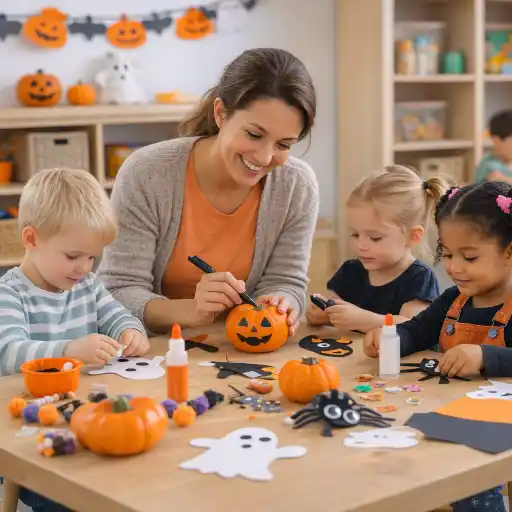
- 🎃 Pumpkin Bowling: plastic bottles as pins, small soft pumpkins as balls. Modify distance for ages.
- 🧟 Zombie Tag / Mummy Races: simple variations of tag and relay races. For mummy wrap, use fabric strips instead of toilet paper for reusability and safety.
- 🕸️ Spider Web Walk: painter’s tape web on floor for balance practice. Ask kids to walk, tiptoe, or hop along lines.
- 🎵 Monster Freeze Dance: play music and pause—freeze! Add shape or animal prompts for learning extension.
- ⚠️ Safety checklist:
- 1. Clear the play area.
- 2. Use non-slip footwear and short costumes.
- 3. Limit players per game and supervise closely.
- 4. Have first-aid and allergy plans visible; state requirements vary - check your state licensing agency.
Timing: 10–15 minutes per game keeps momentum and prevents fatigue. Rotate outside if weather permits to reduce noise indoors.
4. How can I make Halloween inclusive and allergy-safe for every child?
Inclusion starts with planning and family communication. Use the teal pumpkin concept to signal non-food treats and make allergen-aware choices visible. Resources explain how families and communities adopt teal pumpkins and food-free options (food allergy strategies, teal pumpkin story).
- Communicate early: 3 quick items to send in your family note:
- Schedule and costume guidelines (no masks that obscure vision).
- Request for allergy info/list of banned foods.
- Offer ideas for non-food donations and the option to opt out of candy activities.
- Implement the Teal Pumpkin approach: display a visual sign and offer a bin of non-food treats so families know you’re allergy-aware (Teal Pumpkin tips).
- Provide choices: let children choose a non-scary costume, a calm space, and an alternative activity (e.g., quiet coloring or a social story about Halloween).
- Family swap & buy-back: organize a supervised swap or a classroom buy-back where kids trade candy for a small toy donated by families—this preserves tradition without risk.
Why it matters: inclusive planning reduces anxiety for children and families, builds trust, and demonstrates professional care. For more allergy-friendly treat lists and signage ideas, see Allergic Living.
5. What common mistakes should I avoid, and how should I tell families?
Common mistakes often create chaos rather than cheer. Below are typical pitfalls and practical fixes—use these as a quick checklist when you draft a family note or staff huddle plan.
- ❌ Mistake: Too many activities at once → Fix: Limit to 3 centers and stagger start times (reduces lines and overstimulation). ChildCareEd recommends simple schedules and short rotations (planning guide).
- ❌ Mistake: Ignoring sensory needs → Fix: Set up a clear, calm corner with soft seating, headphones, and a visual timer.
- ❌ Mistake: Last-minute costume or snack rules → Fix: Send a one-page family letter 1–2 weeks ahead with clear costume, snack, and allergy guidance. Sample content ideas are available in ChildCareEd’s Halloween Safety.
- ❌ Mistake: Expecting staff to improvise transitions → Fix: Assign a floating staff member, pre-bundle materials in tubs, and use picture schedules for children.
FAQ (quick):
- Q: Can we include small food items? A: Only with explicit family permission and documented allergy checks; non-food treats are safest.
- Q: What about costumes? A: Encourage comfortable costumes—no long capes, no realistic weapon props.
- Q: How long should rotations be? A: 10–15 minutes per center for preschoolers.
- Q: How do we handle scared children? A: Offer a ‘not-scary’ option and a calm corner; rehearse via social stories.
- Q: Where can I get more lesson-ready downloads? A: Check childcare provider resources such as ChildCareEd and printable packs from Pre-K providers (Pre-K printable fun).
Common mistakes avoided lead to calmer transitions, safer play, and more meaningful learning. Keep plans simple and preview the day with staff and families.
Conclusion
Non-candy Halloween ideas let daycare staff center children’s safety, learning, and belonging. Use an organized schedule, pick a small set of well-staffed centers, choose non-food rewards, and communicate clearly with families. Small changes—teal-pumpkin signage, a calm corner, and a few sensory-friendly options—make the holiday joyful for every child. For quick inspiration and activity lists, see ChildCareEd’s Halloween resources (activities, gross-motor games, safety). Happy planning—and don’t forget to check licensing specifics: state requirements vary - check your state licensing agency.
- Safe and Sound: Creating Healthy Environments for Every Child
- Basic Health & Safety and Breastfeeding Awareness
- Medication Administration and the Prevention of and Response to Food and Other Allergies in the Child Care Environment
- Nutrition Essentials for Child Care Providers
- Medication Administration and the Prevention of and Response to Food and Other Allergies in the Child Care Environment
- Texas Director Credential
- Access for All: Inclusion and the ADA
- Wellness in Action: Teaching Healthy Habits to Children
- Family Child Care: Building, Premises, and Outdoor Safety
- CDA Certification en Español: Recursos y Consejos para Educadores Bilingües
- 😫🧸 ¿Qué hacer cuando un bebé no quiere dormir la siesta en el aula?
- Curso Para Trabajar En Daycare:Qué Necesitas Para Empezar
- Recursos en Español sobre el Sueño Seguro del Bebé
- Que es Título 22 en California?
- Capacitación en Salud y Seguridad Preventiva en Línea para Proveedores de Cuidado Infantil
- Cómo Iniciar el Proceso de Obtención de la Licencia de Cuidado Infantil
- ¿Cómo solicito la licencia para una guardería en California?
- Regulaciones de Licenciamiento de Cuidado Infantil en California para Centros y Hogares de Cuidado Infantil Familiar
- Normas de Licenciamiento de Cuidado Infantil en Virginia para Centros Diurnos Infantiles y Hogares Diurnos Familiares
- Proporciones de Cuidado Infantil y Tamaños de Grupo por Edad en Maryland (Guía Rápida para Centros y Hogares)
- Lista para Guardería en Casa en Illinois: Cómo Iniciar una Guardería en el Hogar
- Lista para Guardería en Casa en California: Cómo Iniciar una Guardería en el Hogar
- Lista para Guardería en Casa en Texas: Cómo Iniciar una Guardería en el Hogar
- Cómo Trabajar en el Cuidado Infantil en Wisconsin: Requisitos y Pasos
- Cómo Ser Maestra de Preescolar en Dakota del Norte
- Capacitación Previa al Servicio para Proveedores de Cuidado Infantil en Nevada
- How can providers and families keep children safe while trick-or-treating?
- What are safe, engaging non-candy Halloween ideas for daycares?
- ¿Todos los niños deben participar en el tiempo de círculo?
