Costumes, decorations, and special activities can turn an ordinary classroom day into a whirlwind of anticipation. A clear visual plan and familiar routines help children enjoy Halloween while supporting smoother transitions and calmer participation; explore ChildCareEd’s The ABCs of Behavior: Turning Challenges into Learning Opportunities  Buy Now $55.00 to deepen your understanding of behavior and practice positive, consistent responses. For ready-to-use visuals, the Celebration-Day Visual Schedule and Transition Cards Buy Now $0.00 can help you show children what stays familiar, what changes, and what comes next.
Why do predictable routines matter when Halloween excitement rises?
Halloween can be joyful, but it may also bring louder rooms, unfamiliar costumes, special visitors, unusual snacks, and changes to the usual schedule. Young children are still developing the ability to manage anticipation, wait, shift attention, and interpret what adults expect. When several changes happen at once, excitement can spill into restlessness, conflict, withdrawal, or distress. A predictable framework helps children understand the day without requiring them to suppress their feelings.
Routines are more than a timetable: they provide cues about what is happening, what will happen next, and how children can participate. NAEYC describes routines and transitions as essential parts of a supportive classroom. The Indiana Resource Center for Autism also notes that transition supports—including visual schedules and advance cues—can improve participation and reduce reliance on adult prompting. These supports may be useful for many learners, including children who benefit from extra processing time, concrete information, or less dependence on spoken directions.
Predictability does not mean making a special day identical to every other day. Instead, preserve familiar anchors—arrival, meals, rest, and departure—while making planned changes visible. Think of the routine as the steady path through the celebration: children can explore the fun because they have a dependable sense of what comes next.
How can you adapt the regular schedule without losing its familiar structure?
Begin with the schedule children already know. Keep the order of core activities as consistent as possible, then add the celebration elements where they naturally fit. If a parade or craft replaces an activity, show that change rather than posting an idealized schedule that no longer matches the day.
Use a group visual schedule with familiar photos, simple pictures, or words paired with images. Include major events and the transitions between them: arrival, morning meeting, centers, costume or craft time, snack, outdoor play, rest, and pickup. A short individual strip or “now/next” card may be more manageable for a child who is overwhelmed by a full-day display. Keep a change card handy for weather shifts, a delayed visitor, or another unexpected adjustment.
- Review the day’s sequence with children before the celebration begins.
- Mark the current activity and show when it is finished.
- Build cleanup, handwashing, costume adjustments, and movement time into the plan.
- Use a consistent cue—such as a song, timer, or brief countdown—before transitions.
- Preserve meal, rest, and other essential care routines wherever possible.
As NAEYC’s guidance on daily routines and classroom transitions emphasizes, thoughtful timing and sequencing are part of a supportive environment. An accurate, simple schedule is more helpful than an elaborate one that staff cannot keep current.
How do visual schedule and transition cards help children know what to expect?
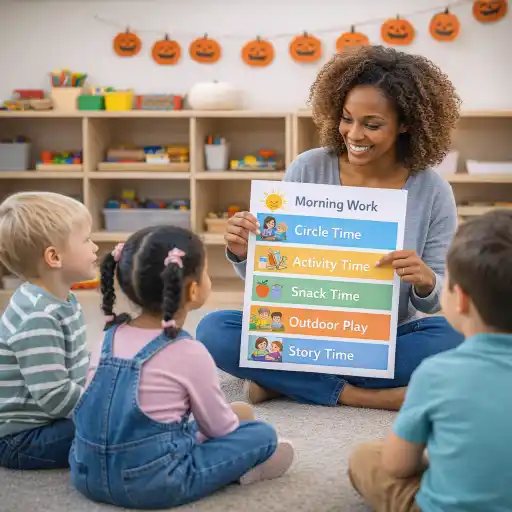
Visuals make the sequence of the day available beyond the moment an adult gives a verbal direction. A child can look, point, revisit the information, or carry a card to the next area. The Indiana Resource Center for Autism explains that visual schedules can clarify upcoming activities and increase predictability; transition cues may also reduce challenging behavior and support more independent movement between activities.
For Halloween, use celebration-day cards to distinguish familiar routines from special events. For example, display “morning meeting,” “pumpkin activity,” “wash hands,” and “snack” in order. Pair images with short labels, and teach children what each card means before the busy day. If costumes or decorations are unfamiliar, preview photographs or describe them calmly in advance.
- Choose images children recognize, such as photos of your own classroom or materials.
- Show only the amount of information children can use; a short sequence can be clearer than a crowded chart.
- Use a visual timer or countdown when children need help seeing that an activity is ending.
- For a brief transition, try a “first/then” cue: “First put away the paint, then choose a book.”
- Offer a personal or portable card when a child needs an individual reminder.
🌟 Invite a child helper to move the “now” marker or turn over a finished card, while allowing children to participate in ways that suit their comfort and abilities. The cards are information and support—not a test of compliance.
How can staff support big feelings while maintaining the routine?
Excitement is not misconduct. A child who is speaking loudly, moving quickly, or hesitating to join may be communicating a need for movement, reassurance, reduced sensory input, or more time to process the change. Staff can keep the schedule steady while responding flexibly to the child in front of them.
Notice early signs and consider what happened just before the child’s response. The antecedent-behavior-consequence framework described in the Indiana Resource Center for Autism’s guide to A-B-C data can help teams observe patterns without labeling a child. If the costume parade reliably leads to overwhelm, for example, the team might offer a quieter viewing spot, a shorter participation option, or a familiar adult nearby.
- Use a calm, brief statement: “It’s noisy. You can watch from here or take a quiet break with me.”
- Keep a supervised calm space available, with familiar books or quiet activities.
- Offer choices within reasonable boundaries, including the option not to wear a costume.
- Give children time to respond after directions instead of repeating them rapidly.
- Recognize helpful efforts specifically: “You checked the card and walked with the group.”
Keep expectations developmentally appropriate, and coordinate staff language so children receive steady, respectful guidance. If a child remains distressed, prioritize safety and connection over completing the planned activity on schedule.
How can you plan an inclusive, manageable celebration day?
Inclusion starts with recognizing that children and families have different traditions, sensory preferences, and comfort levels around Halloween. Keep holiday participation flexible and offer meaningful alternatives, such as an autumn art activity, a nature-themed story, or the choice to observe rather than join a parade. Avoid assuming every child celebrates or wants to wear a costume.
Keep the program intentionally simple. A small number of well-prepared activities is easier to supervise and less likely to overwhelm children than a packed rotation of stations. Share the plan with families in advance, including costume expectations, any food plans, and the quieter options available. Invite family input without asking a child to represent a culture or tradition.
- Limit special activities and prepare materials before children arrive.
- Offer quiet and active choices, as well as ways to participate without touching, speaking, or dressing up.
- Check food allergies and follow program food policies before serving treats.
- Use safe, age-appropriate decorations and keep pathways and exits clear.
- Plan staff positions and supervision for transitions, bathrooms, and group activities.
For additional seasonal activity ideas, see ChildCareEd’s Halloween classroom activities. State requirements vary - check your state licensing agency for applicable supervision, food, safety, and program rules. A welcoming celebration leaves room for children to engage, pause, or choose another way to take part.
What common planning mistakes can make the day harder?
Even thoughtful celebrations can become demanding when there are too many activities, the posted plan is inaccurate, or adults assume that every child will respond to excitement in the same way. A useful reset is to ask: What information do children need now? Which routine can remain familiar? What choice would make participation more accessible?
- Changing the schedule without updating visuals: Move or replace the card and briefly explain what changed.
- Giving a last-minute verbal warning only: Pair short spoken reminders with a visual cue and enough time to process.
- Overloading the day with activities: Select a few meaningful experiences and protect rest, meals, and ordinary play.
- Pressuring children to wear costumes or join: Offer alternatives and respect children’s comfort.
- Using a calm space as punishment: Teach it as an optional, supervised place for a break.
- Interpreting distress as defiance: Observe triggers, consider sensory and communication needs, and respond with empathy.
After the celebration, take a few minutes with the team to reflect. Which transitions went smoothly? When did children need additional preparation? Did the visuals match what happened? Use these observations to refine the plan for future special events. The goal is not a perfectly quiet Halloween; it is a day in which children feel informed, supported, and safe enough to participate.
Conclusion: How can you keep Halloween fun and predictable?
When Halloween excitement takes over, predictable routines help children anticipate the day, manage transitions, and participate in ways that work for them. Keep familiar care anchors, show special events on a clear visual schedule, preview changes, and prepare staff to respond to big feelings with calm, consistent guidance. A flexible plan can protect both the joy of celebration and children’s sense of security.
Start with a few practical steps: review the schedule with children, prepare transition cards and a change card, simplify the activity lineup, and offer a quiet option alongside group events. Use observations after the day to see what helped and where the plan needs adjustment. For a fuller learning experience in interpreting behavior and responding positively, explore The ABCs of Behavior: Turning Challenges into Learning Opportunities Buy Now $55.00. Small, thoughtful supports can make a busy celebration more predictable for children, families, and staff.
Additional ChildCareEd courses for professional learning
- Every Moment Matters: Schedules and Transitions Buy Now $55.00 — practical learning about schedules, transitions, and classroom environments.
- Moving About the Classroom: Effective Transitions for Everyday Buy Now $35.00 — strategies for planning smoother preschool transitions.
- Self-Regulation & Change: Helping Children Cope Buy Now $16.00 — approaches to supporting children through change and transitions.
- Effective Approaches for Autism and Inclusion Buy Now $55.00 — inclusive classroom strategies, communication supports, and sensory adaptations.
- Viewing Guidance in a Positive Light Buy Now $24.00 — developmentally appropriate positive guidance strategies.
- Moving About the Classroom: Effective Transitions for Everyday
- Responding to Emergencies
- Positive Attention: Interactions and Supervision of Infants and Toddlers: For Workforce Solutions
- What Makes Me Special: An Overview of Autism and ADHD
- The ABCs of Behavior: Turning Challenges into Learning Opportunities
- Pediatric RSV First Aid & CPR/AED
- Positive Attention: Interactions & Supervision for Infants & Toddlers
- Texas Director Credential
- Behind the Scenes: Baby Routines ONLINE
- Every Moment Matters: Schedules and Transitions
- Mummy Races & Zombie Tag: Halloween-themed Gross Motor Games
- 👶 ¿Cuáles son las proporciones y grupos requeridos en Dakota del Norte? 🏫
- Recursos en Español sobre el Sueño Seguro del Bebé
- 10 Ejemplos de Cómo la Cultura Influye en el Desarrollo Infantil
- Proporciones de Cuidado Infantil y Tamaños de Grupo por Edad en Maryland (Guía Rápida para Centros y Hogares)
- Proporciones de Cuidado Infantil y Tamaños de Grupo por Edad en Nueva Jersey (Guía Rápida para Centros y Hogares)
- Proporciones de Cuidado Infantil y Tamaños de Grupo por Edad en Virginia (Guía Rápida para Centros y Hogares)
- Lista para Guardería en Casa en Texas: Cómo Iniciar una Guardería en el Hogar
- Retraso del Habla en la Guardería: Cómo Pueden Ayudar los Proveedores
- Canciones, juegos y preguntas de círculo para niños
- La mejor manera de hacer seguimiento a la capacitación de su equipo de daycare How to Organize Staff Training for Your Child Care Center Cómo organizar la capacitación del personal para su centro de cuidado infantil
- Cómo simplificar la capacitación para sus empleados de daycare
- How can providers and families keep children safe while trick-or-treating?
- What are safe, engaging non-candy Halloween ideas for daycares?
- How Can Teachers Support Children’s Emotional Development During Halloween?
- How Can Preschool Teachers Encourage Sharing and Cooperation During Halloween?
- How Can Child Care Providers Use Positive Guidance During Halloween?
- How Can Child Care Providers Keep Classroom Routines Predictable When Halloween Excitement Takes Over?
- How Can You Help Children Return to Classroom Routines the Morning After Halloween?
- How Can a Halloween Staff Debrief Improve Your Child Care Program?
