Kindergarten readiness is not a race to master worksheets or read ahead; it is the growing ability to learn, participate, and manage everyday routines. For practical ways to strengthen children’s emotional readiness, explore ChildCareEd’s From Tantrums to Triumphs: Equipping Preschoolers with Self-Regulation Skills Buy Now $25.00 and Are They Ready for Kindergarten? Buy Now $35.00; these trainings offer strategies for classroom practice and a broader view of readiness as you continue reading.
Why does a balanced view of readiness matter?
Providers and directors often hear families ask whether a child knows enough letters or numbers to start school. Those are understandable questions, but readiness is broader than a checklist of academic facts. Children enter kindergarten with varied strengths, experiences, languages, temperaments, and support needs. A useful readiness framework helps adults notice what each child can already do and plan meaningful next steps rather than turning school entry into a pass-or-fail test.
Research reviews describe readiness through multiple, interacting domains: learning-related skills, social behavior, language, early literacy and mathematics, health, and children’s experiences at home and in care. The selective review of predictors of school readiness in literacy and mathematics likewise emphasizes processes of learning and communication—not only isolated academic tasks. A child who is curious, can ask for help, and returns to a challenging activity is demonstrating readiness even if letter knowledge is still emerging.
This perspective matters for equity, too. Children’s opportunities and developmental pathways differ; readiness should guide supportive teaching, not label a child or family. State requirements vary - check your state licensing agency.
Which skills support learning across the kindergarten day?
Rather than ranking academics, independence, and self-regulation as competitors, consider how they work together. Self-regulation includes developing abilities to manage attention and impulses, remember information, and shift strategies. The OECD describes inhibition, mental flexibility, and working memory as related capacities that support learning, relationships, and well-being. They help a child wait for materials, remember a direction, or adapt when a game changes.
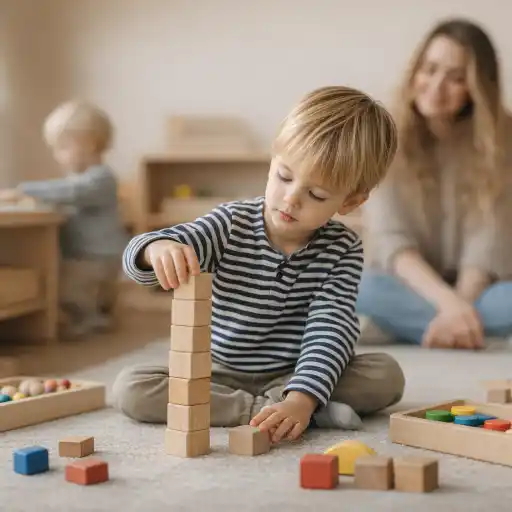
These capacities do not replace literacy or mathematics; they help children access those experiences. During a story, a child listens, recalls events, and talks about a character. In block play, children compare quantities, plan a structure, negotiate roles, and persist when it falls. NYU’s report on a kindergarten study found that an approach combining executive-function support with academic learning was associated with academic gains, underscoring the value of integrating—not separating—these domains.
- Language and early academics: Enjoying books, communicating ideas, exploring sounds and letters, counting objects, and noticing shapes or patterns.
- Social-emotional learning: Naming feelings, taking turns, communicating needs, and practicing ways to recover from frustration.
- Learning behaviors: Paying attention for an age-appropriate period, trying again, following a simple sequence, and seeking help.
Notice the developing #attention and #language behind the observable task, not just whether a child gets the answer right.
How does independence help children participate?
Independence means having opportunities to do manageable tasks with increasing confidence—not doing everything without adult help. In a kindergarten setting, self-help skills can reduce stress and make it easier for children to join the group: putting away belongings, washing hands, opening a familiar lunch container, managing clothing, and following a predictable routine. Just as important is knowing how to ask an adult for support when a task is difficult or a need arises.
NAEYC’s family guidance on kindergarten transition recommends building independence through ordinary responsibilities and routines. In child care, educators can make these skills part of the day rather than a separate drill. Place materials within children’s reach, use picture cues for multi-step tasks, allow enough time to try, and offer help that preserves the child’s participation. For example: “You pulled the zipper up halfway. Would you like to try the rest, or would you like me to hold the bottom?”
- Let children practice putting on and removing coats, storing bags, and cleaning up materials.
- Offer child-sized tools and containers that are possible to manage, while adjusting for individual motor or access needs.
- Use consistent visual routines for handwashing, transitions, and snack clean-up.
- Recognize effort and strategies, rather than expecting every child to complete a task at the same pace.
Such everyday #routines foster agency and confidence. Development, disability, culture, and prior experience all shape how and when a child becomes comfortable with a particular task.
Why is self-regulation a foundation rather than a requirement for perfect behavior?
Self-regulation is developing, and young children still need adults to help them manage strong feelings, wait, and shift attention. Expecting kindergarten-bound children to remain calm or follow every direction without support misunderstands the skill. A child’s distress may reflect fatigue, sensory needs, a difficult transition, limited communication, or uncertainty—not a lack of readiness or motivation.
Head Start guidance describes responsive relationships and predictable environments as foundations for social-emotional learning. Co-regulation is the adult’s supportive role: staying calm, naming what is happening, keeping everyone safe, and helping the child find a next step. When a child is upset, long explanations rarely help in the moment. A brief statement such as “You wanted that truck. I won’t let you hit. I’m here; let’s take a breath” combines connection with a clear boundary.
Teach strategies when children are calm, then practice them in meaningful contexts. Games such as Freeze Dance and Simon Says invite children to pause and adjust their actions; pretend play offers practice in holding a role and negotiating a shared story. Offer calming choices and model words for asking for a turn or help. The goal is gradual growth in #selfregulation, not immediate adult-like control. For further professional learning, ChildCareEd’s CDA Subject Area 3  Buy Now $80.00 explores social-emotional development, guidance, predictable care, and self-regulation.
How can educators nurture all three areas in daily practice?
Integrated teaching happens in the moments children already find meaningful: play, meals, transitions, stories, and helping jobs. A pretend market, for instance, can invite children to make signs, count pretend fruit, share materials, remember an order, and handle a change in the play plan. Educators can extend the learning with a question or a small prompt without taking over children’s ideas.
- 📚 During a read-aloud, invite children to predict what might happen, notice a character’s feelings, and retell a favorite part.
- 🧩 In block play, encourage children to plan, compare sizes, test a design, and decide together how to solve a problem.
- 🧥 At arrival and departure, use picture cues and allow children time to manage belongings and seek help as needed.
- 🎵 Before transitions, give a brief warning and use a familiar song or visual cue so children can anticipate what comes next.
- 🤝 During conflicts, help children name the problem, hear one another, and practice a useful phrase such as “Can I have a turn when you’re finished?”
Observe children across settings and over time. Record specific examples—what the child did, the context, and what support helped—rather than making broad judgments such as “not ready.” Share strengths and practical next steps with families, respecting home languages and family priorities. If developmental concerns persist, discuss observations with the family and follow appropriate screening or referral procedures. The ChildCareEd overview of kindergarten readiness skills offers additional context for classroom-family conversations.
What common readiness mistakes can programs avoid?
A common pitfall is treating readiness as a narrow academic race. Repeated worksheets may leave little room for children to practice communication, problem-solving, movement, and persistence through active experiences. Another is confusing compliance with regulation: a child who is quiet may still need support, while a child who is active can be deeply engaged in learning.
Programs can avoid these traps by using observation and responsive planning. Do not compare children publicly or rely on a single task to make sweeping conclusions. Avoid expecting self-help skills without teaching them, and avoid treating a calm-down area as punishment. Instead, teach its use as a supported option and ensure children’s dignity and supervision. Make expectations visible and predictable, while adjusting cues, materials, time, and adult assistance to fit individual needs.
- Instead of: asking, “Can this child already read?” Try: noticing how the child attends to books, communicates ideas, and explores print.
- Instead of: completing every task for a child to save time. Try: breaking the task into steps and offering just enough help.
- Instead of: viewing a difficult moment as defiance. Try: considering the child’s communication, environment, and unmet needs, then teaching a safer response.
Kindergarten readiness is a shared transition, not a burden that belongs to a child or family alone. Programs and receiving schools can communicate about routines and expectations, and families can share what helps their child feel secure.
Conclusion: Which skills matter most before kindergarten?
The strongest answer is not academics, independence, or self-regulation alone. Children benefit from a balanced foundation: language and early academic experiences, practical self-help skills, supportive relationships, and developing self-regulation. These areas reinforce one another. A child who can ask for help, try a manageable task, and return to a story or game is using several readiness skills at once.
For providers and directors, the practical goal is to create predictable, warm environments where children can play, communicate, practice independence, and receive help without shame. Observe progress over time, partner with families, and respond to each child’s strengths and needs. Readiness is a process; the aim is not perfection on the first day, but a confident start with adults prepared to keep supporting growth.
Five ChildCareEd courses for further learning
- From Tantrums to Triumphs: Equipping Preschoolers with Self-Regulation Skills Buy Now $25.00 — classroom strategies for self-regulation and emotional support.
- Are They Ready for Kindergarten? Buy Now $35.00 — a readiness overview spanning skills and social-emotional preparation.
- Supporting Children’s Independence Buy Now $24.00 — practical support for self-help, autonomy, and growing independence.
- The Best Promotion is Play Buy Now $24.00 — ways play supports development, problem-solving, and cooperation.
- CDA Subject Area 3 Buy Now $80.00 — professional learning in social-emotional development and positive guidance.
- Teacher-Child Interactions for Stronger CLASS® Outcomes
- What Makes Me Special: An Overview of Autism and ADHD
- Supporting Children's Independence
- 45 Hours Director-Administration ONLINE
- Pediatric RSV First Aid & CPR/AED
- CDA Subject Area 3
- Are They Ready for Kindergarten?
- Reading Aloud and Storytelling
- Lesson Planning for Preschoolers
- Texas Director Credential
- CDA Certification en Español: Recursos y Consejos para Educadores Bilingües
- Ready, Set, Kindergarten!
- How can we prepare preschoolers for kindergarten success?
- Kindergarten Readiness Checklist for Preschool Teachers and Parents
- What Kindergarten Readiness Skills Do Children Need?
- How can we prepare children for the transition to kindergarten in New York?
- How Can Child Care Programs Best Prepare Little Ones for the Kindergarten Transition?
- How can we best prepare preschool children for kindergarten?
- How can preschool programs best prepare children for kindergarten?
- Is Your Child Ready for Kindergarten? A Kindergarten Readiness Checklist
- How Can Child Care Programs Build Meaningful Kindergarten Readiness?
- How Can Teachers Support Children Starting Kindergarten This Fall?
- Why May Emotional Self-Regulation Matter More Than Academic Skills Before Kindergarten?
- How Can Child Care Providers Support Kindergarten Emotions on the First Day of School?
- What Should Child Care Providers Prioritize When Preschool Readiness Goals Compete for Time?
- What Common Kindergarten Readiness Mistakes Should Preschool Teachers Avoid?
- How Can Preschool Programs Prepare Children for Kindergarten Without Pushing Academics Too Early?
- Which Skills Matter Most Before Kindergarten: Academics, Independence, or Self-Regulation?
