Kindergarten readiness is not a pass-or-fail test—it is a gradual, whole-child process that grows through relationships, routines, play, and purposeful learning. For a focused professional learning experience, explore Are They Ready for Kindergarten? Buy Now $35.00, a three-hour training that helps providers understand cognitive, physical, and social-emotional readiness and translate that knowledge into stronger classroom practice.
Why Is a Whole-Child View of Readiness Essential?
Families often ask whether a child is “ready” as though readiness could be reduced to knowing letters or counting to ten. In practice, readiness reflects the interaction of communication, social-emotional development, physical skills, approaches to learning, cognition, and daily independence. Research summarized by the Early Childhood Research & Practice study of teacher and parent beliefs shows that families and educators commonly value literacy, social development, and familiarity with classroom routines—but may define readiness differently.
A balanced approach matters because children develop unevenly. One child may speak confidently but need support with zippers; another may recognize many letters while still learning to join group play. A readiness checklist should guide observation, planning, and family conversations—not label children or predict their future.
Programs can organize planning around five connected domains:
- Language, literacy, and communication
- Social-emotional development and self-regulation
- Early mathematics, reasoning, and approaches to learning
- Fine- and gross-motor development
- Self-help skills and #independence
When children feel secure and capable, they are better positioned to participate, persist, communicate, and learn. State requirements vary - check your state licensing agency.
Which Skills Should Providers Prioritize Before Kindergarten?
Readiness goals should be specific enough to inform teaching but flexible enough to honor developmental and cultural differences. Providers can use the ChildCareEd kindergarten readiness guide as a family-friendly reference while adapting goals to local expectations.
- Language and literacy: enjoying books, listening to stories, answering questions, using sentences, recognizing some letters, noticing print, and playing with rhymes and sounds.
- Early mathematics and cognition: counting meaningful objects, comparing quantities, sorting, identifying patterns, solving simple problems, and using spatial words such as under, beside, longer, and smaller.
- Social-emotional learning: taking turns, joining cooperative play, naming feelings, following group expectations, asking for help, and trying calming strategies.
- Motor development: drawing, manipulating small materials, using scissors safely, running, jumping, balancing, and participating in active play.
- Self-help: toileting, handwashing, managing clothing fasteners, opening familiar food containers, storing belongings, and completing simple routines.
Children do not need fluent reading before kindergarten. Shared reading, storytelling, vocabulary, print awareness, and sound play are developmentally appropriate foundations. Likewise, self-regulation develops over time; children need coaching and repeated practice rather than an expectation of perfect compliance.
🌱 A useful planning question is: “What can this child almost do, and what support will help them participate more independently?”
How Can Play and Daily Routines Build Readiness?
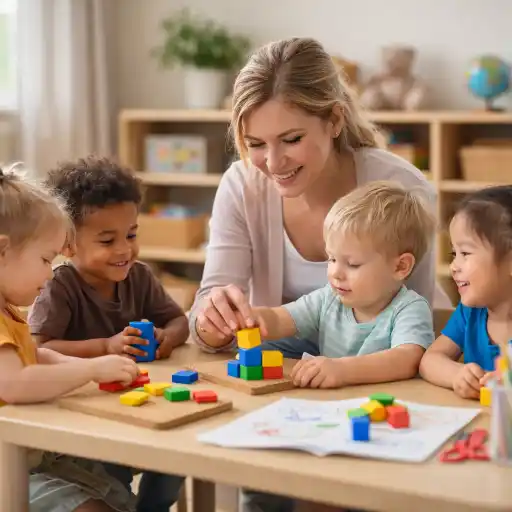
Play is not separate from readiness; it is one of the primary contexts in which readiness develops. The ChildCareEd discussion of play-based readiness emphasizes that dramatic play, blocks, games, movement, and open-ended materials support language, problem-solving, self-control, and social competence more meaningfully than worksheet-heavy instruction.
Embed intentional practice into predictable routines:
- Arrival: invite children to locate belongings, greet peers, and follow a visual routine.
- Read-alouds: preview one or two words, ask an open question, and invite children to retell or act out a part of the story.
- Snack: count portions, compare amounts, practice opening containers, and encourage children to request assistance.
- Transitions: provide warnings, use songs or picture cues, and assign helper roles.
- Centers: offer blocks, dramatic play, art, writing materials, puzzles, books, and manipulatives that encourage collaboration and sustained attention.
- Outdoor play: provide opportunities for running, hopping, balancing, climbing, and negotiating shared games.
Protect at least one sustained play period whenever possible. Teachers can extend learning with brief prompts: “How could you make the bridge stronger?” or “What might your character need next?” The adult’s role is to scaffold thinking without taking control of the play.
How Can Programs Partner With Families and Schools?
Families are children’s first and most enduring teachers. Effective partnership is two-way: providers share observations and practical ideas, while families contribute knowledge about language, culture, strengths, routines, and priorities. A policy brief from the Boston College Center for Child and Family Policy identifies family engagement as a key component of quality early care and education.
Programs can make transition support concrete:
- Share a short, strengths-based checklist covering academics, social-emotional development, motor skills, and self-help.
- Send one practical home idea each week, such as reading for ten minutes, counting steps, or practicing coat fasteners.
- Offer materials in families’ preferred languages and communication formats.
- Invite families to ask questions about school routines, enrollment, transportation, meals, and orientation.
- Arrange classroom visits, photograph books, or conversations with receiving kindergarten teachers when possible.
- Share relevant learning information with appropriate consent and according to program policy.
Use calm, specific language: “We see that Amira enjoys stories and remembers details. We are helping her follow two-step directions; what works well at home?” This approach avoids judgment and turns families into collaborators.
For staff who want deeper strategies for read-alouds and family-supported literacy, Reading Aloud and Storytelling  Buy Now $16.00 offers focused professional learning that can strengthen daily language routines.
How Should Providers Observe, Document, and Respond to Concerns?
Assessment should help teachers understand children and plan responsive support. Maryland’s Ready 4 Kindergarten system, for example, describes assessment across social foundations, language and literacy, mathematics, and physical well-being and motor development, including observations in natural settings. The NAEYC article Assessment in Kindergarten: Meeting Children Where They Are similarly cautions against relying on inflexible, one-time measures, especially for dual language learners.
A low-burden process works well:
- Choose two or three individualized targets, such as using more descriptive language, waiting for a turn, or managing a backpack.
- Record brief, objective observations across activities and settings.
- Try targeted supports for two to four weeks, such as visuals, simplified directions, modeling, peer support, or additional practice.
- Share patterns and strengths with the family, asking what they observe at home.
- If concerns persist, recommend discussion with the child’s pediatrician or a qualified developmental professional and follow local referral procedures.
Possible reasons to act promptly include regression, persistent communication concerns, significant difficulty participating despite consistent support, or concerns across multiple settings. Screening is not a diagnosis and should never be used to define a child’s potential. For professional development on observation, screening, and documentation, explore Developmental Screening in Early Childhood Buy Now $16.00.
Avoid common pitfalls: comparing children publicly, assuming bilingual development indicates delay, waiting because kindergarten is months away, or treating a checklist as a pass-fail test.
Conclusion: What Does Meaningful Kindergarten Readiness Look Like?
Meaningful kindergarten readiness means helping children enter a new learning community with growing confidence, communication, self-regulation, physical competence, curiosity, and everyday #skills. It does not require children to master every academic task or perform identically. The most effective programs build readiness through warm relationships, purposeful #play, predictable routines, rich language, movement, independence practice, and responsive observation.
For immediate program improvement, choose one routine to strengthen this week, such as a dialogic read-aloud, a visual transition sequence, or a self-help station. Then select two or three individual goals, document small gains, and share those successes with families. Consistent, joyful practice is more powerful than pressure.
In short, the answer to “How can child care programs build meaningful kindergarten readiness?” is to prepare the whole child while strengthening the connections among children, families, educators, and schools. With thoughtful planning and early support, every child can be welcomed as a capable learner.
Frequently Asked Questions
- Does a child need to read before kindergarten? No. Letter awareness, rhymes, vocabulary, storytelling, comprehension, and interest in books are more appropriate foundations than fluent reading.
- How long should families practice at home? Short, enjoyable routines of about 5–15 minutes are often more sustainable than long drills.
- What if a child speaks more than one language? Observe communication across languages, consult the family, and recognize home-language development as an asset.
- When should a provider suggest screening? Discuss persistent patterns, regression, or limited progress after appropriate supports with the family; state requirements vary - check your state licensing agency.
- What training can support staff implementation? Relevant options include Social Foundations and Responsive Classrooms Buy Now $24.00, Supporting Children’s Independence Buy Now $24.00, and the readiness training linked above.
- CDA Preschool Credential with Portfolio Review
- Reading Aloud and Storytelling
- CDA Family Child Care Credential with Portfolio Review
- CDA Bridge Bundle: Family Child Care without Portfolio Review
- Are They Ready for Kindergarten?
- CDA Bridge Bundle: Infant/Toddler without Portfolio Review
- CDA Bridge Bundle: Preschool without Portfolio Review
- Creating Engaging and Meaningful Learning Experiences
- Texas Director Credential
- CDA Certification en Español: Recursos y Consejos para Educadores Bilingües
- Ready, Set, Kindergarten!
- What Skills Really Matter for Kindergarten Readiness (and Why Worksheets Aren't the Answer)?
- How can we prepare preschoolers for kindergarten success?
- What Kindergarten Readiness Skills Do Children Need?
- What Kindergarten Readiness Skills Should My Program Build?
- How Does Guided Play Build School-Ready Skills in New York Preschoolers?
- How can we prepare children for the transition to kindergarten in New York?
- How can we best prepare preschool children for kindergarten?
- How can child care programs build strong readers before kindergarten?
- How can preschool programs best prepare children for kindergarten?
- How Can Preschool Programs Best Prepare Children for Kindergarten?
- Is Your Child Ready for Kindergarten? A Kindergarten Readiness Checklist
- How to Become a Kindergarten Teacher in Texas: Which Certification Path Should You Choose?
- Is My Preschooler Ready for Kindergarten? Milestones Beyond ABCs and 123s
- How Can Child Care Programs Build Meaningful School Readiness?
- How Can Child Care Programs Build Meaningful Kindergarten Readiness?
- How Can Teachers Support Children Starting Kindergarten This Fall?
- What Should a 5-Year-Old Know Before Kindergarten?
- What Should Child Care Providers Prioritize When Preschool Readiness Goals Compete for Time?
