Starting kindergarten can feel exciting, uncertain, and surprisingly demanding for young children and their families. Teachers can make the transition more manageable by strengthening children’s independence, social-emotional skills, language, and confidence through everyday routines; for deeper professional learning, explore Are They Ready for Kindergarten? Buy Now $35.00, which helps providers translate whole-child readiness into practical classroom support. For a broader overview of the preschool-to-kindergarten transition and ways to support families, see Transitions to Kindergarten.
Why Does the Kindergarten Transition Deserve Intentional Support?
Kindergarten is more than a change of classroom. For many children, it is their first experience with a larger school community, longer routines, unfamiliar adults, new peers, and increased expectations for communication and self-management. Families may also be navigating registration, transportation, meals, supplies, health forms, and uncertainty about what “ready” means.
A strengths-based approach begins by asking: What does this child already do well, and what support will help the child participate more independently? Children develop unevenly. One child may confidently tell stories but need help with coat fasteners; another may recognize letters but need coaching during group play. Both children deserve responsive, joyful preparation.
- Protect play and relationships as central learning contexts.
- Practice routines in brief, repeated moments rather than through pressure.
- Share children’s strengths and support strategies with families.
- Coordinate with receiving schools whenever possible.
Which Skills Should Teachers Prioritize Before Kindergarten?
Teachers should address the whole child rather than focus narrowly on worksheets, letter drills, or early reading performance. NAEYC describes readiness as including personal care, motor coordination, emotional expression, self-regulation, communication, and foundational academic learning. These domains are interconnected: a child who can ask for help, manage belongings, and recover from frustration is better able to engage with literacy and mathematics.
Useful priorities include:
- Language and literacy: listening to stories, answering questions, retelling events, learning vocabulary, noticing print, and playing with rhymes and sounds.
- Early mathematics: counting meaningful objects, sorting, comparing quantities, recognizing patterns, and using spatial language.
- Social-emotional development: taking turns, joining cooperative play, naming feelings, asking for assistance, and practicing calming strategies.
- Independence: washing hands, using the toilet, managing clothing, opening familiar containers, carrying a backpack, and cleaning up.
- Motor and attention skills: drawing, cutting, manipulating small materials, moving safely, balancing, and participating briefly in group experiences.
Teachers can use a simple observation-based planning tool: select two or three individual goals, identify the support needed, and review progress regularly. Avoid presenting goals as a test. The purpose is to guide responsive teaching and help families notice growth.
How Can Daily Routines Build Kindergarten Confidence?
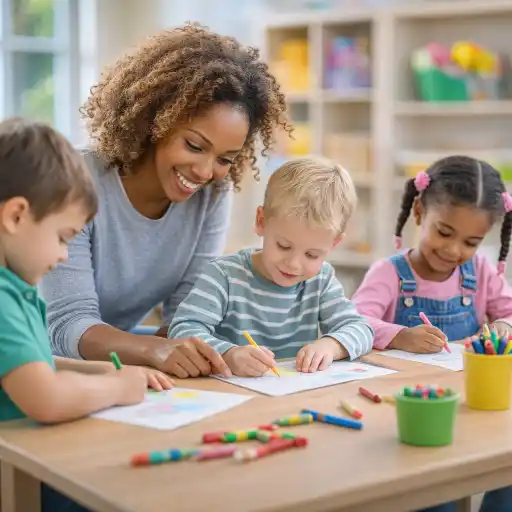
Readiness develops most naturally when practice is embedded in the classroom day. Predictable routines reduce cognitive load and help children understand what comes next. They also create repeated opportunities to exercise #independence, communication, attention, and self-regulation.
- Arrival: Use photographs or symbols to show where children place belongings, greet an adult, and choose an opening activity.
- Read-aloud: Ask children to predict, describe character feelings, explain unfamiliar words, and retell one part of the story.
- Snack: Invite children to count portions, compare amounts, open containers, and request help appropriately.
- Transitions: Give a brief warning, offer a song or helper role, and point to the next activity on a visual schedule.
- Learning centers: Provide blocks, dramatic play, writing materials, puzzles, books, art, and manipulatives that encourage collaboration and sustained engagement.
- Outdoor play: Include running, jumping, balancing, climbing, and cooperative games to strengthen motor development and regulation.
🌱 Keep practices short, playful, and consistent. A two-minute backpack routine repeated daily may be more effective than a long lesson offered once. Teachers can also role-play common kindergarten experiences, such as lining up, carrying a lunch tray, finding a restroom, or asking an unfamiliar adult for assistance. The goal is familiarity—not perfect performance.
For additional support with predictable routines, transitions, and classroom organization, consider Every Moment Matters: Schedules and Transitions  Buy Now $55.00.
How Can Teachers Partner With Families and Schools?
Families are essential partners because they know the child’s routines, language, culture, strengths, sensory preferences, and ways of coping with change. According to Head Start guidance on family engagement, responsive collaboration can support children’s confidence and strengthen family involvement during the kindergarten year.
Make partnership concrete and accessible:
- Send a one-page readiness guide that balances social-emotional, self-help, motor, language, and early academic skills.
- Ask families how they prefer to communicate and provide information in their home languages when possible.
- Share one manageable home activity at a time, such as reading for ten minutes, counting steps, or practicing a zipper.
- Invite families to orientation, open houses, school visits, or virtual photo tours.
- Ask families what helps their child manage separation, noise, transitions, or unfamiliar settings.
- With appropriate consent, share strengths, successful strategies, and relevant developmental information with receiving educators.
Teachers can also contact local kindergarten staff to compare routines, vocabulary, expectations, and support systems. Visits in both directions are valuable: preschool teachers learn what children will encounter, while kindergarten teachers gain insight into children’s early learning experiences. Administrative details matter as well. Remind families to verify enrollment deadlines, transportation arrangements, health requirements, and school-specific information. State requirements vary - check your state licensing agency.
For focused professional learning in culturally responsive family collaboration, explore Engaging Families for Child Success Buy Now $55.00.
How Should Teachers Support Children With Diverse Needs?
Every child deserves a transition plan that reflects individual abilities, communication styles, culture, language, and support needs. Children with disabilities, developmental differences, anxiety, sensory sensitivities, or emerging language skills may benefit from additional predictability and collaboration. Dual language learners should not be viewed through a deficit lens; their home languages are assets that can support identity, communication, and learning.
Practical supports may include:
- Using visual schedules, first-then language, gestures, and concrete demonstrations.
- Providing extra time to respond and multiple ways to communicate.
- Practicing routines in smaller steps before combining them.
- Offering a quiet space as a voluntary regulation option, never as punishment.
- Using familiar books, photographs, objects, and songs to build continuity.
- Coordinating with families, early intervention providers, special educators, and school teams with consent.
Observation should guide support. Record what happens, when it happens, what the child appears to need, and which strategies help. Avoid assumptions based on a single incident or on bilingual development. If concerns persist across settings, or if a child loses previously acquired skills, speak with the family promptly and follow local referral procedures. Developmental screening is not a diagnosis; it is one tool for deciding whether further conversation or evaluation may be useful.
Professional learning such as Developmental Screening in Early Childhood Buy Now $16.00 can strengthen staff understanding of screening, documentation, and collaboration.
What Common Mistakes Should Programs Avoid?
Even caring, committed programs can unintentionally create stress during the transition. Reviewing common pitfalls helps directors and teachers adjust their approach.
- Overemphasizing academics: Balance early literacy and mathematics with play, movement, relationships, self-help, and emotional development.
- Using long readiness checklists: Offer a short, strengths-based guide with practical next steps rather than a pass-or-fail list.
- Waiting until summer: Begin conversations and routine-building early, then increase preparation gradually as kindergarten approaches.
- Assuming one transition fits all: Individualize supports for children attending different schools, children with disabilities, and dual language learners.
- Communicating only one way: Use conversations, phone calls, translated materials, visual information, and flexible meeting options.
- Sharing concerns without strengths: Begin with what the child enjoys and can do, then describe a specific skill to keep developing.
Directors can create a simple program-wide action plan:
- Identify local receiving schools and points of contact.
- Schedule at least one school connection or kindergarten visit when feasible.
- Choose three shared readiness messages for staff and families.
- Provide teachers with visual supports and routine-practice ideas.
- Review observations and family feedback before the school year ends.
Small, coordinated steps protect children from unnecessary pressure while giving adults a clear role. The transition should feel like an extension of secure relationships and meaningful learning—not a sudden demand to perform.
Conclusion: How Can Teachers Help Children Start Kindergarten With Confidence?
Teachers support children starting kindergarten by preparing the whole child through warm relationships, purposeful #play, predictable routines, rich language experiences, movement, self-help practice, and responsive observation. The strongest transition plans connect children, families, early learning programs, schools, and community resources.
Start with one manageable improvement this week: add a visual arrival routine, practice opening lunch containers, conduct an interactive read-aloud, or invite families to share a calming strategy. Document small gains and celebrate them. Children do not need to be perfect on the first day; they need trusted adults who recognize their abilities and help them approach something new with courage.
Key takeaways:
- Readiness includes social-emotional, communication, motor, self-help, and early academic development.
- Short, repeated routines are more supportive than high-pressure drills.
- Families should receive clear information and be treated as knowledgeable partners.
- School collaboration creates continuity and reduces uncertainty.
- Early observation and referral support children whose needs require additional planning.
With intentional preparation and compassionate partnership, teachers can help every child enter kindergarten feeling welcomed, capable, and ready to keep learning.
Frequently Asked Questions
- Does a child need to read before kindergarten? No. Enjoying books, understanding stories, learning vocabulary, noticing print, and playing with sounds are more appropriate foundations than fluent reading.
- How much should families practice at home? Short, enjoyable activities of approximately 5–15 minutes can be effective when they fit naturally into daily routines.
- What if a family is worried that their child is not ready? Listen empathetically, share specific observations and strengths, and identify one or two practical skills to practice together.
- How can teachers support dual language learners? Honor the home language, use visuals and gestures, provide opportunities for communication, and collaborate with families about language development.
- When should a teacher recommend screening? Follow local procedures when concerns persist, appear across settings, involve regression, or significantly limit participation despite consistent classroom supports.
- Moving About the Classroom: Effective Transitions for Everyday
- Lesson Planning for Preschoolers
- Mental Health in Early Childhood
- CDA Home Visitor Subject Area 3 Part 3 Birth to 5
- CDA Home Visitor Subject Area 2 Part 3 Birth to 5
- CDA: A Closer Look at Assessments
- Are They Ready for Kindergarten?
- Emergent Learning & Development
- Creating Environments that Nurture Growth and Community
- Supporting Children's Independence
- Keeping Our Youngest Students Safe: The Vital Importance of Pediatric First Aid and CPR Training for Teachers
- CDA Certification en Español: Recursos y Consejos para Educadores Bilingües
- Ready, Set, Kindergarten!
- 💛🧩 ¿Cómo puedo hacer que mi enseñanza sea inclusiva para los niños con autismo?
- Cómo Celebrar el Día Nacional del Kindergarten
- How can we prepare preschoolers for kindergarten success?
- Kindergarten Readiness Checklist for Preschool Teachers and Parents
- What Kindergarten Readiness Skills Do Children Need?
- Grants and Free Resources for New Kindergarten Teachers
- Can California’s Universal TK Expansion Make the Early Learning Pipeline Stronger?
- What Kindergarten Readiness Skills Should My Program Build?
- What Does Washington’s Early Learning Expansion Mean for Infants, Toddlers, and Working Families?
- How can we prepare children for the transition to kindergarten in New York?
- How Can Child Care Programs Best Prepare Little Ones for the Kindergarten Transition?
- How can preschool programs best prepare children for kindergarten?
- How Can Preschool Programs Best Prepare Children for Kindergarten?
- How Can Child Care Programs Build Meaningful School Readiness?
- How Can Child Care Programs Build Meaningful Kindergarten Readiness?
- How Can Teachers Support Children Starting Kindergarten This Fall?
- How Can Child Care Providers Support Kindergarten Emotions on the First Day of School?
