Handwashing is a simple, affordable, and highly effective way to promote healthier habits in early childhood programs. This article provides practical, classroom-ready activities and program-level strategies that help young children learn the five essential handwashing steps and apply them throughout their daily routines. Directors and providers will find engaging demonstrations, room-setup tips, staff coaching language, family partnership ideas, and consistent routines that are easy to teach, supervise, and maintain. To strengthen these practices, explore ChildCareEd’s Shoo, Germs! Don’t Bother Me!  Buy Now $24.00, which helps providers teach children about germs and healthy hygiene habits, and Prevention and Control of Infectious Diseases Buy Now $16.00, which covers everyday practices for reducing the spread of illness in childcare settings. Remember that state requirements vary, so always consult your state licensing agency when developing or updating health and hygiene procedures.
Why it matters:
1) Fewer illnesses: Teaching reliable hand hygiene reduces gastrointestinal and respiratory infections and lowers absenteeism (see CDC guidance for schools and ECE settings as part of CDC Clean Hands).
2) Lifelong independence: Early practice builds children’s ability to care for themselves at school, home and in the community (see ChildCareEd’s overview in Handwashing for kids: fun ways to teach it).
3) Practical prevention: Handwashing is an easy, evidence-based layer of protection that complements cleaning and illness policies (Health and safety refreshers; CCOHS).
Key hashtags in this article: in your #handwashing routine with #children in the #classroom to support #hygiene and #health.
What quick activities teach proper handwashing to young children?
Providers need short, repeatable activities that make an invisible risk visible and keep practice playful. Try these classroom-ready ideas (all easy to repeat):
- 🔬 Glitter or GloGerm demo: Apply a tiny bit of glitter lotion or use a GloGerm kit to show how "germs" travel. Let children wash once quickly and again using the full routine so they see the difference (described in multiple GloGerm reports and ChildCareEd activities).
- 🧪 Pepper + soap experiment: Float pepper in water and show how soap repels the pepper. This dramatizes how soap works, a staple in ChildCareEd's activity lists (Wash, Scrub, Shine!).
- 📚 Step-card sequencing: Make five picture cards—Wet, Soap, Scrub, Rinse, Dry—and have children put them in order. Then practice at the sink.
- 🎵 Song + micro-stories: Use a 20-second song (two rounds of "Happy Birthday") or a 20-second micro-story while children scrub; ChildCareEd suggests simple sink-side stories to time scrubbing (Handwashing for kids).
- 🧴 Job roles & repetition: Rotate roles such as "Soap Captain" or "Rinse Helper" so children feel ownership. Praise effort—"I see you scrubbing between fingers—great!"
Practical tips:
- Use repeatable language: the five short steps (wet, lather, scrub, rinse, dry) make coaching fast and consistent (CDC family guidance).
- Keep supplies ready: step stools, easy soap pumps, paper towels, and posters help independence (ChildCareEd).
How can teachers build handwashing into daily routines and the physical classroom?
Routine + environment = habit. Design the daily flow and physical space so handwashing is expected, easy, and brief. Follow these steps to build a repeatable, staff-friendly plan:
- 🕘 Pick 5–7 key times to wash and post them by sinks: arrival, before food, after toileting/diapering, after outdoor or sensory play, and after coughing/sneezing. ChildCareEd suggests a short posted schedule so children and families know when to wash (Handwashing for kids). For easy, low-prep outdoor activities you can pair with these routines (and then practice washing hands afterward), try quick group options like making and flying paper airplanes; see our
- for simple methods suitable for young children.
- 🚰 Make sinks reachable: step stools, stable footings, and lever or push faucets reduce rushing. Place soap and paper towels within easy reach.
- 📋 Use visual cues: A 5-step poster or picture sequence near each sink reminds children and reduces staff prompts.
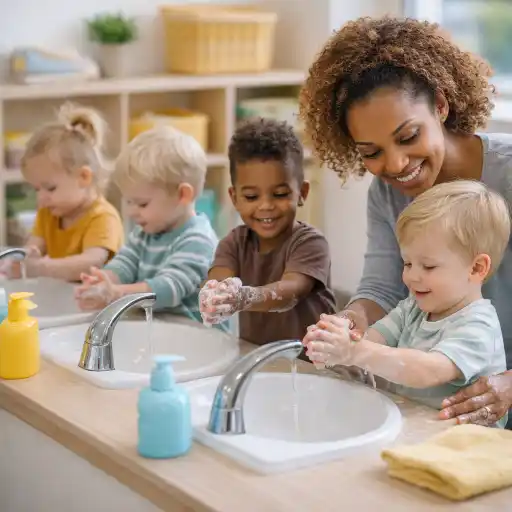 Minnesota MDH and ChildCareEd offer printable posters and step guides (MN Dept. of Health).
 - 🧯 Provide supplies and placement: liquid soap, paper towels, and a supervised sanitizer (60%+ alcohol) where sinks are not available—placed out of young children's reach when unsupervised—are consistent with CDC school guidance.
- 📅 Schedule practice: build a short whole-group handwashing practice into the week so children and new staff can watch and learn without the pressure of schedules.
Why classroom design matters:
1) Accessibility cuts refusal: children who can reach sinks and see the steps are more likely to do the full routine.
2) Visibility supports staff: posters and step-cards reduce repeated verbal prompts, which saves time across the day. For printable resources and posters to post, see ChildCareEd posters Buy Now $0.00 and MN Dept. of Health materials (MN MDH).
How do we teach technique, timing, and supervision so habits stick?
Technique + timing + adult modeling = habit formation. Use these evidence-based coaching strategies drawn from public health and early childhood resources:
- ⏱️ Teach the five steps: Wet • Lather • Scrub (20 seconds) • Rinse • Dry. Keep the wording the same each time so children internalize the pattern (CDC).
- 🎶 Time with a song or story: Singing two rounds of "Happy Birthday" or a 20-second micro-story helps young children meet the scrub time (ChildCareEd).
- 👩🏫 Model behavior: Children imitate adults. Staff should wash their hands visibly and narrate what they do. Invite children to wash with a teacher to practice steps side-by-side.
- 🔍 Use demonstrations: GloGerm or glitter experiences show where germs hide and why scrubbing under nails and between fingers matters (see GloGerm examples and ChildCareEd glitter demos).
- 🧑🤝🧑 Supervise and scaffold: Younger children and those with special needs need adult help. The CDC emphasizes supervision for children under 6 when using hand sanitizer (CDC).
Coaching language (short and kind):
- "Soap on—scrub to the song!"
- "Nice work getting between your fingers—one more big scrub!"
- "We wash to keep our friends healthy. Thanks for helping!"
Products and safety notes:
- Use plain liquid soap—antibacterial soaps aren’t required in most ECE settings (CCOHS).
- Hand sanitizer with at least 60% alcohol is a useful backup when sinks aren’t available, but it does not remove dirt and is less effective on visibly soiled hands (CDC).
How can providers partner with families and avoid common mistakes?
Families are key partners in habit-building. Use short, consistent messages and tools that travel between home and program.
- 📣 Share one short list: Send a small card with the five steps and the key times to wash (arrival, before food, after toileting, after outdoor and sensory play). ChildCareEd suggests sending the same class song home so families can reinforce timing (Handwashing for kids).
- 🏠 Model at drop-off: Invite caregivers to wash with their child at arrival or send home a 2-line script: "We wash hands before snacks—will you practice this at home?"
- 📚 Offer family activities: Share quick home experiments like the glitter germ demo and an easy song. Links to printable posters and MN/CDC resources help families learn the same language (MN Make Hand Washing a Healthy Habit; CDC).
- 🛑 Common mistakes (and fixes):
- 🚫 Rushing the scrub step — Fix: use the same song or timer every time.
- 🚫 Treating sanitizer as a full substitute — Fix: keep sanitizer as a backup and prioritize soap/water after toileting or when hands are dirty.
- 🚫 Changing routines too often — Fix: pick one set of words and one song and use them consistently.
- 🚫 Returning mouthed toys to shelves uncleaned — Fix: enforce the "Wash Me" bin and a daily cleaning plan.
- 🤝 Communicate kindly: Use a three-step script at drop-off—acknowledge concern, state observation, point to the policy. This keeps conversations short and respectful (ChildCareEd guidance on family communication).
FAQ (short)
- Q: Can sanitizer replace soap and water? A: No—soap and water are best. Use sanitizer when sinks aren’t available and supervise young children (CDC).
- Q: How long to scrub? A: About 20 seconds—two rounds of "Happy Birthday" is an easy cue (CCOHS).
- Q: What products are OK? A: Plain liquid soap and paper towels; sanitizer should be 60%+ alcohol and used under supervision (CDC).
- Q: Who enforces rules? A: Licensing and health departments set rules. State requirements vary - check your state licensing agency.
Conclusion
1) Pick a short, consistent plan: 5 key times, 5 simple steps, and one timing cue that staff and families use. 2) Make the sink area easy to use with step stools, clear pictures, soap and towels. 3) Use playful demos (glitter/GloGerm, pepper/soap, step cards, songs) to make the invisible visible and to practice technique. 4) Tie handwashing to cleaning, diapering, and illness policies so it supports broader infection control (see ChildCareEd and CDC materials linked above).
These steps take small daily time investments from staff, but they produce big returns: fewer illnesses, steadier attendance, and children gaining independence. You’re creating a culture where handwashing is expected, practiced, and shared between program and home. For printable posters, short lesson plans, and further training resources, see ChildCareEd’s handwashing pages (Handwashing for kids; Wash, Scrub, Shine!) and your local public health guidance. State requirements vary - check your state licensing agency.
- Early Emotional Wellness
- Emergent Learning & Development
- Balancing Physically Active Play in Child Care
- Birth to Five CDA Credential with Portfolio Review
- CDA Bridge Bundle: Family Child Care without Portfolio Review
- CDA Bridge Bundle: Infant/Toddler without Portfolio Review
- CDA Bridge Bundle: Preschool without Portfolio Review
- Building a Healthier Tomorrow: Preventing Childhood Obesity
- Wellness in Action: Teaching Healthy Habits to Children
- Balancing Active Play in Child Care
- National Nutrition Month #HealthConscious #LivingHealth
- CDA Certification en Español: Recursos y Consejos para Educadores Bilingües
- 🧼Band-Aids, Germs & Giggles: Why Basic Health & Safety Training Is a Big Deal in Child Care
- Cómo Celebrar el Día Nacional del Kindergarten
- Which Oklahoma Farms and Ranches Offer Preschool Field Trips That Teach About Animals and Community?
- How can child care programs keep children healthy every day?
- How Can We Create a Healthy Childcare Environment?
- How can New York childcare programs help children in the concrete jungle fall in love with nature?
- How Can Early Childhood Programs Encourage Healthy Habits?
- Celebrando la amistad en el cuidado infantil durante el Día de los Mejores Amigos
- Canciones, juegos y preguntas de círculo para niños
- How Can Minnesota Child Care Programs Build A Strong Handwashing And Hygiene Routine?
- Which Handwashing Activities Best Help Young Children Build Healthy Habits?
- How can group child care programs effectively prevent the spread of illness?
- How can child care programs build healthy hygiene habits?
- Health and Safety Training: 7 Everyday Habits That Protect Children in Care
- How Can Child Care Providers Build Healthy Habits for Young Children?
- Why Doesn’t a Handwashing Reminder Alone Close Germ-Control Gaps in Child Care?
