Positive guidance is a way teachers help young children learn how to behave. It focuses on teaching skills, not shaming. When teachers use positive guidance, the room feels safer, children learn more, and staff feel less stressed. This article gives simple steps you can use tomorrow. You will see ideas for preventing problems, what to do in the moment, how to plan for hard-to-change behaviors, and how to team with families and staff. Remember: state requirements vary - check your state licensing agency.
Why it matters:
- 😊 Children who feel safe try new skills and learn better.
- 📉 Staff who use consistent steps feel calmer and stay longer at work.
- 🤝 Families join in when the program is kind and clear.
Use these big ideas in your #classroom: build warm relationships, set clear limits, teach replacement skills, and use consistent routines for our #children. When teams use steady #guidance, we support better #behavior and stronger partnerships with #families. For practical help, see Creating a Positive Learning Environment and What Positive Behavior Guidance Strategies Actually Work?
How can we stop problems before they start?
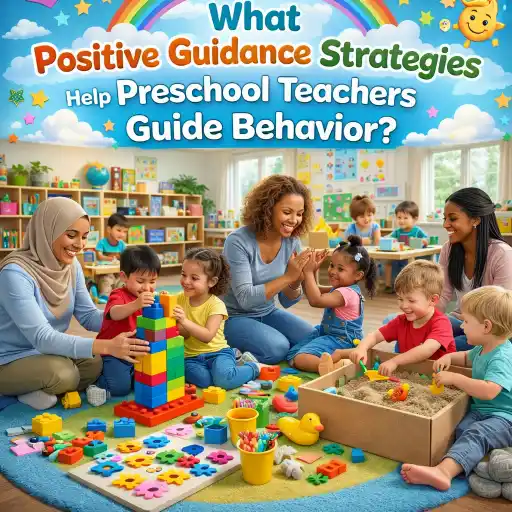
Prevention is the most powerful step. Small changes in the room and day prevent many meltdowns. Try these simple steps. Pick 1–2 to try this week and watch for change.
- 😊 Make the day predictable: post a picture schedule at child height and give a 2-minute warning before transitions. See ideas at ChildCareEd: Creating a Positive Learning Environment.
- 📚 Arrange clear centers: label areas for blocks, art, quiet reading with photos so children know where to go.
- ⏱️ Balance activity and calm: mix active play and quiet time. Add short movement breaks so children can burn energy.
- 🧩 Keep crowding low: limit how many children use a center at once. Fewer kids = fewer fights.
- 🔁 Teach 3–5 simple rules with pictures and practice them often (example: "Hands are for helping").
These prevention steps follow the Pyramid Model and proven classroom practices. For research and tools that back this up, see the Pyramid Model resources at the National Center for Pyramid Model Innovations and practical tips at What Positive Behavior Guidance Techniques Work in Child Care?.
What should I do in the moment when a child acts out?
- 🧘 Stay calm and get near. Bend down, keep a soft voice, and breathe with the child.
- 📣 Name the feeling: say one short label like "You’re mad" or "You seem sad." Words help children learn feelings.
- ⛔ State the limit: use one clear sentence: "Hands are for helping. Hitting hurts."
- 🔁 Teach one replacement skill: offer a choice or calm step (deep breaths, ask for a turn, use a break card).
Use ABC thinking (Antecedent-Behavior-Consequence) to notice patterns. For quick support scripts and examples, see What Positive Behavior Guidance Strategies Actually Work? and tips on in-the-moment responses in What Positive Behavior Guidance Techniques Work in Child Care?. If the situation is about safety or repeats often, follow your center policy and document the behavior. State requirements vary - check your state licensing agency.
When is it time for a behavior plan or Positive Behavior Support (PBS)?
- 👥 Build a team: include teachers, family, director, and any mental health or special education consultants.
- 🔍 Observe and collect data: use short ABC notes to find what leads up to the behavior and what the child gains from it.
- 🧠 Find the function: decide whether the child seeks attention, avoids tasks, gets toys, or something else.
- 🛠️ Plan prevention: change the classroom or routine to make the problem less likely.
- 📘 Teach skills: teach turn-taking, asking, calming, or other replacement skills with practice and praise.
- ✅ Change responses: make sure the behavior no longer works for the child and praise the new skill.
For the PBS process and tools, see the National Center for Pyramid Model Innovations PBS overview and CSEFEL materials on team planning and behavior support at CSEFEL What Works Brief. ChildCareEd also outlines practical steps in What Positive Behavior Guidance Strategies Actually Work?.
How can we work with families and our team without blame?
Good work with families is short, kind, and focused on strengths. Try this quick family-team routine. Keep notes brief and share one small plan to try for a week.
- 🤝 Start with a strength: say one thing the child does well ("Lola loves blocks").
- 📊 Share one fact: one short observation (time, place, what happened). Keep it objective.
- 🧾 Offer one small plan: "We’ll try a 2-minute warning and teach 'my turn.' What works at home?"
- 🔍 Track progress: use simple notes and meet to tweak steps weekly or monthly.
Use restorative language to repair trust after rough moments. Restorative practices help teams focus on harm and repair instead of blame; see the CDC overview on restorative practices at CDC: Restorative Practices. For family collaboration examples and scripts, ChildCareEd has practical guides at What Positive Behavior Guidance Strategies Actually Work?.
Conclusion — Quick checklist to try this week
- 😊 Post a picture schedule and give a 2-minute warning at transitions.
- 📋 Teach one replacement skill (ask for a turn, deep breaths) and practice it in circle time.
- 🧘 Use the 4-step calm response (calm, name, limit, teach) every time.
- 🤝 Send one short family note: strength + fact + one small plan to try for a week.
- 🔍 If behavior repeats, collect ABC notes and form a team to try PBS steps.
For quick training and deeper study, see ChildCareEd courses like Viewing Guidance in a Positive Light  Buy Now $24.00 and Staying Positive: Guidance for Preschoolers Buy Now $24.00. You are not alone. Small, steady steps help teachers, children, and families feel safer and more confident.
- CDA Home Visitor Subject Area 3 Part 3 Birth to 5
- Guiding School-Aged Children
- Power of Art: Bldg Self-Esteem & Positive Behavior for ALL Abilities
- Teach with Respect!
- Our School Age Family Tree: Children, Staff, & Parents
- CDA Bridge Bundle: Family Child Care without Portfolio Review
- CDA Bridge Bundle: Infant/Toddler without Portfolio Review
- CDA Bridge Bundle: Preschool without Portfolio Review
- Staying Positive: Guidance for Preschoolers
- ¿Cuál es la Diferencia Entre la Crianza Respetuosa y la Crianza Permisiva?
- Ejemplos de Crianza Respetuosa vs. Crianza Permisiva
- How can preschool teachers use simple classroom management techniques that really work?
- Classroom Management in Preschool: Simple Strategies That Work
- How can DC early childhood educators use simple classroom management tips in busy preschool rooms?
- What Positive Guidance Strategies Help Preschool Teachers Guide Behavior?
- How Can Early Childhood Programs Teach Social-Emotional Learning Effectively?
- How can preschool programs teach social-emotional learning effectively?
- How to Manage a Preschool Classroom with Confidence
- How Can Child Care Directors Make Inclusive Practices Consistent Across Every Classroom?
- Why Do Classroom Management Strategies Fail With 3-Year-Olds—and What Works Instead?
- Preschool Classroom Rules: How to Teach Expectations Without Constant Reminders
- Toddler Classroom Management Strategies for the 5 Hardest Parts of the Day
- What Are 10 Positive Guidance Strategies Every Child Care Teacher Should Know?
- When a Child Refuses to Follow Directions, What Should Teachers Do?
- Why Is My Toddler Screaming in Daycare, and What Can Teachers Do?
- How Can New Teachers Learn Children’s Names Without Turning It into a Memory Test?
