Toddler development training helps teachers and directors know what to watch for, how to teach helpful skills, and how to work with families. This short guide explains simple, practical steps you can use right away. It is written for busy child care leaders and staff who want clear guidance that fits real classrooms.
Why it matters:
1) Early identification helps children get support sooner. The CDC Watch Me! training explains why spotting delays early changes outcomes for kids. When providers know milestones, they can share clear observations with families and doctors.
2) Training builds team confidence and reduces stress. When staff know what to look for and how to respond, the classroom runs smoother and children learn more. Use short tools and checklists so tracking is fast and consistent.
Key words to remember: helping your #toddlers meet #milestones through focused #training, good #observation, and strong partnerships with #families.
1) What should a toddler development training include?
- 🧭 Clear milestones: Teach common toddler skills (language, social, motor, thinking). Use resources like the CDC milestone lists for 2-year-olds (Milestones by 2 Years) and practical lists on ChildCareEd.
- 🔎 Observation & screening basics: Show how to watch, note, and use brief checklists. Link training to simple tools so staff can do monitoring every day. The CompSAT guidance explains ethical observation and documentation.
- 🛠 Practical strategies: Include quick teaching moves for language, motor play, and behavior. See posts on motor skills and language from ChildCareEd and Promoting Language Development.
- 🤝 Family partnership and referral steps: Teach how to share observations kindly and when to refer. Remind staff: state requirements vary - check your state licensing agency.
- 📚 Follow-up tools: Provide checklists, short videos, and quick practice sessions (15–30 minutes) so staff can keep skills fresh. The CDC resources for educators are helpful.
2) How do providers use observation and screening without overloading staff?
- 📁 Pick one short tool: Use a milestone checklist or the CDC Milestone Tracker app so staff can note growth during routine activities (CDC milestones).
- 📝 Teach staff to record 1–2 short observations per child each week (brief notes or photos). This builds a helpful record without long forms. ChildCareEd offers free PDFs on observing and recording development (Nurture Me resources).
- 😊 Make it team-based: Use short team huddles (5–10 minutes) to share any concerns. When everyone uses the same language, families get clearer information.
- 🔁 Use screening at key times: Know your program or state screening schedule. Minnesota’s recommended instruments list shows good choices if you use formal screening (MN Dept. of Health).
- 📞 Know referral steps: If staff notice a worry, practice a short script to share with families and suggest next steps (doctor visit, referral to early intervention). The CDC Watch Me! Module 1 teaches how to communicate with families.
3) What classroom strategies should training teach for real toddler moments?
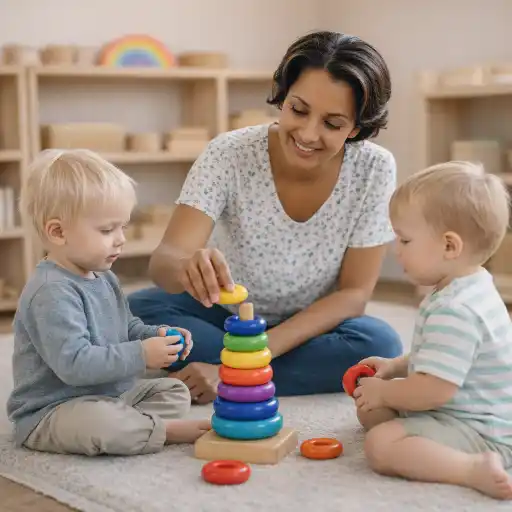
Training should give simple, teachable moves staff can use every day. Focus on prevention, teaching, and teamwork.
- 🎯 Prevention routines: Teach predictable schedules, picture cues, and short transitions. These reduce upset times and make learning easier. Manitoba’s best practices for guiding behavior has helpful, classroom-ready tips (Manitoba guide).
- 🗣 Language in the moment: Train staff to label actions, expand child speech, and ask simple questions during play. ChildCareEd’s language post gives practical phrases for daily use (Promoting Language Development). For hands-on activity examples and short lesson ideas to build a language-rich environment, see the A Taste of Words training for practical strategies and classroom prompts.
- 🤸 Motor-rich learning: Use short active games, obstacle paths, and manipulatives to build gross and fine motor skills. See creative ideas in the ChildCareEd motor skills post (How motor skills shape development).
- 🧡 Positive behavior guidance: Teach the 4-step calm response (stay calm, name feeling, state limit, teach replacement). ChildCareEd offers scripts and prevention steps that staff can practice (Positive Behavior Guidance).
- 🔄 Practice with role-play: Use short role-play drills in staff meetings so everyone uses the same words. Small rehearsals build consistency and confidence.
4) How do we avoid common mistakes and work well with families?
Common mistakes are easy to fix if training includes these parts.
- 😵 Mistake: Inconsistent responses across staff. Fix: Teach 1–2 short scripts and practice them in staff meetings. Use the same wording when talking with families.
- 😓 Mistake: Long lectures during upset moments. Fix: Train the 4-step calm response (calm, name feeling, limit, teach) so staff act quickly and teach a new skill.
- ⚠️ Mistake: Waiting too long to refer. Fix: Train staff to use brief ABC notes (Antecedent-Behavior-Consequence) and to consult early when a behavior repeats or affects learning. The CSEFEL/DEC guidance explains prevention and when to add supports.
- 🤝 Working with families: Start with strengths, share one fact, and offer one small plan to try for a week. ChildCareEd shows sample scripts for family notes and teamwork (What Positive Behavior Guidance Techniques Work).
- 📌 Track training records: Use state tools where available (for example, Tennessee’s TNPAL and TrainTN) so staff credentials and training are easy to verify.
FAQ (quick answers for directors)
- Q: How long should a training be? A: Short modules (15–60 minutes) plus a practice session work best. Repeat often.
- Q: Who should watch for milestones? A: Everyone who works with the child: teachers, assistants, and substitutes.
- Q: When should we refer for screening? A: If a child misses several milestones or loses skills, or if behaviors block learning. Use the CDC checklists to guide conversations.
- Q: Where do I find good tools? A: ChildCareEd free resources, CDC Watch Me! training, and state screening lists (e.g., Minnesota) are great starting places.
- Q: What about licensing? A: State requirements vary - check your state licensing agency for rules about screening and record keeping.
Summary
Toddler development training should be practical, short, and classroom-focused. Train staff to: 1) know key #milestones, 2) use simple #observation habits, 3) teach language, motor, and behavior strategies, and 4) partner with #families for referrals. Use trusted resources like ChildCareEd articles and CDC materials (Watch Me!) to build your program’s plan. Small, steady practice makes big differences for children and your team.
Good training is short, hands-on, and focused on real classroom tasks. Include these parts:Make monitoring simple and part of the day. Use easy steps your team can do without extra hours.- 45 Hour Child Growth and Development
- 45 Hour Preschool Methods and Materials
- 45 Hour Infant and Toddler Methods and Materials
- CDA Bridge Bundle: Family Child Care without Portfolio Review
- CDA Bridge Bundle: Infant/Toddler without Portfolio Review
- CDA Bridge Bundle: Infant/Toddler
- 45-Hour Infant and Toddler Curriculum
- Texas Director Credential
- Infant and Toddler Trainings
- Navigating Michigan's Child Care Crisis through a Rewarding Career Change with ChildCareEd
- Invest in Your Skills, Invest in Children: ChildCareEd Training for Michigan Providers
- 😫🧸 ¿Qué hacer cuando un bebé no quiere dormir la siesta en el aula?
- Cómo usar tu certificación de 90 horas en Maryland para completar tu CDA
- ¿Cuáles son los pasos, requisitos y opciones en línea para la certificación de 90 horas en cuidado de Infantes/Toddlers en Maryland?
- Regulaciones de Licenciamiento de Cuidado Infantil en California para Centros y Hogares de Cuidado Infantil Familiar
- Cómo Trabajar en el Cuidado Infantil en California: Requisitos y Pasos
- Cómo Ser Maestra de Preescolar en Maryland
- Capacitación Previa al Servicio para Proveedores de Cuidado Infantil en Dakota del Norte
- Capacitación Previa al Servicio para Proveedores de Cuidado Infantil en Virginia
- Cómo Ser Maestra de Preescolar en Virginia
- What should Toddler Development Training teach child care providers?
- What should toddler development training teach my staff?
- Online CDA Classes: A Flexible Path Toward Your CDA Credential
- Where Can You Get Your CDA Online? Start Your Credential with ChildCareEd
- 45 Hour Infant and Toddler Certification: Is 45 Hours Enough to Be a Lead Teacher in Maryland?
- How Can Child Care Providers Support Healthy Toddler Development?
- How Can Child Care Providers Support Infant and Toddler Development?
