Busy DC preschool rooms need simple, practical ideas that work right away. This short guide gives clear steps for directors 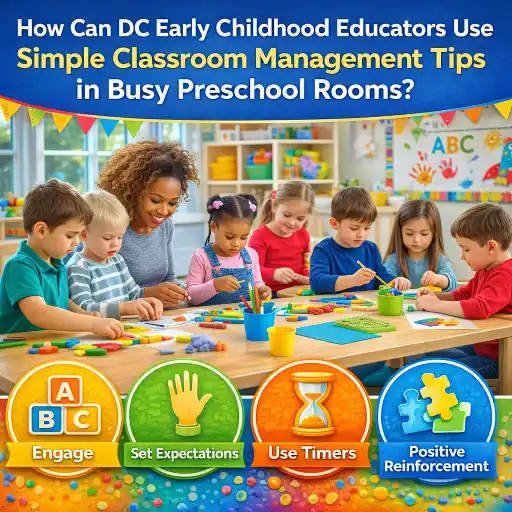 and teachers who have little time but big hearts. You will find quick routines, room set-up tips, ways to guide behavior with respect, and steps to bring families and staff together. Keep your #routines and #visuals clear, organize your #centers to reduce conflict, teach #behavior as a skill, and keep families (#families) in the loop for better results.
Why does classroom management matter in a busy DC preschool?
Key reasons it matters (short list):
- 😊 Children feel safe: routines reduce worry and help kids join in.
- 🔧 Teachers teach more: fewer disruptions mean more learning time.
- 🤝 Families see progress: consistent practices at school and home help children grow.
Practical note: small steps often work best in busy rooms. Also, state requirements vary - check your state licensing agency. For a quick plan you can use with staff, try ChildCareEd's course ideas like Classroom Management is Collaboration!  Buy Now $16.00.
What simple routines and signals can teachers use right now?
Try this short teaching plan every day:
- 🔹 Say it: Name the routine (example: “Walking feet”).
- 🔸 Show it: Model the action yourself or with a puppet.
- 😊 Practice it: Let children try with a quick role-play or song.
- 👏 Praise it: Give specific praise right away ("Thanks for walking, Ana!").
Use a visible picture schedule at the child's eye level and offer small individual cards for children who need them. Use simple cues for transitions: a 2-minute warning, a song, or a visual timer. These small routines cut down on running, pushing, and crowding. For printable visuals and more scripts, see ChildCareEd's visual schedule resources.
How can room layout and labeled centers reduce behavior problems?
Try these setup steps (easy to change):
- 📚 Define centers: blocks, art, books, sensory, and quiet. Label with pictures.
- 📏 Keep traffic lanes open: move shelves so kids don’t run across the room.
- 🧰 Duplicate favorites: put the same toy in two areas to avoid fights.
- ⏱️ Use rotation cues: timers, helper charts, or songs make turns fair.
- 🛋️ Add a calm corner: soft light, feelings chart, a comfy seat for settling.
For staff planning, try a simple zoning chart activity like 'Zoning to Maximize Learning' Buy Now $0.00 and presenter notes at Presenter Notes Buy Now $0.00. Small room moves—labels, shorter shelves, clear bins—can change the flow and lower conflict quickly.
How do I guide challenging behavior and partner with families and staff?
Positive guidance teaches skills instead of only stopping behavior. Use data, short scripts, and team plans. ChildCareEd's guides on positive guidance share useful steps: How Can Positive Guidance Improve Classroom Management. For more on focused behavior plans and training, see Turning Behavior Around for Toddlers and Preschoolers Buy Now $25.00.
Follow this team approach:
- 🔎 Observe: Note when and where behaviors happen (simple ABC notes).
- 🗣️ Use scripts: short, calm statements that all adults use the same way.
- 🔁 Teach replacement skills: show the child what to do instead (ask, wait, share).
- 🤝 Partner with families: share one positive and one concern with a plan.
- 👩⚕️ Get help early: consult mental health or special ed if needed.
Use program-wide frameworks when helpful: the Pyramid Model links to PBIS for early childhood; see Linking the Pyramid Model and PBIS. For children with attention needs, the CDC gives classroom strategies that pair well with these steps: CDC: ADHD in the Classroom. For practical accommodations, assessment tips, and classroom adaptations for children with special needs (including ADHD), see Children with Special Needs. Remember: state requirements vary - check your state licensing agency.
Conclusion — What can you try this week?
Try one small change and watch the difference. Quick checklist to try this week:
- 👏 Pick 1 rule (three words or less), make a picture poster at child height, and teach it with the 4-step plan above.
- 📌 Label one center and add a simple rotation cue (timer or song).
- ✉️ Send one positive note or photo to a family before Friday.
Common mistakes and how to avoid them:
- 🚫 Too many rules — fix: keep 3–5 and teach them well.
- 🚫 Posting rules but not practicing — fix: role-play and model daily.
- 🚫 Different adults say different things — fix: agree on short scripts in staff meetings.
- 🚫 Blaming children instead of changing the environment — fix: look for room hot spots first.
FAQ (short):
- Q: How long to teach a routine? A: Short daily practice; small repeats help most.
- Q: What if one child needs more help? A: Use a simple individual plan and involve family and consultants early.
- Q: When to ask for outside help? A: If behavior is intense, ongoing, or stops learning, get support.
- Q: How to keep calm? A: Use scripts, take short breaks, and lean on teammates—your calm helps kids calm down.
For more printable tools, scripts, and courses, start with ChildCareEd resources like Effective Classroom Management Strategies for Preschool Teachers and Classroom Management in Preschool. You are doing important work—small, steady steps make a big change. #routines #visuals #centers #behavior #families
Room layout is a quiet helper. When centers are clear and materials are easy to find, children make better choices, and conflict drops. ChildCareEd explains center ideas and room plans in pieces like Classroom-tested strategies and Classroom Management in Preschool. Why it matters: Good classroom management helps children feel safe and lets teachers teach more. When days are predictable, children play and learn better, and staff feel less stressed. For helpful overviews and practical ideas you can use, see Effective Classroom Management Strategies for Preschool Teachers and classroom-tested tips at Classroom-tested strategies. Routines help children know what comes next. Teach only a few short rules (3–5) and practice them often. CSEFEL's brief on routines shows how pictures and step-by-step practice help children follow daily tasks: CSEFEL What Works Brief #3. ChildCareEd also gives ready-to-use tips for teaching routines: How can preschool teachers use simple classroom management techniques that really work?
- 45 Hour Child Growth and Development
- CDA Preschool Credential
- CDA Preschool Credential with Portfolio Review
- Birth to Five CDA Credential with Portfolio Review
- CDA Bridge Bundle: Family Child Care without Portfolio Review
- CDA Bridge Bundle: Preschool without Portfolio Review
- Texas Director Credential
- CDA: Communication: Keep It Simple
- CDA Certification en Español: Recursos y Consejos para Educadores Bilingües
- Cuáles Son las Señales de Alerta en el Desarrollo Infantil que Todo Educador Debe Conocer?
- 👶 ¿Cuáles son las proporciones y grupos requeridos en Dakota del Norte? 🏫
- Recursos en Español sobre el Sueño Seguro del Bebé
- 10 Ejemplos de Cómo la Cultura Influye en el Desarrollo Infantil
- Proporciones de Cuidado Infantil y Tamaños de Grupo por Edad en Maryland (Guía Rápida para Centros y Hogares)
- Retraso del Habla en la Guardería: Cómo Pueden Ayudar los Proveedores
- Cómo Trabajar en el Cuidado Infantil en Carolina del Norte: Requisitos y Pasos
- Cómo Ser Maestra de Preescolar en Illinois
- Cómo Ser Maestra de Preescolar en Maryland
- What Should DC Early Childhood Teachers Know About Pay Equity Right Now?
- How can DC early childhood educators keep classrooms safe in busy urban child care settings?
- How can DC early childhood educators use simple classroom management tips in busy preschool rooms?
- How can DC child care programs keep kids safe outdoors from insects, wildlife, and bites?
- How do ChildCareEd's urban childcare courses help Michigan providers in high-density communities?
- Will DC’s Early Childhood Educator Pay Equity Fund Survive?
- After DC Early EdX 2026: Why Do Early Educator Mental Health and Advocacy Matter More Than Ever?
- Celebrando la amistad en el cuidado infantil durante el Día de los Mejores Amigos
- Cómo simplificar la capacitación para sus empleados de daycare
- ¿Todos los niños deben participar en el tiempo de círculo?
