Setting clear limits helps children feel safe and learn what to expect. This short guide is for New York child care providers and directors. It gives simple steps you can use right away to set limits that teach skills, keep everyone safe, and include families and staff. You will see easy ideas for preventing problems, what to say in the moment, how to team with families, and when to get extra help. Remember: state requirements vary - check your state licensing agency.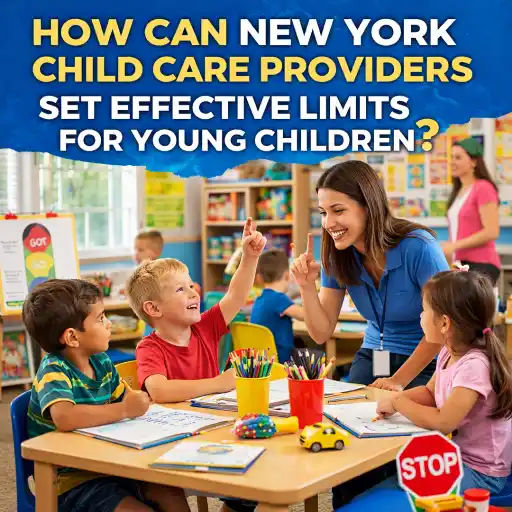
Why it matters:
1) Children learn faster when they feel safe and know the rules.
2) Clear limits lower conflict and help staff feel calmer.
3) Families trust programs that use kind, consistent guidance. Use small steps and build from there. See practical tools and scripts on ChildCareEd: What Positive Behavior Guidance Techniques Work?.
What are simple, effective limits I can set in my New York child care program?
- 😊 "Hands are for helping."
- 📋 "Walking feet inside."
- 🎯 "Use kind words."
Make limits that fit your room and children’s ages. Put rules near centers (blocks, art, snack). Use photos of your children, following the rules,s so they see familiar examples. For more prevention ideas, read ChildCareEd: What Positive Behavior Guidance Strategies Actually Work?.
Use these prevention steps each day:
- 📅 Post a simple picture schedule and give a 2-minute warning before switches.
- 🧩 Arrange clear play zones and label shelves with photos.
- ⏱️ Mix active and quiet times so children can move often.
- 🔁 Offer two safe choices to reduce power struggles.
Keep it brief and repeat. Practice the rules with role-play and songs. For New York training options and CEUs, see ChildCareEd: Courses in New York. And remember: state requirements vary - check your state licensing agency for local rules.
How do I teach and reinforce limits so children actually learn them?
- 🧠 Teach: Show the rule with a short script and demo. Example: "Hands are for helping. Watch me show gentle hands."
- 🎭 Practice: Role-play at circle time. Let children try asking for a turn or using calm words.
- 👏 Catch and praise: Tell children what they did right ("You used gentle hands—thank you").
- 🔁 Remind: Give quick reminders before transitions ("2 minutes until clean-up").
When a child is upset, use calm, short steps. The CDC gives clear time-out steps but also suggests cooling and coaching first; see CDC: Steps for Effective Time-Outs. Many programs prefer a Time-In (stay with the child to help calm) because it teaches skills. ChildCareEd explains how to respond calmly and teach replacement skills in What Positive Behavior Guidance Techniques Work?. Because biting and hitting are common developmental behaviors, review why they happen and practical classroom and family response strategies in our overview at Are biting and hitting normal in children?.
Short script you can use in the moment (practice with staff):
- 📣 Name the feeling: "You look upset."
- ⛔ State the limit: "Hands are for helping. Hitting hurts."
- 🔁 Offer a replacement: "You can ask, ‘My turn, please’ or squeeze this ball."
- 👏 Praise soon after: "I like how you asked for a turn."
Keep adult talk short when kids are upset. For more scripts and word-for-word phrases, review ChildCareEd: Positive Discipline Strategies.
How do I work with families and staff so limits stay consistent?
- 🤝 Start with a strength: "Marco loves blocks." This builds trust.
- 🤝 Family engagement for child success: For staff who want to strengthen how they communicate with families about behavior and limits, ChildCareEd's Engaging Families for Child Success
 Buy Now $55.00 is a 6-hour online course covering strength-based communication, family partnership strategies, and how to deliver observations and plans in ways that build trust — directly supporting the strength-plus-fact-plus-plan notes and family follow-up steps described throughout this article.
 - 📊 Share one short fact: time, place, what happened (keep it factual).
- 🧾 Offer a tiny plan: try the same 2-minute warning and the same calm phrase for a week.
- 🔍 Check in: set a short follow-up (3–7 days) to see progress.
Use short written notes that say: strength + fact + plan. ChildCareEd provides sample scripts and family communication tips in "What Positive Behavior Guidance Techniques Work?" and "Positive Discipline Strategies." The National Pyramid Model resources at the NCPMI Resource Library also offer family engagement ideas.
Train staff together so everyone uses the same short scripts. Practice in staff meetings and role-play tough moments. This reduces burnout and keeps your #classroom calm. If you need formal training or coaching, ChildCareEd lists local courses and resources for New York at ChildCareEd: Courses in New York.
What common mistakes should I avoid, and when should I get extra help?
Common mistakes and how to avoid them:
- ❌ Inconsistency across staff — fix: pick 1–2 scripts and practice them weekly.
- ❌ Long lectures during meltdowns — fix: keep words short and calm.
- ❌ Shaming language — fix: name the behavior, not the child ("Hitting hurts" not "You’re bad"). See ChildCareEd: Managing without shame.
- ❌ Waiting too long to involve families or specialists — fix: call a team meeting early and use simple data notes.
When to get more help:
- 📈 Behavior is frequent, severe, or causes injury.
- 👥 The child is not learning skills after consistent practice.
- 🔔 Staff feel unsafe or very stressed (watch for burnout).
Collect simple ABC notes (Antecedent-Behavior-Consequence) to find patterns. The CDC describes behavior concerns and when to seek evaluation at CDC: Behavior or Conduct Problems. For crisis prevention and safe de-escalation training, consider Therapeutic Crisis Intervention (Cornell). The National Pyramid and ChildCareEd resources can help you make a team plan; see NCPMI and ChildCareEd guidance.
🧠 Behavior observation and positive guidance: To help staff identify behavior triggers and respond consistently with calm, skill-building strategies, ChildCareEd's The ABCs of Behavior: Turning Challenges into Learning Opportunities Buy Now $55.00 is a 6-hour online course that teaches the Antecedent-Behavior-Consequence framework in a practical, classroom-focused way — giving your whole team a shared language for the ABC note-taking, scripted responses, and limit-setting steps outlined in this guide.
FAQ (quick answers):
- Q: How many rules? A: 3 simple rules work best for young children.
- Q: Time-Out or Time-In? A: Time-In (calm coaching) often teaches skills better; use Time-Out only as part of a full safety plan — see CDC Time-Out steps.
- Q: How long to wait for a change? A: Measure small wins over weeks, not days.
- Q: Where to find New York training? A: See ChildCareEd: Courses in New York and local OCFS or licensing supports. State requirements vary - check your state licensing agency.
Conclusion
Setting effective limits is simple when you keep rules short, teach them often, and work with families and staff. Try these quick actions this week:
- 📌 Post 3 picture rules near centers and practice them once a day.
- ⏰ Add a 2-minute warning at transitions for a whole week.
- 🗣️ Use a short, calm script in the moment (name feeling, state limit, offer choice).
- 🤝 Send one short family note
You are doing important work. Small, steady steps help children learn and make your program calmer and safer. For more tools, scripts, and training, visit ChildCareEd resources such as What Positive Behavior Guidance Techniques Work? and the NCPMI library at NCPMI. Remember: state requirements vary - check your state licensing agency.
Limits work best when everyone uses the same words and steps. Use a short, respectful routine with families and your team.Limits are short rules that kids can understand and follow. Pick 3 rules and show them with pictures at child height. Examples: Teaching limits means showing, practicing, and praising. Use tiny lessons and practice often. Follow these steps:
- 45 Hour Child Growth and Development
- 45 Hour Preschool Methods and Materials
- Mastering Supervision: Keeping Children Safe in All Settings
- Bienvenido! Welcoming All Families
- Pediatric RSV First Aid & CPR/AED
- CDA Bridge Bundle: Family Child Care without Portfolio Review
- CDA Bridge Bundle: Infant/Toddler without Portfolio Review
- CDA Bridge Bundle: Preschool without Portfolio Review
- Texas Director Credential
- Wellness in Action: Teaching Healthy Habits to Children
- Empowering Early Childhood Education: NYAEYC
- How Can Childcare Educators Thrive in the Big Apple?
- CDA Council's Early Educators Leadership Conference
- CDA Certification en Español: Recursos y Consejos para Educadores Bilingües
- 🔍 ¿Qué ves cuando observas a un niño aprender?
- Regulaciones de Licenciamiento de Cuidado Infantil en California para Centros y Hogares de Cuidado Infantil Familiar
- Proporciones de Cuidado Infantil y Tamaños de Grupo por Edad en Maryland (Guía Rápida para Centros y Hogares)
- Proporciones de Cuidado Infantil y Tamaños de Grupo por Edad en Nueva Jersey (Guía Rápida para Centros y Hogares)
- Proporciones de Cuidado Infantil y Tamaños de Grupo por Edad en Virginia (Guía Rápida para Centros y Hogares)
- Horas de Capacitación Anual para Proveedores de Cuidado Infantil en Maryland
- Cómo Celebrar el Día Nacional del Kindergarten
- Can grants and vouchers in New York help child care providers?
- Why Does Punishment Backfire With Young Children?
- How can New York child care providers set effective limits for young children?
- Canciones, juegos y preguntas de círculo para niños
- Cómo simplificar la capacitación para sus empleados de daycare
- What Does New York's Health Care Plan Requirement Mean for Your Program?
- How can New York providers host effective parent-teacher conferences?
- What Does the CoComelon Debate Mean for Providers — How Should We Manage Screen Time for Toddlers?
- Do You Need a Family Day Care Registration or Group Family Day Care License in New York?
