Children with special needs learn best when we make the day clear, kind, and full of chances to try. This article gives practical steps for child care providers and directors in #California who want to use simple tools: play, pictures, and positive words. You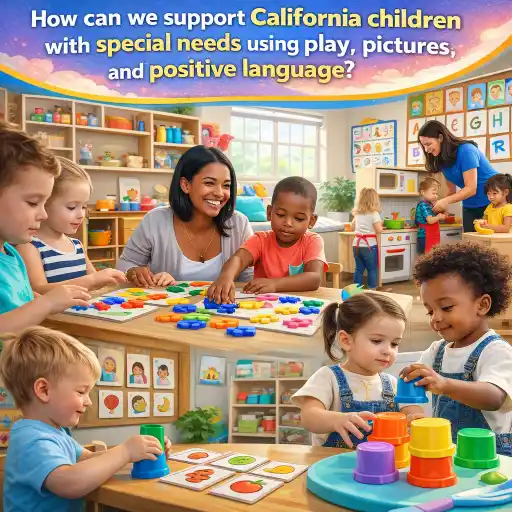 will find quick ideas you can try today, links to helpful resources (many from ChildCareEd), and tips on working with families and local agencies. Remember: state requirements vary - check your state licensing agency.
How can play help children with special needs in my classroom?
- 😊 Use short, guided play steps: 1) show the toy or game, 2) model how to play, 3) let the child try, 4) celebrate the attempt. Repeat often.
- 📋 Set up play zones: a calm book corner, a cozy block area, and a sensory table. Label zones with pictures and simple words so children find them easily—see visual ideas at ChildCareEd visuals Buy Now $0.00.
- 🎯 Adapt toys: use big crayons, chunky puzzles, or trays to keep pieces together. For movement, offer simple obstacle courses or heavy-work jobs (carry a basket) to help regulation—ideas in Adapting Activities.
- 🤝 Pair peers: choose kind buddies to model play. Peer support helps with social skills and belonging. Research and practice support this approach as part of inclusive care; see Inclusive Care Strategies.
Tip: Keep play brief and predictable. Small wins matter—each success grows confidence. Use your observations to make small changes and track progress. For more on early intervention and why acting early helps, read Early Intervention Strategies.
How can pictures and visual schedules reduce stress and build independence?
- 😊 Choose one format: wall chart, pocket chart, personal flip book, or a photo on a clipboard. Keep it at child eye level and change with Velcro or magnets. ChildCareEd explains easy steps in How Can Visual Schedules Help.
- 📷 Use real photos when possible: a photo of the actual sink, cubby, or teacher helps a child match pictures to places and routines.
- 🔁 Teach with practice: model checking the schedule, give 5- and 1-minute warnings, and let children move the card when an activity is done. Reinforce their checking with praise.
- 🎛️ Adapt level by child: objects, photos, icons, or words. For children with autism, visual supports and video models are powerful; see strategies like those in the DRDP guidance, Using the DRDP with Children with ASD, and visual schedule ideas from Autism Strategies for Teachers. Programs can also connect families and staff to awareness and inclusion materials; see Shining a Light on Autism Awareness Month for practical ideas to promote inclusion and community support.
Common pitfall: too many small pictures or too much text. Keep 6–8 main parts of the day for young children. Use color coding for quiet vs. active times. Visuals work best when staff and families use the same system—share photos of the schedule with families so they can match routines at home.
How can positive language and simple supports improve behavior and communication?
- 😊 Use short, specific directions: say "Hands on the table" instead of "Stop running." Pair words with gestures and pictures. ChildCareEd’s guidance article has ready-to-use steps: How Can Positive Guidance Improve Classroom Management.
- 📈 Teach and practice social skills: role-play sharing, teach a simple rule set (3 rules), and use praise that names the behavior ("You asked for a turn—thank you!").
- 🛠️ Use visual supports and AAC: picture cards, sign, or simple speech devices help children express needs—see Supporting Communication Buy Now $0.00 and ideas for simple AAC at TalkSense.
- 🔍 Prevent before you respond: set routines, reduce triggers, and offer choices. For behavior planning and data-based supports, use ChildCareEd’s Behavior Support Buy Now $0.00 resources.
Common mistakes and how to avoid them:
- 🛑 Inconsistent wording: train staff to use the same phrases and cues.
- ⚠️ Long group times: shorten circle time and offer movement options.
- 🔁 Missing transitions: give clear warnings and use a First–Then approach.
How do I partner with families and California systems to get the right supports?
Working with families and agencies is the heart of good care. In California, there are many local supports, and saying yes to inclusion often means connecting families to programs and learning together.
- 😊 Start with listening: ask families what works at home and what they worry about. Share simple observations (facts and strengths).
- 📞 Know local resources: link families to Early Start, Regional Centers, or services like Help Me Grow LA. For county supports and professional development, explore local offices such as the Contra Costa County Early Learning Programs.
- 📚 Use California guidance: the state book Inclusion Works! and the MAP newsletters offer local practices and trainings that can help programs say “yes” to inclusion (MAP Aug 2022, MAP Sep 2023).
- 🧭 Get trained and refer: staff trainings like Special Needs: From Referral to Inclusion
 Buy Now $24.00 help teams understand IFSPs/IEPs and ADA expectations. When a child needs more support, follow referral steps and document observations. Remember: state requirements vary - check your state licensing agency.
FAQ (quick):
- Q: When should I refer? A: If concerns are persistent, affect learning or safety, or worry families, start the conversation and consider a referral.
- Q: Can visuals work at home? A: Yes—share photos of your schedule so families match routines.
- Q: What if staff feel unsure? A: Start with short trainings and small coaching steps; ChildCareEd has many free resources.
- Q: Where to find local help? A: Check regional centers, Help Me Grow, county early learning offices, and ChildCareEd links above.
Conclusion: Small, consistent changes make big differences. Use playful routines, clear pictures, and positive language. Partner with families and local California resources to keep learning going. For ready tools and printable visuals, start with ChildCareEd resources linked above and build from one small change today.
Key ideas: #inclusion #visuals #play #communication #California
Positive words teach skills. When teachers use short, calm, and encouraging language, children learn social rules and feel safe. Positive guidance lowers stress for staff and children and helps with #communication. Pictures make the day simple for children who are not yet reading or who process information differently. A clear picture plan lowers anxiety, speeds transitions, and builds #independence.Why it matters: Play builds skills. When children play, they practice talking, moving, solving problems, and making friends. Play is also how young children show what they know. For children with special needs, play can be the bridge to learning and belonging. Using play with purpose helps your whole group and supports #inclusion.
- 45 Hour Child Growth and Development
- CDA Home Visitor Subject Area 3 Part 3 Birth to 5
- 45 Hour Preschool Methods and Materials
- Bienvenido! Welcoming All Families
- Equity in Action with Head Start
- 45 Hour Infant and Toddler Methods and Materials
- Pediatric RSV First Aid & CPR/AED
- Recognize, Respond, Respect: Supporting Diverse Learners
- Texas Director Credential
- CDA Certification en Español: Recursos y Consejos para Educadores Bilingües
- 🔍 ¿Qué ves cuando observas a un niño aprender?
- 💛🧩 ¿Cómo puedo hacer que mi enseñanza sea inclusiva para los niños con autismo?
- ¿Cómo incluir a niños con necesidades especiales en cuidado infantil? Guía práctica y sencilla
- Apoyo en Español para Capacitaciones Grupales Presenciales y por Zoom en Cursos Selectos
- 10 Ejemplos de Cómo la Cultura Influye en el Desarrollo Infantil
- Regulaciones de Licenciamiento de Cuidado Infantil en California para Centros y Hogares de Cuidado Infantil Familiar
- Proporciones de Cuidado Infantil y Tamaños de Grupo por Edad en Nueva Jersey (Guía Rápida para Centros y Hogares)
- Proporciones de Cuidado Infantil y Tamaños de Grupo por Edad en Virginia (Guía Rápida para Centros y Hogares)
- Apoyo en Preescolar para Retrasos del Habla: Estrategias Simples que Ayudan
- Retraso del Habla en la Guardería: Cómo Pueden Ayudar los Proveedores
- Cómo Trabajar en el Cuidado Infantil en California: Requisitos y Pasos
- How can we bring a farmers market and fresh fruit activities to preschoolers in California?
- How can California early childhood educators use inclusive communication strategies for children with special needs?
- How can we support California children with special needs using play, pictures, and positive language?
- How can California early childhood educators communicate respectfully with diverse families?
- How can we celebrate diversity and inclusion in California early childhood classrooms?
- Celebrando la amistad en el cuidado infantil durante el Día de los Mejores Amigos
- Canciones, juegos y preguntas de círculo para niños
- Proporciones para guarderías en casa bajo el Título 22: Cómo la mezcla de edades cambia su capacidad en California
