Curious how short, hands-on science activities can boost curiosity, language, and early reasoning in your program? Try a few quick experiments that honor children’s questions, build #preschool learning routines, and make complex ideas manageable. For a practical next step, consider ChildCareEd’s Building Early Science Foundations  Buy Now $16.00 course — it offers ready-to-use strategies and activity scaffolds you can apply immediately; you may also find the 2-hour Basic Science in Early Childhood Buy Now $25.00 useful for planning one-off investigations and meeting in-service training goals.
What criteria make a science experiment developmentally appropriate for preschoolers?
Developmentally appropriate experiments for ages 3–5 are short, safe, and built to invite questions and repeated trials. Good preschool science is not a lecture; it’s an invitation: a clear question, simple materials, a chance to predict, test, and talk about results. Aim for activities that last 5–20 minutes and use familiar supplies so children focus on #experiments and ideas rather than logistics.
Key features to check before you begin:
- Single-variable focus: test one change at a time so outcomes are meaningful.
- Safe materials: no small choking hazards or strong chemicals; adult-only steps when heat or concentrated substances are needed.
- Repeatable steps so children can try variations and learn persistence.
- Built-in language prompts and simple recording options (drawing, photos, or tally marks).
Why it matters: early science experiences support vocabulary, early math comparisons, and curiosity-driven thinking — all foundations for later school success. For guidance on designing age-appropriate experiments, see ChildCareEd’s practical tips as part of STEM for preschoolers: simple experiments.
Include #STEM intentionally: add counting, measuring, or pattern noticing to strengthen cross-domain learning.
Which simple, low-prep experiments can I do tomorrow that children will love?
Here are classroom-tested, low-cost invitations you can set up in minutes. Each supports prediction, observation, and discussion — the heart of scientific thinking.
- Walking Water (capillary action): three cups, colored water, and folded paper towels — watch color move and mix over time.
- Sink or Float: a tub of water and a mixed collection of safe objects for sorting and tallying.
- Color-Mixing with Droppers: clear cups, primary food coloring, droppers — count drops, predict outcomes, and compare hues.
- Seed Germination in a Cup: clear plastic cups, paper towels, and bean seeds — daily observation and drawing build #observation skills.
- Ramp Races (simple physics): cardboard, blocks, toy cars — test height, surface, or car weight one at a time.
- 🌟 Lava Lamp (density & gas release): water, oil, food coloring, and an effervescent tablet (adult handles tablets) — mesmerizing and ripe for questions.
Short teaching moves: ask “What do you think will happen?” before testing and “What did you notice?” after. Encourage children to try again and change just one thing so they see cause-and-effect. For printable activity ideas (like water-drop counting), explore resources from ChildCareEd’s activity posts and course materials. To add a playful investigation of static electricity, explore activities for National Static Electricity Day.
How do I set up space, materials, and routines to keep experiments both safe and meaningful?
Design a small, consistent discovery area: a tray or low table with clearly labeled materials, a simple rule sign (materials stay on table; no tasting), and hand-washing nearby. Prep the adult steps (measuring solutions, soaking seeds) ahead of time so children get maximal hands-on time. Remember: state requirements vary - check your state licensing agency.
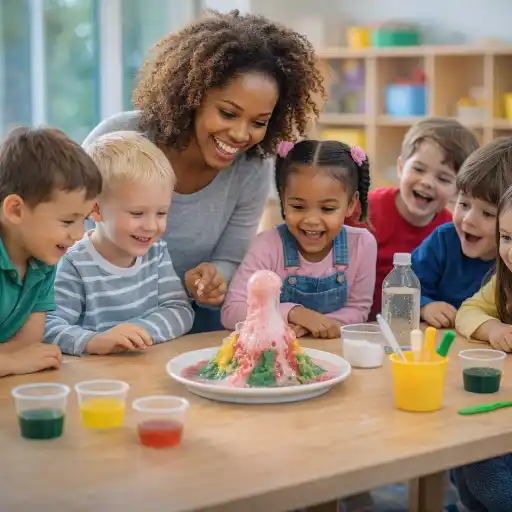
Safety and sanitation guidance is essential in group settings. Follow basic cleaning and sanitizing routines for shared materials; the CDC provides practical cleaning and disinfecting tips tailored to early care settings (CDC: How To Clean and Disinfect Early Care and Education Settings), and keep chemicals, tablets, and heat sources out of reach of children.
Organization checklist:
- Pre-measured materials in small cups or zip bags for quick setup.
- Trays and washable tablecloths for easy cleanup.
- Visual rules and a short group introduction (1–2 minutes) to set expectations.
- Active supervision: position yourself so you can see and hear every child while they experiment.
When you need deeper planning support, consider structured professional learning such as ChildCareEd’s Basic Science in Early Childhood Buy Now $25.00 or Building Early Science Foundations Buy Now $16.00 to align your area, materials, and documentation with best practices.
Keep #safety visible: have an accessible first-aid kit and document procedures for spills or ingestion events in your program plan.
How can I guide inquiry without taking over and make learning visible?
The teacher’s role is to scaffold thinking, not to fix outcomes. Use short, open prompts and pause to wait for children’s responses. Ask “What do you notice?” “How could we test that?” and “What changed?” — these prompts build language and reasoning. Offer small tools for recording: a shared chart, individual drawing pages, or a tablet photo station for pictorial journals.
Practical documentation moves:
- Photo sequence: take 3–5 photos during the experiment and print for a classroom timeline.
- Child voice captions: write a short quote from the child under their photo to preserve thinking.
- Simple data charts: tallies for sink vs float, or a color‑mixing results table where children add a sticker.
- Science journals: short drawings and one-sentence observations collected over days for projects like seed germination.
Documenting learning helps you plan next steps, share progress with families, and demonstrate how #experiments connect to standards and school-readiness goals. If you want to embed science into weekly planning, courses such as Lesson Planning for Preschoolers Buy Now $24.00 and DAP for Preschool Buy Now $24.00 provide practical templates for integrating short investigations into routines.
What common mistakes do providers make and how can they be avoided?
Common pitfalls are easy to fix with small shifts in practice. Here are frequent mistakes and straightforward solutions:
- ❌ Too much adult instruction: instead, set materials out, ask one strong question, and wait for children’s attempts.
- ❌ Testing multiple variables at once: control variables so cause-and-effect is clear—change only one thing at a time.
- ❌ No clear cleanup or routine: plan cleanup steps into the invitation (counting cups, wiping trays) so experiments are repeatable and sustainable.
- ❌ Skipping documentation: take one quick photo and a short handwritten note; small evidence makes learning visible and helps with follow-up.
Troubleshooting quick issues:
- If children lose interest, reduce choices or add a peer partner to re-engage curiosity.
- If materials overwhelm the table, pre-sort into smaller sets so each child tests fewer items.
- If a reaction is too vigorous, model a smaller version for demonstration before letting children try a milder setup.
State requirements vary - check your state licensing agency for any rules about chemical use, sanitation, or record-keeping. Small planning steps and consistent routines keep experiments joyful, safe, and repeatable.
Conclusion: What should I try first, and how can I keep growing my practice?
Start small: pick one short, low-prep experiment (color mixing or sink/float are perfect) and invite a small group. Use one open question, provide hands-on time, document with a photo and a child quote, and follow up with a simple extension the next day. Those small cycles build confidence for you and curiosity for children.
For ongoing professional growth and ready-to-implement lesson materials, explore courses that pair pedagogy with activities: Building Early Science Foundations Buy Now $16.00, Basic Science in Early Childhood Buy Now $25.00, Lesson Planning for Preschoolers Buy Now $24.00, DAP for Preschool Buy Now $24.00, and Enhancing STEM Education for Infants and Toddlers Buy Now $16.00 each offer practical strategies you can adapt to your setting.
Main takeaway: brief, supervised, repeated #experiments done with simple materials build language, reasoning, and excitement for learning. Keep safety and documentation simple, and let children’s questions drive the next steps. You’re ready to make science a regular, joyful part of your #preschool day.
- 45 Hour Child Growth and Development
- Lesson Planning for Preschoolers
- CDA Preschool Credential with Portfolio Review
- Building Equity: Inclusionary Practices in Preschool
- Building Early Science Foundations
- Tomorrow's Einsteins: Infant and Toddler Science
- Art from the Heart for Preschoolers: Open Ended Art Projects that Build Self-Esteem
- Texas Director Credential
- Montessori Cultural Activities: Exploring the World Through Play and Learning
- Boo-tiful Science: Glow-in-the-Dark STEAM Experiments for Mini Mad Scientists
- 💛🧩 ¿Cómo puedo hacer que mi enseñanza sea inclusiva para los niños con autismo?
- 👶 ¿Cuáles son las proporciones y grupos requeridos en Dakota del Norte? 🏫
- 10 Ejemplos de Cómo la Cultura Influye en el Desarrollo Infantil
- Proporciones de Cuidado Infantil y Tamaños de Grupo por Edad en Nueva Jersey (Guía Rápida para Centros y Hogares)
- Proporciones de Cuidado Infantil y Tamaños de Grupo por Edad en Virginia (Guía Rápida para Centros y Hogares)
- Easy Ways to Add STEM to Your Preschool Classroom
- How can I use STEM activities in my Preschool and Pre-K classroom?
- How Do Art Activities Support Cognitive Growth in North Dakota Preschoolers?
- How can Michigan classrooms teach children about the Great Lakes with hands-on science activities?
- Celebrando la amistad en el cuidado infantil durante el Día de los Mejores Amigos
- Canciones, juegos y preguntas de círculo para niños
- How can preschool teachers use simple STEM activities to spark big learning?
- Summer Preschool Activities for Art, Science, and Sensory Play
- How can I build a nature-based curriculum for my New York program?
- How can superhero-themed winter science activities energize your classroom?
- How can we teach preschoolers to ask better questions and make predictions?
- How can simple science experiments transform my preschool classroom?
- STEM for Preschoolers: What to Do When the Experiment Doesn’t Work
