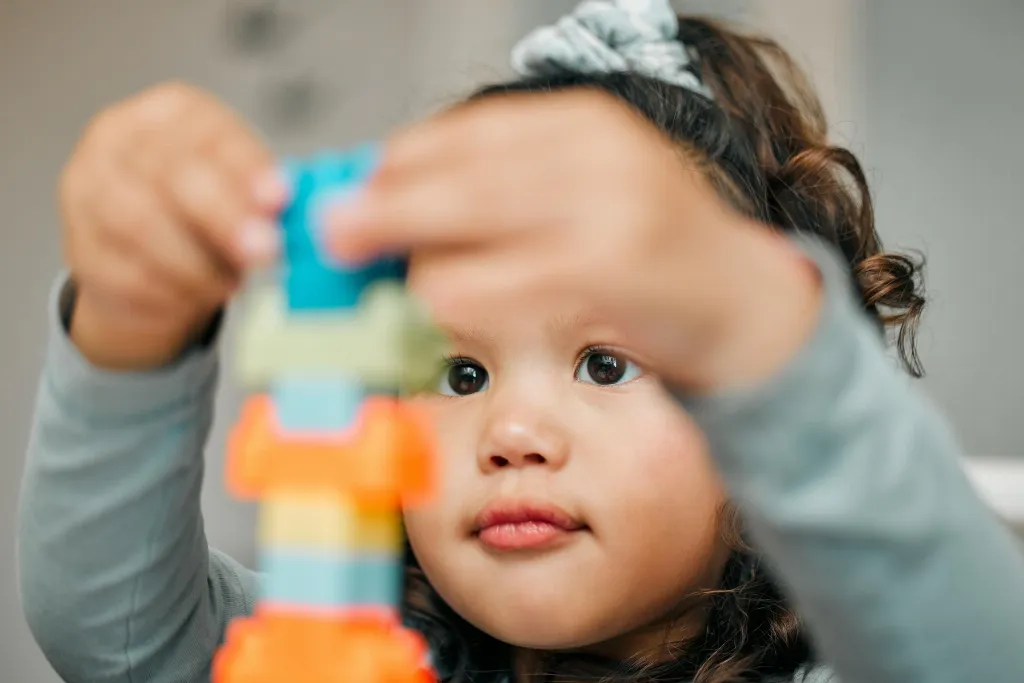
 You see children every day. That makes you one of the best people to notice early differences. Watch for #autism in your #toddlers room. Learn to spot patterns, support families, and start helpful steps like #screening, working with #families, and early #intervention.
Early action gives children a better chance to learn new skills. When we notice early, families can get services fast and children often make more progress. For tools and classroom ideas, check the ChildCareEd guides and courses linked below.
What early signs of autism should I watch for in toddlers?
Watch daily routines and play for repeating patterns. Not every difference means autism. But if several things happen again and again, note them.
- 👀 Social clues
- Does not make steady eye contact or share smiles.
- Rarely points or brings objects to show others.
- Plays alone more than peers.
- 🗣️ Communication clues
- Delayed babbling or talking, or losing words they used to say.
- Repeats words or phrases (echolalia).
- Uses few gestures like waving or pointing.
- 🔁 Behaviors and sensory clues
- Lines up toys or plays the same way every time.
- Strong reactions to sound, touch, or texture.
- Hand-flapping, rocking, or other repeated movements.
- 🧩 Play clues
- Little pretend play or focuses on parts of toys instead of the whole toy.
These practical signs match our ChildCareEd guide on early signs (Early Signs of Autism in Toddlers and Preschoolers) and CDC milestone lists (CDC Developmental Milestones).
How do I document concerns and talk with families without causing worry?
Good documentation and kind communication help families act. Your role is to observe, record, and partner—not to diagnose. Training like CDC's Watch Me modules explains this well (Watch Me! Module 1).
- 📝 Document facts: date, time, setting, who saw it, and a short objective note of what happened.
- Example note: “10/2, circle time, did not look when name called twice; looked at floor instead.”
- 🤝 Start with strengths when you talk with families.
- Say what the child does well, then share specific examples of concerns.
- 🗣 Use neutral language and invite family input.
- Try: “I’ve noticed X a few times. Do you see this at home?”
- 📎 Offer resources and help with next steps (forms, numbers, or visits).
- ChildCareEd has family-friendly handouts and conversation tips (How to Support Families).
Common mistake: waiting too long. If you have repeated observations, share them early. The CDC notes that providers are often the first to spot differences (CDC Screening and Diagnosis).
What steps should I take after spotting signs (screening, referral, classroom supports)?
Follow clear steps so families can get help quickly. Use brief notes, suggest screening, and link to early intervention if needed. Remember: state requirements vary - check your state licensing agency.
- 📑 Keep clear records of what you saw and how often.
- 📞 Talk privately with the family, name strengths first, then share observations with examples.
- 🔍 Suggest screening or a well-child visit. The AAP and CDC recommend autism screening at 18 and 24 months (CDC Screening for ASD).
- ➡️ If screening is positive, families can be referred for a full evaluation and early services. Early intervention (IDEA Part C) serves children under 3; schools serve older children.
- 🧾 Offer to help with calls or paperwork and share local resource links from ChildCareEd (Resources - ChildCareEd).
Screening tools like the M-CHAT are commonly used. If a child screens positive, a specialist team may do an in-depth evaluation (CDC: Clinical Steps).
How can I support the child in my classroom day-to-day?
Small changes often help a lot. Try a few consistent strategies and track what helps. ChildCareEd has many classroom ideas and sensory tips (Sensory Needs).
- 🧭 Predictable routines and visuals
- Use picture schedules and give 2-minute warnings before transitions.
- 🛋 Calm corner and sensory choices
- Provide a quiet spot, headphones, or fidgets. Teach children how to use them.
- 🎯 Break tasks into small steps
- Give clear, simple directions and one step at a time.
- 🤝 Peer support and taught play
- Use buddy play and short, structured group games to teach social skills.
- 📊 Track progress
- Note small gains (new word, joined play) and share them with families and therapists.
For intervention types and classroom-friendly methods, see the CDC treatment overview (CDC Treatment and Intervention) and ChildCareEd's practical classroom guides (Autism Awareness Course  Buy Now $16.00).
Conclusion and FAQ
Summary: You can make a big difference by watching, recording, and partnering with families. Use simple classroom supports while families get screening and services. Early help matters. Consider using our ChildCareEd article on April is Autism Awareness Month to share information with families and plan inclusive classroom activities.
FAQ
- Q: When should I tell a family? A: As soon as you have repeated, documented observations. Be kind and factual.
- Q: Do I diagnose? A: No. You observe and refer. Diagnosis is done by trained specialists.
- Q: Can supports start before diagnosis? A: Yes. Many services, like speech or classroom strategies, can begin earlier.
- Q: Where to learn more? A: Use ChildCareEd articles and CDC materials linked above.
- 45 Hour Child Growth and Development
- 45 Hour Preschool Methods and Materials
- Birth to Five CDA Credential with Portfolio Review
- 45 Hour Infant and Toddler Methods and Materials
- Seeing All of Me: Overview of Autism and ADHD
- 45 Hour School Age Methods and Materials
- Texas Director Credential
- 45 hour Growth and Development Birth-age 12 ONLINE
- Every Moment Matters: Schedules and Transitions
- Shining a Light on Autism Awareness Month
- CDA Certification en Español: Recursos y Consejos para Educadores Bilingües
- 🧩 Primeras señales de autismo en niños pequeños — Qué observar 👀
- 🧩 ¿Cómo puedes hacer que tu aula sea más inclusiva para los niños con autismo?
- 🪁¿Cómo puede el juego apoyar de manera poderosa a los niños con autismo?🧩
- 💛🧩 ¿Cómo puedo hacer que mi enseñanza sea inclusiva para los niños con autismo?
- 🚨 Reporte Obligatorio en Nevada
- Cómo Abrir Una guardería Para Niños Con Necesidades Especiales?
- ¿Cuáles son los pasos, requisitos y opciones en línea para la certificación de 90 horas en cuidado de Infantes/Toddlers en Maryland?
- ¿Qué Preguntas Vienen en el Examen CDA de Nacimiento a los Cinco Años?
- Capacitación en Línea con Certificado sobre Abuso y Negligencia
- Retraso del Habla en la Guardería: Cómo Pueden Ayudar los Proveedores
- Could It Be Autism? Signs to Notice in Toddlers
- Celebrando la amistad en el cuidado infantil durante el Día de los Mejores Amigos
- What should providers expect at different ages and when should they recommend further evaluation?
- Rosh Hashanah Sensory Bin Ideas: Apples, Honey, Shofars, and Sweet New Year Play
- What Should a Teacher Do If They Suspect Autism?
- What Early Signs of Autism May Child Care Providers Notice?
- How Can You Help an Autistic Preschooler Join a Group Game on Their Own Terms?
- How Can Preschool Educators Encourage Learning Through Play?
