Many early childhood providers in North Dakota see toddlers who talk later than others. You can help them every day with warm teaching, simple changes to routines, and good teamwork with families and specialists. This short guide gives easy steps you can use today in your #toddlers room to support #speech and #language growth, partner w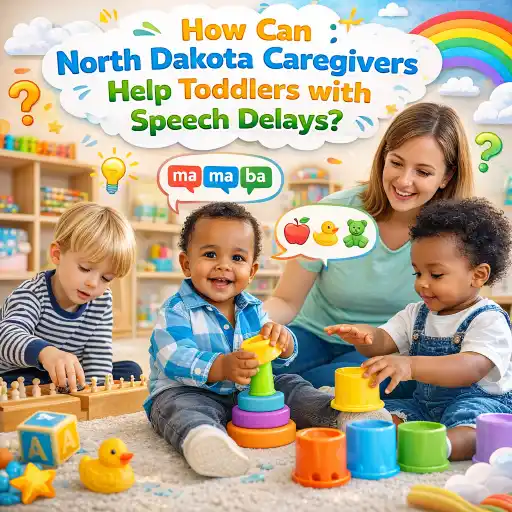 ith #families, and connect to #earlyintervention when needed.
What early signs should I watch for in my classroom?
Knowing the signs helps you notice a pattern fast. Use clear notes and short examples so you can share facts with families or referral teams. Common signs to watch for:
- 🔍 Very few or no words by 12–18 months (limited babbling or few consistent words). See CDC milestone checklists for examples at CDC: Learn the Signs. Act Early.
- ✅ Little vocabulary growth or no two-word phrases by about 24 months. For milestone details, see Milestones by 2 Years.
- 🔎 Speech that is hard for familiar adults to understand by age 3, or heavy reliance on gestures instead of words. The ChildCareEd guide lists classroom signs and tracking tips.
- ⚠️ Loss of words or skills at any age, or frequent ear infections — these are urgent reasons to act and to recommend a hearing check (see Nemours KidsHealth).
Why this matters: when children can’t say what they want, they get frustrated. That can affect play, behavior, and later reading. Early noticing gives us the chance to help before gaps grow. Understanding the sensitive period for language can help caregivers prioritize early, rich language experiences from birth through age six. Keep short, dated notes (exact words used, setting, who understood) — these make referrals faster and more useful (see Speech Delay in Daycare: How Providers Can Help).
What simple classroom strategies work right away?
You don’t need special tools to help. Small routine changes give many chances to practice words. Try these easy strategies from ChildCareEd and SLP tips:
- 📚 Read and label: read a short book each day and name pictures. Repeat key words often (see Language Development Milestones).
- 🗣️ Narrate and parallel talk: describe what you or the child is doing. "You are pouring juice." This links words to action and makes language natural (How to Help Children With Speech Delay).
- ⏳ Pause and wait: ask a question, then count silently to five or ten. Give thinking time so the child can try words.
- 🔁 Model and expand: if a child says "car," respond: "Big car!" (recast the child’s words instead of correcting).
- 🖼️ Use visuals & signs: picture cards, choice boards, and simple signs ("more," "all done") reduce frustration and teach words quickly (Babies and Sign Language).
- 🤝 Peer buddies & small groups: pair a quieter child with a talkative peer during play to create natural practice moments.
Use these supports with the whole group so no child feels singled out. Keep celebrating attempts—every try is progress.
How do I work with families and make helpful referrals in North Dakota?
Families trust you—your tone matters. Use a strength-first, fact-based approach. Steps to partner well:
- 📝 Prepare: gather dated examples (exact words, settings, who understood). Short notes help families and specialists. ChildCareEd shows sample notes and scripts in Supporting Children with Speech Delays in Child Care.
- 🤝 Start with strengths: "I love how Sam points to books—he’s curious." Then share your observation with facts, not labels.
- 💬 Ask about home: "How does Sam talk at home?" Learn the home language and any family goals—remember bilingual children often split words across languages, and that is normal.
- 🌐 Supporting dual language learners: For staff working with bilingual toddlers, ChildCareEd's Building Bridges for Dual Language Learners
 Buy Now $16.00 is a 2-hour online course that helps providers understand typical bilingual language development, avoid common misidentifications, and use strategies that support growth in both languages — directly addressing the dual language learner guidance in the common mistakes section.
 - ➡️ Offer next steps: suggest simple home activities, a hearing check, or contacting the child’s pediatrician. Explain screening and referral options (the CDC explains early intervention and how to find state programs at CDC: Early Intervention resources).
- 📞 Help with referrals: families can call state early intervention directly. Offer to share your notes with permission and to support families while they wait.
Note: state requirements vary - check your state licensing agency. In North Dakota, families may self-refer to Early Intervention; use the CDC and local public health pages to find contact info. If a child has very few words by 24 months, loses skills, or has unclear speech at age 3, suggest a speech-language evaluation (AAFP clinical guidance: Speech and Language Delay in Children).
How do we track progress and avoid common mistakes?
Good tracking and consistent teamwork make referrals and therapy work better. Follow these practical steps:
- 📈 Keep short, dated records: list words the child uses, settings, who understood them, and any changes over time. Even a quick daily line helps.
- 🎥 If allowed, collect short video clips that show attempts to communicate (get family permission first).
- 🔁 Try classroom supports for 4–6 weeks and note changes. Small gains are real gains.
- ✉️ With permission, share concise notes with the family and the SLP or early intervention team. Your classroom examples are powerful evidence.
- 📋 Developmental screening and referral: To build staff confidence in spotting early signs and navigating the referral process, ChildCareEd's Developmental Screening in Early Childhood Buy Now $16.00 is a 2-hour online course covering how to observe, document, and communicate developmental concerns to families and specialists — a direct match for the tracking and referral steps outlined in this guide.
Common mistakes and how to avoid them:
- ❌ Waiting too long. ✅ Fix: Share observations early and offer simple supports while you monitor.
- ❌ Vague notes like "not talking." ✅ Fix: Write exact words, frequency, and who understood.
- ❌ Pressuring the child to say words. ✅ Fix: Model and expand instead of demanding perfect speech.
- ❌ Assuming bilingualism is a delay. ✅ Fix: Support both languages and watch each for growth; see ChildCareEd resources about dual language learners.
If concerns continue, refer to a speech-language pathologist and audiology. Early help improves social skills, confidence, and later reading success (see Early Intervention Strategies and the CDC milestones at CDC Milestones).
Conclusion
You can make a big difference for toddlers with speech delays by noticing patterns, using everyday strategies, partnering with families, and tracking progress. Quick tips to remember:
- 📌 Notice signs early and keep dated notes.
- 📚 Use routine talk, read, pause-and-wait, and visuals every day.
- 🤝 Talk with families kindly, share facts, and offer referral help.
- 📞 Refer when patterns show limited words by 24 months, loss of skills, or very unclear speech by age 3.
Resources you can share right now: ChildCareEd’s practical guides such as Supporting Children with Speech Delays in Child Care, and CDC milestone tools at CDC: Learn the Signs. Act Early. For clinical guidance, see the AAFP review at AAFP and family explanations at Nemours KidsHealth. Remember: state requirements vary - check your state licensing agency and local early intervention contacts. Thank you for the steady, caring work you do every day for young children.
- 45 Hour Child Growth and Development
- Easy Steps to Resume and Interview Success
- Birth to Five CDA Credential with Portfolio Review
- 45 Hour Infant and Toddler Methods and Materials
- Pediatric RSV First Aid & CPR/AED
- CDA Infant/Toddler Credential with Portfolio Review
- CDA Bridge Bundle: Infant/Toddler without Portfolio Review
- 45-Hour Infant and Toddler Curriculum
- Texas Director Credential
- CDA Certification en Español: Recursos y Consejos para Educadores Bilingües
- 👶 ¿Cuáles son las proporciones y grupos requeridos en Dakota del Norte? 🏫
- Proporciones de Cuidado Infantil y Tamaños de Grupo por Edad en Virginia (Guía Rápida para Centros y Hogares)
- Lista para Abrir una Guardería en Casa en Dakota del Norte: Cómo Empezar
- Cómo Ayudar a Niños con Retraso del Habla en el Cuidado Infantil
- Apoyo en Preescolar para Retrasos del Habla: Estrategias Simples que Ayudan
- Retraso del Habla en la Guardería: Cómo Pueden Ayudar los Proveedores
- Cómo Trabajar en el Cuidado Infantil en Carolina del Norte: Requisitos y Pasos
- Cómo Ser Maestra de Preescolar en Dakota del Norte
- Capacitación Previa al Servicio para Proveedores de Cuidado Infantil en Dakota del Norte
- Las Mejores Ideas de Excursiones para Guarderías en Dakota del Norte
- How can I manage North Dakota’s new 40-Hour CCAP attendance rule?
- How Can North Dakota Caregivers Help Toddlers with Speech Delays?
- How should sleep schedules for infants and toddlers work in North Dakota childcare programs?
- Celebrando la amistad en el cuidado infantil durante el Día de los Mejores Amigos
- How can SUN Meals and CACFP keep North Dakota children fed all summer?
- What Are North Dakota's Child-to-Staff Ratios by Age Group?
- How can I prepare my North Dakota program for the July 13 CCDF rule changes?
- How can North Dakota child care programs lay reading foundations the right way?
- How can North Dakota providers best care for two-year-olds during the toddler years?
