When preschoolers work toward a shared idea, they practice the communication, flexibility, and trust that make a classroom community thrive. Build those skills with intentional routines and play invitations, and deepen your practice with The Best Promotion is Play  Buy Now $24.00, a course exploring how play supports development, problem-solving, and cooperation. For a broader focus on classroom relationships and peer problem-solving, explore Supporting Social Learning: Creating Classrooms that Care Buy Now $35.00.
Cooperative play does not mean every child agrees, shares instantly, or follows an adult’s plan. It means children are beginning to coordinate ideas and actions around a common purpose—with thoughtful adult support when they need it. Small, repeated opportunities help this learning become part of the everyday classroom rhythm.
Why does cooperative play matter in preschool?
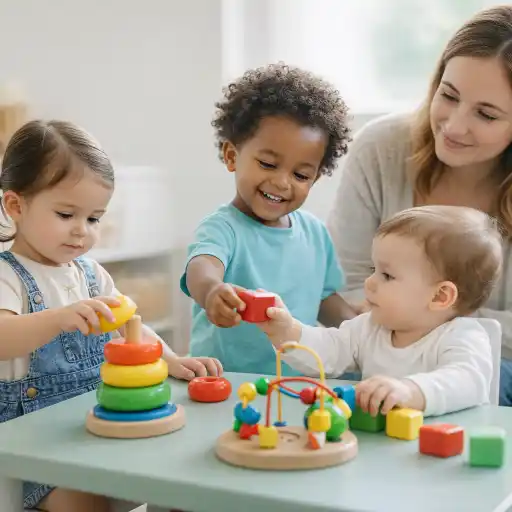
Cooperative play is more than children occupying the same center. Children build toward a shared goal, take on roles, exchange ideas, and adjust their plans as play unfolds. A group making a pretend restaurant, for example, may decide who cooks, who serves, and what the customers will order. This kind of shared activity gives children meaningful reasons to talk, listen, wait, and solve problems together.
These experiences nurture language, perspective-taking, self-regulation, and flexible thinking. They also create opportunities for friendships and a sense of belonging: a child’s contribution can become part of something the group could not make alone. Peer interaction is a learning context, not simply a reward for children who already know how to get along. CSEFEL guidance emphasizes directly teaching and practicing social skills, then supporting children as they use them during play and daily routines (CSEFEL’s brief on promoting positive peer interactions).
Development varies. Some children may observe, play beside peers, or join briefly before they sustain a shared plan. Those stages are not failures; they are useful information about the support a child may need. Notice what each child already does—watches closely, offers a material, imitates a peer—and use that strength as a bridge toward fuller participation.
How can the classroom environment invite children to collaborate?
Make collaboration possible before asking children to cooperate. Arrange centers so a few children can work comfortably together, keep materials visible and accessible, and choose open-ended items that allow several ideas. Blocks, dramatic-play props, large paper, puppets, loose parts, and shared puzzles offer many ways to contribute without prescribing one correct result.
Protect unhurried play time when the schedule allows. Children need time to develop an idea, assign roles, encounter a challenge, and revise their plan; frequent interruptions can dissolve a shared storyline just as it gets going. Small groups can also reduce waiting and make it easier for every child to be heard. Predictable routines, clear spaces, and thoughtful material choices help children focus on their play rather than competing for access.
- Offer a shared purpose: “Can you build one road that reaches both buildings?”
- Use role cards, picture cues, or job choices when they make entry into play clearer.
- Rotate classroom jobs so every child can contribute and experience responsibility.
- Include props, books, and play themes that reflect children’s languages, cultures, interests, and family experiences.
- 🧱 Try a group construction challenge with simple materials and invite children to decide how the parts fit together.
Plan for varied ways to participate: speaking, pointing, demonstrating, observing before joining, or taking a helper role. Inclusion is not a demand that every child play in the same way; it is thoughtful access to meaningful opportunities. Adjust materials, group size, sensory demands, and language supports to suit the children in your care.
Which activities help preschoolers practice shared goals?
Choose activities where children genuinely need one another’s contributions. A cooperative task should leave room for children’s decisions; if each child merely completes an isolated piece, the activity may be group work without much collaboration. Explain the shared purpose briefly, model a useful phrase if needed, and then let children shape the process.
- Collaborative mural: Spread a large sheet of paper across a table or wall. Children choose a theme, decide where elements belong, and share materials. Ask, “What might we add so this becomes everyone’s picture?”
- Group building: Invite a small team to create a bridge, animal home, or neighborhood. Children can plan, gather materials, build, test, and revise together.
- Dramatic-play scenario: Turn a center into a market, clinic, or restaurant. Props and optional role cards can help children start a shared story; roles should change over time.
- Parachute or movement game: Children coordinate their movements to keep a soft ball rolling or make gentle waves. Make safety expectations and available movement adaptations clear.
- Shared puzzle or story: Children can sort pieces together or take turns adding a character, event, or illustration to a group story.
Activities described by Edutopia—including collaborative art, parachute games, and a group maze—highlight a useful principle: attend to how children work together, not just whether they finish or “win” (Teaching Cooperative Play in Prekindergarten). Keep activities brief enough to maintain interest, and repeat favorites. Familiar formats let children practice new social skills without having to learn a new set of directions each time.
How can educators coach cooperation without taking over?
Educators make cooperation teachable by modeling language, noticing attempts, and stepping in with care when support is needed. Before play, rehearse short phrases with puppets or during circle time: “Can I join?” “What job can I do?” “Can I have a turn when you’re finished?” “Let’s try it together.” Children who are still developing spoken language can use gestures, pictures, signs, or other communication supports.
During play, be an observant coach rather than the director. A specific comment helps children notice their own contribution: “You asked Maya where the next block should go, and she showed you.” Open questions can extend thinking: “What could make the bridge steady?” or “How can both ideas fit?” Pause after asking. Children may need processing time before they respond or act.
Conflict is a normal part of shared play; it can become practice in communication and repair. Approach calmly, ensure everyone is safe, and describe what you observe without assigning blame. NAEYC’s three-step approach recommends naming behavior and feelings, explaining the impact, and guiding children toward an appropriate next action (A Three-Step Approach to Help Children Navigate Conflict).
- Pause and help children settle if emotions are high.
- Name the problem neutrally: “You both want to use the same truck.”
- Offer simple options or invite ideas: take turns, trade, build together, or choose another material.
- Support repair, such as returning an item, rebuilding, or trying the request again.
Rather than requiring an immediate apology or taking over every disagreement, help children practice a next step. Your calm, consistent presence communicates that conflict can be worked through safely.
How can providers include every child and notice progress?
Children bring different temperaments, communication styles, interests, abilities, and experiences to peer play. Some are eager to lead; others may watch first, prefer a predictable role, or need more time to respond. Offer invitations without pressure: “You can watch, hold the picture card, or join as the builder when you’re ready.” Pair children thoughtfully, but avoid keeping them in fixed “helper” and “helped” roles. Rotate partnerships so each child has chances to contribute and receive support.
Make play accessible through visual sequences, picture-based role choices, adapted tools, clear turn cues, and flexible group sizes. Accept home languages and nonverbal communication as meaningful participation. Reflect on whether the room’s materials and pretend scenarios represent the families and communities children know. State requirements vary - check your state licensing agency.
Observe specific actions rather than making broad judgments about a child’s social ability. Brief notes can record whether a child invited a peer, accepted a role, offered an idea, waited, or used support to resolve a disagreement. Look for progress over time: a child who once watched from the edge may begin passing materials or proposing the next step. Share concrete observations with colleagues and families, while respecting confidentiality.
Directors can sustain this work through short staff reflections: Which children found a way into play? What adult prompt helped? What adjustment might improve access next time? Consistent language across the team helps children encounter familiar support in different centers and routines. Small gains count; they show that a supportive environment is making participation more possible.
How can you make cooperative play part of everyday practice?
The best ways to support cooperative play are practical and consistent: prepare spaces that welcome shared activity, offer open-ended experiences with real common goals, teach useful social language, coach conflict calmly, and adapt participation so every child can belong. Cooperative play is not a performance in which preschoolers must agree at all times. It is a developing practice built through repeated opportunities to plan, contribute, negotiate, and try again.
Start with one manageable change tomorrow. Add a shared building challenge, protect a longer stretch of center time, or teach one joining phrase and notice when children try it. Record a brief observation, then reflect with your team on what helped. With patient, strengths-based guidance, children can move from playing alongside one another toward meaningful shared stories and projects.
For a deeper professional learning experience, ChildCareEd’s The Best Promotion is Play Buy Now $24.00 examines how play supports development and classroom cooperation. You can also explore Supporting Social Learning: Creating Classrooms that Care Buy Now $35.00 for strategies centered on relationships, community, and children’s problem-solving.
As you make space for #cooperation, purposeful #play gives #preschoolers practice with #communication, #empathy, and shared discovery.
- 45 Hour Child Growth and Development
- Beyond the Classroom: Connecting Families to Essential Services
- 45 Hour Preschool Methods and Materials
- Reducing the Risk of Sudden Infant Death Syndrome
- Bienvenido! Welcoming All Families
- Working Together: Teachers & Preschoolers
- The Best Promotion is Play
- Texas Director Credential
- Every Moment Matters: Schedules and Transitions
- How motor skills shape child development and creative ways educators can foster them.
- CDA Certification en Español: Recursos y Consejos para Educadores Bilingües
- ❄️ ¿Qué actividades al aire libre funcionan bien para los niños de Illinois en cada estación? 🌷🍂
- Consejos de Supervisión Activa para Salones de Preescolar y el Juego al Aire Libre
- Can simple indoor movement games teach listening and cooperation to preschoolers in Oklahoma?
- Team-Building Activities for Daycare: Helping Children Learn Together
- Celebrando la amistad en el cuidado infantil durante el Día de los Mejores Amigos
- Canciones, juegos y preguntas de círculo para niños
- Team-Building Games for Preschoolers That Teach Cooperation
- Belonging Activities for Kids Who Feel Left Out: Simple Ways to Help Them Join In
- How Can Bingo Games Support Turn-Taking and Social Skills?
- How Can You Support an Autistic Child in a Preschool Classroom?
- How Can Teachers Help Two Children Build Together When They Disagree on the “Right” Way?
- What Is the Difference Between Parallel Play and Cooperative Play?
- What Can Preschool Teachers Learn from a Child’s Play Preferences?
- How Can Providers Plan Meaningful After-School Choices for Seven- and Eight-Year-Olds?
- How Can Holiday-Neutral Movement Activities Create a More Inclusive Classroom?
- What Are the Best Ways to Support Cooperative Play in Preschool?
- What Are the Best Ways to Support Cooperative Play in Preschool?
