When two children insist their building plan is the only right one, the moment can become a powerful lesson in listening, flexibility, and teamwork—not just a dispute over blocks. Explore Connections That Count: Building Relationships in Child Care  Buy Now $55.00 for practical strategies that support cooperation, positive guidance, and social-emotional growth; the course can help you bring a more intentional relationship-based approach to everyday classroom interactions.
For focused practice in guiding peer disagreements, you can also explore You’re Not My Friend Anymore: Learning Conflict Resolution Buy Now $16.00. The ideas below offer a simple way to coach children through their competing visions while keeping the building—and the relationship—open to new possibilities.
Why does a disagreement about building deserve more than a quick adult decision?
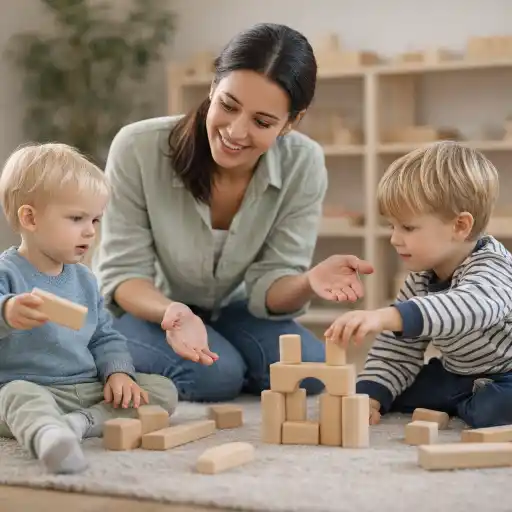
Block play may look like a simple activity, but it asks children to coordinate plans, materials, space, and relationships. One child may want a tall tower; another may want a wide base or a bridge. Each idea can make sense from that child’s point of view. When an adult immediately decides which plan is correct, the structure may get built faster, but children lose a chance to practice listening, negotiating, and combining ideas.
Disagreement is not automatically a sign that play has failed. It can reveal children’s developing language, persistence, perspective-taking, and understanding of how structures work. Block play offers opportunities for problem-solving, imagination, self-expression, mathematics, and social-emotional learning, as described in NAEYC’s discussion of what children learn from block play.
Our goal is not to make children agree instantly or to have every project end with a single shared design. Instead, we can help them recognize that different ideas can coexist, change, or be tested. That shift—from “my plan against yours” to “let’s figure out what works”—turns a building disagreement into meaningful collaborative #play.
How can teachers support children before a building disagreement escalates?
Preparation starts before the first block is placed. Set up the building area so children can see and reach a useful variety of blocks and accessories without crowding one another. A spacious, clearly organized area with open-ended materials gives children room to develop their own plans and helps adults notice when extra support is needed.
Teach a few short phrases during calm moments, then model them during play. Children can practice saying, “I have another idea,” “Can we try both?” “Let’s test it,” or “Can I use that block when you’re done?” Pair phrases with pictures, gestures, or communication supports when helpful. Children still learning to speak, multilingual children, and children who use alternative communication may need extra time and accessible ways to contribute.
Before a group challenge, establish that there may be more than one workable design. Try prompts such as, “We are building together. We listen to each builder, keep materials safe, and make a plan we can try.” Briefly introduce ways to combine ideas: build two connected structures, test two designs, or take turns choosing the next feature.
- Offer enough space for children to move around the structure safely.
- Use a visual plan or simple picture cards to make ideas visible.
- Invite children to draw, point, gesture, or describe their proposed design.
- 💡 Present challenges as invitations, not contests with one “best” builder.
What should a teacher do when children insist their design is the only right one?
When voices rise or blocks begin to be grabbed, first attend to safety and emotional regulation. Move close, block unsafe actions if needed, and use a calm, brief statement: “I won’t let blocks be thrown. You both have ideas about this building.” If a child is hurt or distressed, respond to that immediate need before asking the group to reason together.
Once the children are calm enough to participate, describe what you observe without assigning blame: “Maya is placing blocks across the top. Eli is asking for a wide base.” Then acknowledge feelings and perspectives: “You both care about how the building turns out, and you have different plans.” Naming what is happening can help children feel heard without suggesting that one child’s idea matters more.
Resist solving the design problem for them too quickly. Instead, use open prompts: “What do you want your building to do?” “What could we try first?” or “How could both ideas fit?” Wait long enough for children to respond. Some may use a few words, point to a card, or need the adult to offer two manageable choices. Scaffolding is support, not taking over.
If the children are too upset to continue, pause the activity, protect the work if possible, and return to the conversation when they are ready. Adult guidance should keep play safe while allowing children meaningful ownership of the solution.
How can children combine or test two different building ideas?
Help children move from defending their preferred plan to exploring options. Invite each child to explain or show one part of the idea. A teacher might say, “Show us what you want the building to do,” then reflect, “You want a tall tower, and you want a bridge for the cars.” This makes both goals visible and gives children a shared problem to solve.
Brainstorm possibilities before judging them. Ideas could include connecting a tower to a bridge, making two structures side by side, taking turns adding features, or testing one idea and then the other. Ask children which plan they want to try first and what they will look for. If the structure tips, treat that as information: “What changed when we moved the long block?” That supports experimentation without labeling an idea as bad.
Visual challenge prompts can give children a shared starting point while leaving room for their own solutions. Solution cards and problem-solving strategies can also help children consider options when words are hard to find. Make sure any card or prompt is an invitation to think, not a requirement that every child produce the same result.
- Invite each child to show or describe their idea.
- Restate the shared goal in neutral language.
- Ask for more than one possible solution.
- Choose a safe idea both children are willing to test.
- Check what happened and decide whether to continue or revise.
How can teachers keep the experience inclusive and focused on learning?
Children’s ways of participating differ. One child may narrate a detailed plan; another may communicate by pointing, arranging blocks, drawing, or watching before joining. Make room for these differences. Offer clear visuals, gestures, home-language words, adapted tools, or a smaller group when those supports help children contribute. Avoid interpreting quiet observation as lack of interest or assuming that fluent speech means a child should lead.
Keep the emphasis on the process rather than the appearance of the finished structure. Notice behaviors children can repeat: “You listened to the bridge idea,” “You tested a wider base,” or “You changed the plan after it leaned.” Specific feedback reinforces persistence, flexible thinking, and shared effort rather than ranking whose design was best.
Common pitfalls include taking sides, forcing a compromise, or insisting that children share every block immediately. Instead, describe what you see, offer alternatives such as taking turns or using separate materials, and return to the common goal when children are ready. If disagreements repeatedly arise in one area, observe whether crowding, limited materials, unclear expectations, or the timing of the activity may be contributing.
Directors can support consistent practice by discussing shared language during staff meetings and observing how educators respond to children’s ideas. Use brief notes to identify patterns and adjust the environment or groupings. State requirements vary - check your state licensing agency.
How can directors and teachers extend this learning beyond one block-area moment?
Turn a useful moment into a classroom routine. After a building challenge, invite children to reflect: “What did we try?” “How did we make room for another idea?” and “What might we change next time?” Keep the conversation short and concrete. A photo of the structure, a child’s dictated explanation, or a quick drawing can help children revisit their thinking later.
Educators can offer cooperative building prompts regularly—design a home for an animal, create a bridge for toy vehicles, or build a place where several figures can gather. These shared challenges encourage children to plan and communicate, but remain flexible enough for children to make unexpected choices. NAEYC’s article on cross-area play and creative connections describes how combining materials can expand children’s collaborative ideas.
Families can be included by sharing a specific example of the skill children practiced, rather than presenting the disagreement as a problem with a child. For example: “The group had different ideas for a bridge today. With a little coaching, they tested both plans and chose how to connect them.” This strengths-based communication supports shared understanding between home and program.
For deeper professional learning, The Best Promotion is Play Buy Now $24.00 explores how play supports creativity, problem-solving, and cooperation, while Social Foundations and Responsive Classrooms Buy Now $24.00 addresses relationships, positive guidance, and age-appropriate conflict resolution.
Conclusion: What is the “right” way to help children build together?
When two children disagree about the “right” way to build, the most valuable response is usually not to choose a winner or prescribe a design. Keep everyone safe, acknowledge both perspectives, and coach children to share ideas, consider options, and test a solution together. Their structure may change as they go—and that is part of the learning.
Offer preparation, accessible communication supports, open-ended prompts, and specific encouragement for listening and flexibility. With repeated practice, children can begin to see a disagreement not as a reason to stop building, but as a chance to learn what happens when different ideas work together.
- Lesson Planning for Preschoolers
- 45 Hour Preschool Methods and Materials
- Pediatric RSV First Aid & CPR/AED
- 45 Hour School Age Methods and Materials
- CDA Bridge Bundle: Family Child Care without Portfolio Review
- CDA Bridge Bundle: Infant/Toddler without Portfolio Review
- CDA Bridge Bundle: Preschool without Portfolio Review
- Creating Environments that Nurture Growth and Community
- 45-Hour Infant and Toddler Curriculum
- Families, Communities, and Classrooms: Working Together for Children
- CDA Certification en Español: Recursos y Consejos para Educadores Bilingües
- Recursos en Español sobre el Sueño Seguro del Bebé
- ¿Cómo empiezo mi certificación CDA en Florida en línea?
- Proporciones de Cuidado Infantil y Tamaños de Grupo por Edad en Maryland (Guía Rápida para Centros y Hogares)
- Proporciones de Cuidado Infantil y Tamaños de Grupo por Edad en Nueva Jersey (Guía Rápida para Centros y Hogares)
- Proporciones de Cuidado Infantil y Tamaños de Grupo por Edad en Virginia (Guía Rápida para Centros y Hogares)
- Cómo Celebrar el Día Nacional del Kindergarten
- Consejos de Supervisión Activa para Salones de Preescolar y el Juego al Aire Libre
- Retraso del Habla en la Guardería: Cómo Pueden Ayudar los Proveedores
- Cómo Trabajar en el Cuidado Infantil en Carolina del Norte: Requisitos y Pasos
- Celebrando la amistad en el cuidado infantil durante el Día de los Mejores Amigos
- Canciones, juegos y preguntas de círculo para niños
- Getting to Know You Activities for Preschoolers When a New Child Joins the Class
- How Can Child Care Leaders Help Staff Feel Heard Beyond the Suggestion Box?
- How Can Child Care Providers Teach Conflict Resolution to Preschoolers?
- How Can Writing and Art Activities Help Children Name What They Appreciate?
- How Can School-Age Children Disagree Without Adults Taking Over the Discussion?
- How Can Educators Help Children Negotiate When Pretend-Play Rules Change Midgame?
- How Can Teachers Help Two Children Build Together When They Disagree on the “Right” Way?
- What Should You Do When Children Disagree with a Storybook’s Ending?
