Small, intentional changes can transform a preschool classroom from overwhelming to welcoming for an autistic child. For practical guidance on communication, sensory needs, environmental adaptations, and family partnerships, explore Effective Approaches for Autism and Inclusion  Buy Now $55.00; the course can strengthen classroom practice and may help meet professional-development requirements, depending on your state. If play is the child’s strongest pathway to connection, Play with Purpose: Supporting Children with Autism Buy Now
 $55.00$40.00 offers focused strategies for communication, engagement, regulation, and peer interaction.
Why does individualized support matter in preschool?
Autistic children are not a single group with identical needs. Autism may influence communication, sensory processing, social interaction, attention, play, and responses to change, but each child also brings distinctive interests, strengths, relationships, and ways of expressing meaning. The CDC’s information for educators encourages providers to use developmental knowledge and practical resources while recognizing individual differences.
Support is most effective when it increases access, participation, autonomy, and belonging rather than attempting to make a child appear “typical.” A child who communicates with gestures, pictures, signs, speech, or an assistive device is communicating. A child who moves, hums, avoids eye contact, or seeks repetition may be regulating, expressing interest, or signaling a need. These behaviors deserve curiosity rather than immediate correction.
Inclusive practice benefits the entire group. Visual routines, clear directions, calm spaces, flexible participation, and interest-based learning can support children with language differences, anxiety, developmental delays, attention differences, or temporary stress. The goal is a responsive #classroom where every child can learn and belong.
How can you create predictable routines and transitions?
Predictability helps children understand what will happen, what is expected, and how they can participate. It does not mean that every day must be identical. Instead, it means changes are communicated clearly and children have reliable cues to guide them.
- Post a picture-based daily schedule at child eye level.
- Use a “now/next” or first-then board for immediate transitions.
- Give advance warnings with a timer, song, gesture, or short phrase.
- Show the steps of routines such as cleanup, handwashing, and arrival.
- Build realistic time into the schedule for waiting, movement, and gathering materials.
Teach children how to use the schedule rather than simply displaying it. At arrival, review the first activity. Before cleanup, point to the current picture and the next one. Invite the child to move, turn over, or check off the completed card. Use consistent language across adults, such as “First cleanup, then snack.”
When an unexpected change occurs, use a change card or replace the canceled picture with the new activity. Say, “The playground is closed. Change: we will play in the gym.” Keep the explanation concise and preserve as much of the familiar routine as possible. The NAEYC guidance on visual supports describes how pictures, objects, gestures, and text can clarify expectations and foster #independence.
How can you support communication in multiple ways?
Preschool communication includes far more than spoken sentences. Some autistic children use speech fluently; others use scripts, echolalia, gestures, signs, pictures, objects, or communication technology. Every intentional communication attempt should be acknowledged and supported.
Pair brief spoken language with visual information. Instead of giving a long verbal explanation, show a picture of “sit,” “wash hands,” or “outside.” Offer meaningful choices with photographs, icons, or real objects: “Blocks or play dough?” Then pause long enough for the child to process and respond.
- Model functional phrases such as “help,” “more,” “stop,” “my turn,” and “all done.”
- Accept pointing, reaching, signing, vocalizing, pictures, and devices as valid communication.
- Use a first-then board to clarify short sequences.
- Reduce unnecessary questions and give one direction at a time.
- Celebrate communication by responding to its meaning, not by requiring a particular form.
Communication supports should be available throughout the day, not only during challenging moments. Coordinate with families and speech-language professionals when applicable, and use the child’s established system consistently. Never remove a communication device or withhold communication as a consequence.
The NAEYC article on teaching children with autism notes that visual supports can strengthen expressive language and reduce frustration by helping children make choices and communicate intentionally. Responsive adults listen for the message behind behavior and adjust the environment when the child’s current communication method is not being understood.
How can you design a sensory-supportive environment?
A sensory-supportive classroom does not eliminate stimulation. It offers balance, predictability, and options. Observe when participation decreases: Is the room especially loud, crowded, bright, visually busy, or physically uncomfortable? Also consider fatigue, hunger, illness, communication demands, and transitions before concluding that a behavior is sensory in origin.
- Separate louder and quieter areas when possible.
- Reduce visual clutter and keep pathways clear.
- Use natural or adjustable lighting and limit glare or flicker.
- Offer flexible seating, such as a chair, floor mat, cushion, or standing option.
- Provide a supervised calm area with limited stimulation.
- Permit appropriate movement breaks, headphones, or other agreed supports.
Teach children how to use supports during calm periods. Practice entering and leaving the calm area, requesting a break, putting on headphones, or choosing a movement activity. A calm area is not a punishment space and should never be used for confinement. Supports should help the child return to meaningful learning and peer participation when ready.
Safety remains essential. Follow program policies, inspect materials, consider allergies and choking risks, maintain supervision, and use specialized equipment only when appropriate. Normalizing choices for the whole group can reduce stigma: any child may select a quieter seat, look at a book, or take a brief movement break when the classroom expectations permit it.
How can play and peer relationships promote inclusion?
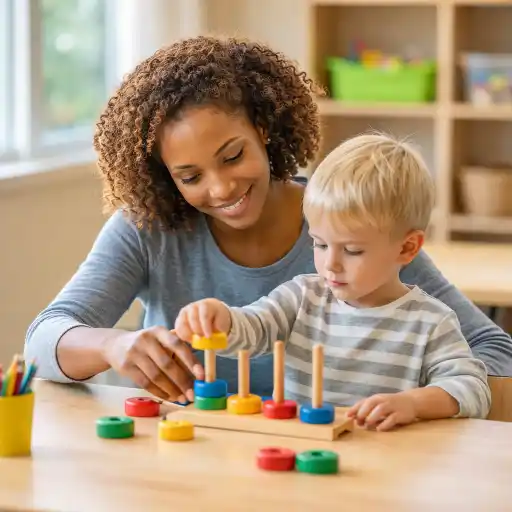
Play provides a natural context for communication, imitation, joint attention, problem-solving, and social connection. Begin with the child’s interests rather than insisting on a predetermined activity. If a child enjoys cars, water, animals, or spinning objects, join respectfully, imitate the play action, and add one small variation.
- Arrange materials so children can play alongside one another without excessive crowding.
- Use short, achievable peer interactions before expecting extended cooperative play.
- Pair children around shared interests and complementary strengths.
- Coach peers with simple language: “Ask for a turn,” “Give the car,” or “Let’s build together.”
- Model turn-taking with visual markers, timers, or duplicate materials.
Do not define successful social interaction only as eye contact, verbal conversation, or conventional pretend play. A child may participate by watching, moving near peers, copying an action, sharing an object, or taking a brief turn. Respectful peer education can focus on kindness, different ways of communicating, and the fact that everyone may need different tools to join an activity.
Play with Purpose: Supporting Children with Autism Buy Now $55.00$40.00 is a relevant next step for providers who want more structured guidance on observing play, promoting joint attention, supporting turn-taking, and using play to build communication and regulation. Play should remain enjoyable, child-centered, and connected to authentic interests.
How can families, specialists, and staff build a consistent plan?
Families are essential partners because they know the child’s history, interests, communication preferences, cultural context, routines, and successful calming strategies. Begin conversations with strengths and specific observations: “She joined the water table for five minutes and used the picture for more.” Avoid labels such as “uncooperative” when describing behavior.
Create a brief support snapshot that includes:
- How the child communicates wants, needs, discomfort, and enjoyment.
- Preferred interests and motivating activities.
- Common triggers or difficult routines.
- Helpful visual, sensory, and interaction supports.
- Safety information and relevant family priorities.
- One or two observable participation goals.
With appropriate consent, coordinate with early intervention providers, speech-language pathologists, occupational therapists, behavior professionals, or special educators. Classroom staff should not diagnose autism or prescribe therapy. Their role is to implement agreed-upon supports, share objective observations, and contribute knowledge about daily participation.
Directors can strengthen consistency by modeling strategies, providing shared staff language, orienting substitutes, protecting planning time, and reviewing supports regularly. If an IEP or IFSP applies, follow the plan and collaborate with the responsible educational team. State requirements vary - check your state licensing agency.
Conclusion: What is the most supportive approach?
Supporting an autistic child in preschool begins with relationship, respect, and careful observation. Make routines visible, communicate in multiple modes, reduce unnecessary sensory barriers, use play to build authentic connection, and create opportunities for peer participation. Individualize supports without isolating the child, and partner with families and specialists through clear, strengths-based planning.
The most effective practice is not a single technique. It is a cycle of noticing, adapting, teaching, observing, and trying again. When adults treat behavior as communication and design the environment for flexible participation, children are more likely to feel safe, capable, and included. Continue building your professional knowledge with Coaching for Success: Inclusive Strategies to Support Children with Autism Buy Now $55.00$45.00, which focuses on individualized scaffolding, predictable routines, and collaboration with families and professionals.
With thoughtful support, an autistic child can do more than remain in the classroom: they can communicate, explore, play, develop #relationships, and experience genuine belonging.
- 45 Hour Child Growth and Development
- CDA Preschool Credential
- Building Equity: Inclusionary Practices in Preschool
- 45 Hour Preschool Methods and Materials
- CDA Family Child Care Credential
- Inclusive Lessons for Preschoolers
- Art from the Heart for Preschoolers: Open Ended Art Projects that Build Self-Esteem
- Effective Approaches for Autism and Inclusion
- Texas Director Credential
- CDA Certification en Español: Recursos y Consejos para Educadores Bilingües
- 🔍 ¿Qué ves cuando observas a un niño aprender?
- 💛🧩 ¿Cómo puedo hacer que mi enseñanza sea inclusiva para los niños con autismo?
- 👶 ¿Cuáles son las proporciones y grupos requeridos en Dakota del Norte? 🏫
- 10 Ejemplos de Cómo la Cultura Influye en el Desarrollo Infantil
- Proporciones de Cuidado Infantil y Tamaños de Grupo por Edad en Maryland (Guía Rápida para Centros y Hogares)
- Proporciones de Cuidado Infantil y Tamaños de Grupo por Edad en Virginia (Guía Rápida para Centros y Hogares)
- Lista para Abrir una Guardería en Casa en Dakota del Norte: Cómo Empezar
- Cómo Ser Maestra de Preescolar en Dakota del Norte
- Celebrando la amistad en el cuidado infantil durante el Día de los Mejores Amigos
- Cómo simplificar la capacitación para sus empleados de daycare
- How Can Your Program Effectively Support Autistic Children?
- How Can Visual Daily Schedule Cards Turn Classroom Chaos into Calm?
- How Can Predictable Classroom Routines Support Autistic Children?
- How Can You Support an Autistic Child in a Preschool Classroom?
- How Can You Help an Autistic Preschooler Join a Group Game on Their Own Terms?
- How Can Preschool Providers Handle Unexpected Routine Changes with Confidence?
- How Can Teachers Support an Autistic Child in a Preschool Classroom?
- How Can You Prepare an Autistic Child for a Small Change in the Arrival Routine?
- How Can Providers Use Feelings Pictures with Autistic Children Without Making Assumptions?
