A seasonal display can catch a child’s eye; a well-planned learning center invites that child to investigate, create, communicate, and return with new questions. Strengthen your approach with ChildCareEd’s Spicing Up the Classroom: Learning Centers  Buy Now $16.00, a focused course on planning centers that support children’s development and intentional teaching. You’ll find practical ways to turn seasonal materials into meaningful play while continuing through the ideas below.
Why should a seasonal center offer more than a decorative theme?
Seasonal colors, props, and displays can make a room feel inviting, but decoration alone gives children little to do beyond looking. A thoughtfully designed center turns the season into an accessible starting point for active learning. Children might compare leaf shapes, test what melts ice, sort seeds, or create a pretend garden market. These experiences connect what children see around them to ideas they can explore with their hands, words, and imagination.
That connection matters because young children build understanding through repeated, meaningful experiences. A seasonal center can support vocabulary, early science and math, fine-motor coordination, collaboration, and emotional expression at the same time. The New York State Education Department’s guidance on student-centered learning environments notes that thematic units can connect subject areas, expand vocabulary, and make learning more memorable when the theme is integrated purposefully.
For providers and directors, a clear purpose also makes planning more manageable. Rather than adding many themed crafts, select a few materials that invite children to make choices and investigate. Link the center to one or two goals, then observe how children use it. The aim is not to make every moment feel like a formal lesson; it is to ensure the environment offers something meaningful to discover beyond its appearance.
What skills and questions can children explore in a seasonal center?
Start with what children can notice, compare, represent, and wonder about in your local environment. A seasonal theme need not be limited to a particular holiday or a four-season model; climate, family experiences, and children’s interests differ. Choose questions that are open enough for multiple ideas and concrete enough for children to investigate.
- 🌱 Observe and describe: Compare a plant’s height over time, describe how a leaf feels, or notice how sunlight changes across a room.
- Sort and count: Group large, safe natural objects by color, size, shape, or texture, then count or create a simple picture graph.
- Predict and test: Ask which objects might float, what could help ice melt, or which materials might keep a toy warm; try the idea and discuss what happened.
- Imagine and communicate: Use seasonal props in dramatic play, make signs or lists, tell stories, and negotiate roles with peers.
ChildCareEd’s article on combining seasonal activities with educational goals offers examples across seasons, from spring planting to winter ice investigations. Use local conditions as your guide: a “winter” investigation might focus on rain or changing daylight rather than snow. An activity becomes more than a themed task when children can make choices, test ideas, and explain what they notice.
How can providers design the center for purposeful, child-led play?
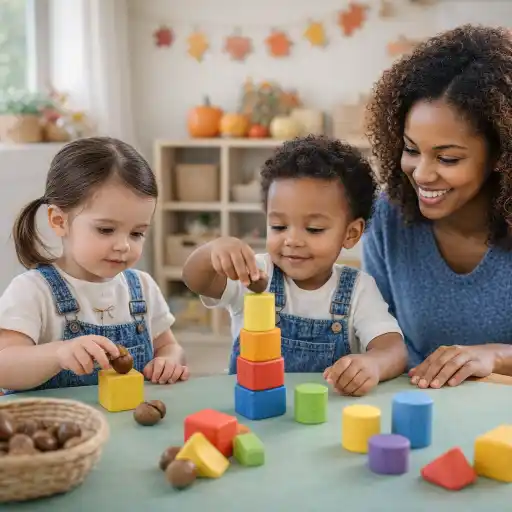
Purposeful design begins with a modest learning intention and a few well-chosen materials. For example, a fall tray with sturdy leaves, sorting bowls, magnifiers, and drawing paper can invite close observation, classification, and representation. A spring garden center might include pots, large seed packets for discussion, child-safe tools, picture books, and a simple growth chart. Keep the invitation open-ended: children may sort, draw, build a story, or ask a question you had not anticipated.
Arrange materials so children can reach and return them independently, while keeping pathways clear and staff sight lines open. Offer a few choices rather than filling every shelf. Add picture labels, accessible tools, and different ways to participate—looking, listening, pointing, drawing, dictating, or touching. The state’s guidance emphasizes student choice and adult conversations that extend thinking; educators can join play, ask a thoughtful question, and then allow children room to lead.
Useful prompts include “What do you notice?”, “How could we find out?”, and “What might we try next?” Avoid turning the center into a sequence of adult instructions or expecting each child to produce the same craft. If interest shifts, adapt one material or question instead of replacing the entire center. Thoughtful learning-center planning supports independence, purposeful play, and smooth supervision.
How can seasonal activities connect science, language, math, and relationships?
Seasonal exploration is especially useful when it lets children connect ideas across areas of development. A leaf investigation, for example, can involve science as children notice change, math as they compare and sort, language as they describe texture and color, art as they make rubbings, and social learning as they share tools and theories. These connections should arise naturally from play rather than become a checklist children must complete.
Providers can extend thinking with brief, responsive interactions. If a child says, “This leaf is smaller,” ask what helped them decide. If children are building a pretend market, introduce paper for signs, labels, or shopping lists. If they are curious about a puddle, return later to notice whether it changed. The Eastern Connecticut State University resource Science with Young Children highlights the value of tools, natural experiences, children’s questions, experimentation, and problem-solving.
Use documentation to make children’s thinking visible without overburdening staff. Record a brief quote, add a dated photo, or keep a drawing beside a later observation. Revisit the record with children: “What did we think would happen? What do we see now?” This reflection supports memory, vocabulary, and reasoning while giving families a concrete view of the learning happening behind the decorations.
How can the center remain inclusive, safe, and responsive?
A seasonal center should welcome children with different abilities, languages, sensory preferences, and family experiences. Do not assume every child celebrates the same holidays or has the same seasonal routines. Use broadly accessible themes—weather, plants, light, clothing, or changes in the local environment—and invite families to share knowledge or ideas voluntarily. Provide choices that do not depend on speaking, touching every material, or completing a specific product.
Safety needs to be planned alongside the learning goal. Inspect natural materials and remove items that are sharp, moldy, contaminated, toxic, or unsuitable for the ages in your group. Consider choking hazards, allergies, sanitation, and sensory sensitivities. Avoid tasting unknown plants, seeds, or berries. For water, small parts, or outdoor exploration, plan active supervision, clear boundaries, and cleanup procedures. State requirements vary - check your state licensing agency.
Common pitfalls are usually avoidable with a little restraint:
- Too much visual clutter: Offer a small, deliberate collection and rotate a few materials when children’s interests change.
- Decoration without interaction: Add tools, open-ended materials, or a question that gives children something to do and wonder about.
- One-size-fits-all participation: Offer alternatives such as observing, drawing, using adapted tools, or dictating an idea.
- Seasonal assumptions: Reflect your community and local environment; avoid presenting one custom or climate as universal.
How can teams plan, document, and improve seasonal centers?
A simple planning cycle keeps seasonal centers intentional without creating an unnecessary workload. First, identify one or two goals, such as describing change, comparing quantities, or cooperating in pretend play. Next, choose a small set of safe materials and a question that invites exploration. Decide who will supervise, how children can access the materials, and what backup plan staff will use if conditions or interest change.
During play, observe before intervening. Notice which materials children choose, what questions recur, who joins or stays at the edge, and what new challenge could extend the play. Record one useful observation—a child’s words, a photo, or a quick note—and use it to plan the next small adjustment. If children are deeply engaged, keep the center stable; novelty is not a goal in itself. If materials are ignored, inaccessible, or difficult to supervise, simplify or adapt them.
Directors can support consistency with shared planning notes and brief staff huddles. A simple record can include the center’s goal, materials, safety considerations, staff roles, children’s observations, and a next step. Share selected photos or child quotes with families, respecting program privacy practices. For additional professional learning on nature-rich environments, explore Creating the Natural Outdoor Classroom Buy Now $16.00. This course can help providers consider how outdoor materials and environments invite discovery across the year.
Conclusion: What should children do beyond admiring the decorations?
A seasonal learning center should invite children to do more than look: observe, ask questions, test ideas, sort, count, create, communicate, cooperate, and revisit discoveries. The decoration can provide a welcoming context, but children’s active exploration is where the learning takes shape. Choose a small number of appropriate materials, connect them to a clear intention, and use open-ended prompts that keep children’s ideas at the center.
Keep participation inclusive, supervision active, and documentation light. Follow children’s interests, adapt the setup when needed, and share meaningful observations with families. With a thoughtful question and a few flexible materials, a seasonal center can become a lively place for #curiosity, #play, #science, #language, and #learning—not just a pretty corner of the room.
Five ChildCareEd courses to explore:
- Spicing Up the Classroom: Learning Centers Buy Now $16.00
- Creating the Natural Outdoor Classroom Buy Now $16.00
- Building Early Science Foundations Buy Now $16.00
- Children at the Wheel ONLINE Buy Now $24.00
- From Play to Planning: Building Culturally Competent, Child-Centered Curriculum Buy Now $55.00
- CDA Bridge Bundle: Preschool
- Pediatric RSV First Aid & CPR/AED
- CDA Bridge Bundle: Family Child Care without Portfolio Review
- CDA Bridge Bundle: Infant/Toddler without Portfolio Review
- CDA Bridge Bundle: Preschool without Portfolio Review
- Texas Director Credential Renewal
- Texas Director Credential
- Bienvenido! Welcoming All Families
- CDA Certification en Español: Recursos y Consejos para Educadores Bilingües
- ❤️ ¿Cómo ayudan los educadores a las familias a acceder a los servicios que necesitan?
- 🤯 ¿Por qué este niño está teniendo un comportamiento difícil de repente?
- 😫🧸 ¿Qué hacer cuando un bebé no quiere dormir la siesta en el aula?
- Qué capacitación se requiere para ser director de cuidado infantil en Texas?
- Recursos en Español sobre el Sueño Seguro del Bebé
- ¿Cómo pueden los equipos de cuidado infantil practicar habilidades rápidas de primeros auxilios en situaciones reales?
- ¿Cómo empiezo mi certificación CDA en Florida en línea?
- Capacitación en Salud y Seguridad Preventiva en Línea para Proveedores de Cuidado Infantil
- Regulaciones de Licenciamiento de Cuidado Infantil en California para Centros y Hogares de Cuidado Infantil Familiar
- Lista para Abrir una Guardería en Casa en Virginia: Cómo Empezar
- Lista para Abrir una Guardería en Casa en Carolina del Norte: Cómo Empezar
- Lista para Guardería en Casa en Illinois: Cómo Iniciar una Guardería en el Hogar
- Lista para Guardería en Casa en California: Cómo Iniciar una Guardería en el Hogar
- Retraso del Habla en la Guardería: Cómo Pueden Ayudar los Proveedores
- Capacitación Previa al Servicio para Proveedores de Cuidado Infantil en Dakota del Norte
- Las Mejores Ideas de Excursiones para Guarderías en Texas
- Canciones, juegos y preguntas de círculo para niños
- ¿Todos los niños deben participar en el tiempo de círculo?
- What Should a Seasonal Learning Center Help Children Do Beyond Admiring the Decorations?
