What if one organized folder could turn tomorrow’s activity planning from a late-night task into a confident ten-minute decision? Printable activities can reduce repeated preparation while preserving purposeful, play-based learning, and Lesson Planning for Preschoolers  Buy Now $24.00 can help you connect ready-made materials to developmental goals while earning a certificate through completed online training. Use the strategies below to build a printable system that gives teachers more time for children—not less intentionality.
Why does reducing preparation time matter for early childhood teachers?
Preparation is necessary professional work, but it should not consume every planning period, evening, or weekend. Directors and teachers often spend valuable minutes searching for materials, rewriting directions, assembling templates, and recreating activities that already worked. A thoughtful printable system shifts that effort from repeated production to purposeful selection and adaptation.
That shift matters because teacher time is closely connected to classroom quality. When materials are ready and clearly organized, educators can devote more attention to observation, responsive interactions, small-group support, and meaningful #play. Research on early childhood time allocation emphasizes the value of child-directed activity, small-group interaction, and opportunities for individualization; printables are most useful when they protect those experiences rather than replace them.
Printable resources also support team consistency. A visual sequence, vocabulary card set, or recording sheet gives multiple educators a shared starting point. New staff and substitutes can understand the activity without asking a teacher to explain every step from scratch.
- Less time is spent locating supplies and rewriting plans.
- Teachers can prepare once and reuse materials across several groups.
- Directors can create a common planning language across classrooms.
- Children receive clearer cues, choices, and opportunities for independent participation.
As the classroom resources guide explains, shared templates and reusable kits can make planning more consistent while helping staff feel calmer and more confident.
Which printable activities provide the greatest time savings?
The most efficient printables are flexible tools, not disposable pages. Choose materials that can be used with different groups, learning goals, and levels of support. A single set of picture cards, for example, may support vocabulary, sorting, storytelling, movement, and matching.
- Visual schedules and routine cards: Post them at children’s eye level to reduce repeated verbal directions and support independence. ChildCareEd’s resource library includes guidance on printable classroom resources.
- Vocabulary and picture cards: Use them for storytelling, categorizing, dramatic play, sound awareness, or family-language connections.
- Open-ended recording sheets: Offer a simple space for children to draw observations, dictate ideas, tally results, or represent a plan.
- Center signs and labels: Help children and adults locate materials quickly and return them consistently.
- Game boards and matching cards: Adapt them for small groups, partner play, or independent practice.
- Lesson-plan templates: Prompt teachers to identify goals, materials, steps, questions, and assessment evidence without starting with a blank page.
Printables save the most time when they pair with hands-on materials. A shape card can guide a block design; a weather chart can accompany outdoor observation; a counting mat can support snack math. This approach reflects guidance from Hands-On Education, which recommends using printables to reinforce experiences rather than giving children paper tasks without a clear purpose.
For additional examples, the ChildCareEd resource library includes a free Preschool Weekly Lesson Plan Template, activity pages, visual tools, and other materials.
How can teachers organize printables for immediate reuse?
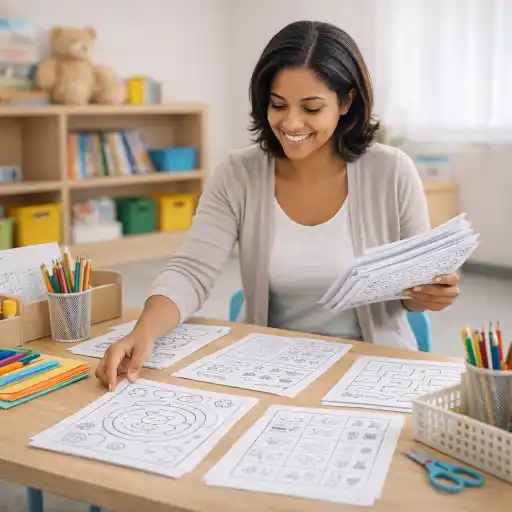
Organization determines whether a printable saves time or becomes another item to search for. Create a simple system that any staff member can understand in less than a minute. Use both a digital archive and a physical grab-and-go collection so teachers can access materials whether they are planning at a computer or preparing the room.
- Sort by purpose first: Create folders for schedules, literacy, math, science, social-emotional learning, fine motor, movement, family communication, and assessment.
- Add age or developmental tags: Label files as infant/toddler, preschool, mixed-age, introductory, or extension.
- Record the companion materials: Note whether an activity needs blocks, play dough, counters, books, clipboards, or recycled items.
- Use durable formats: Print frequently used cards on heavier paper and laminate them when appropriate. Dry-erase sleeves can make observation and writing sheets reusable.
- Prepare themed baskets: Place the printable, directions, needed manipulatives, and a safety reminder together.
- Maintain a “quick choices” list: Keep three options each for movement, quiet focus, literacy, math, science, and outdoor play.
Use clear filenames such as “Preschool—Weather—Vocabulary Cards—Small Group.” Keep one master copy and protect it from accidental edits. Directors can designate a weekly ten-minute restocking routine rather than waiting until materials disappear.
Reuse should not mean repetition without reflection. After an activity, add one short note: “Worked well with pairs; add larger pictures next time.” These brief reflections make future selection faster and gradually improve the collection.
How can printables remain developmentally appropriate and inclusive?
A printable is only a tool; its value depends on how teachers use it. Young children learn through movement, conversation, sensory exploration, relationships, and choice. Therefore, a printable should invite action rather than require prolonged sitting, copying, or one correct product.
Begin with the learning goal. If the goal is vocabulary, children might use picture cards during a story walk, dramatic-play scenario, or sorting game. If the goal is counting, pair a recording mat with real objects. If the goal is scientific thinking, provide a simple prediction-and-observation page after children investigate materials.
Inclusive adaptation can often be built into the same printable:
- Offer photographs, symbols, or objects alongside written words.
- Enlarge images and reduce visual clutter.
- Provide thicker writing tools, stickers, stamps, or dictation as alternatives to handwriting.
- Use home-language labels when possible and invite families to contribute vocabulary.
- Offer seated, standing, partner, and movement-based ways to participate.
- Provide an extension question for children ready for additional complexity.
Children should not be expected to complete identical pages simply because a printable was downloaded. Observe what each child can do, then adjust the level of support. The course Tailoring Instruction to Children’s Needs Buy Now $24.00 offers focused professional learning on differentiation and scaffolding, helping teachers adapt activities while maintaining a common classroom routine.
State requirements vary - check your state licensing agency, especially when printables are used for required documentation, health records, or lesson-plan records.
What common mistakes prevent printables from saving time?
Even well-intentioned printable systems can create extra work. The most common problem is collecting too many resources without deciding how they will be used. A large digital library may feel productive, but searching through hundreds of files can take longer than creating one activity.
- Mistake: Printing everything. Start with two or three high-use tools and evaluate them before expanding.
- Mistake: Treating worksheets as the curriculum. Pair paper materials with play, conversation, manipulatives, movement, and teacher interaction. Guidance on worksheets in preschool supports brief, purposeful use rather than replacing exploration.
- Mistake: Using one format for every child. Add visual, tactile, oral, and movement-based options.
- Mistake: Ignoring copyright and licensing. Check permissions before copying or distributing resources, particularly outside your program.
- Mistake: Failing to test the activity. Review print quality, image clarity, safety, and whether the directions make sense to another educator.
- Mistake: Forgetting cleanup and storage. Include labeled envelopes or bins so the resource is ready for its next use.
✨ A practical quality check is to ask three questions: What will children do with this printable? What will the teacher observe? What hands-on experience will accompany it? If those answers are unclear, the material may be adding preparation rather than reducing it.
Directors can support teachers by protecting paid planning time. Printable resources should make planning more efficient, not justify unpaid preparation. Invite staff to pilot one shared folder, gather feedback, and revise the system together.
How can a child care program build a printable routine this week?
Begin small. A sustainable system is more valuable than an impressive collection that no one uses. During one planning period, choose a weekly theme or child interest and prepare a single basket containing three related printables and the accompanying hands-on materials.
- Identify one recurring challenge: waiting time, transitions, center setup, documentation, or family communication.
- Select one reusable printable: Choose a visual schedule, game, card set, observation sheet, or center label that directly addresses the challenge.
- Pair it with real materials: Add blocks, counters, books, art supplies, natural objects, or dramatic-play props.
- Write one learning intention: Keep it observable, such as “children will compare lengths” or “children will use two new words.”
- Prepare two levels of support: Offer a simpler entry point and an extension question or challenge.
- Document briefly: Record one quote, photograph, or observation that shows children’s participation.
- Review after use: Keep, revise, or retire the resource based on children’s engagement and teacher feedback.
Five useful courses for continued professional learning include:
- Lesson Planning for Preschoolers Buy Now $24.00 — connects preschool activities with developmentally appropriate planning.
- Tailoring Instruction to Children’s Needs Buy Now $24.00 — supports differentiation and scaffolding.
- DAP for Preschool Buy Now $24.00 — strengthens understanding of developmentally appropriate teaching strategies.
- Classroom Tools for Emergent Literacy Buy Now $25.00 — explores practical literacy materials and classroom applications.
- Curriculum Planning Buy Now $24.00 — helps educators connect curriculum, standards, and lesson plans.
Use course information to determine whether a training fits your role and local professional-development requirements. State requirements vary - check your state licensing agency.
Summary: How do printable activities save teachers hours of prep time?
Printable activities save time when they are selected strategically, organized for quick access, reused with durable systems, and paired with meaningful hands-on learning. They can reduce repeated writing, searching, copying, and setup while supporting predictable routines, inclusive participation, and consistent teamwork.
The central question is not whether a printable looks attractive or comes from a popular website. The better questions are: Does it serve a clear developmental purpose? Can children use it actively? Can teachers adapt it? Can the team find it quickly next time?
Start with one challenge, one reusable printable, and one labeled basket. Protect planning time, invite staff feedback, and keep children’s relationships and exploration at the center. When printables function as flexible tools rather than substitutes for teaching, they give educators something invaluable: more calm, focused time to notice, respond, and learn alongside children.
- 18-Hour Train the Trainer
- 45 Hour Child Growth and Development
- Moving About the Classroom: Effective Transitions for Everyday
- 45 Hour Preschool Methods and Materials
- 45 Hour School Age Methods and Materials
- Texas Director Credential
- Moving About the Classroom: Effective Transitions for Everyday
- Playing with a Purpose: Infant/Toddler Lesson Planning
- CDA Certification en Español: Recursos y Consejos para Educadores Bilingües
- Temas y Actividades para el Día Nacional del Kindergarten para Proveedores
- Early Childhood Lesson Plan Examples for Toddlers and Preschoolers
- How can rainy day indoor activities help preschoolers learn kindness and cooperation in Georgia?
- A Simple Guide to Toddler and Preschool Lesson Plans
- Earn ECE Units Online at Your Own Pace
- Small Group Activities for Preschoolers: Play, Learn, and Grow
- Canciones, juegos y preguntas de círculo para niños
- Classroom Resources to Help Child Care Teachers Save Time
- Printable Classroom Resources for Child Care Teachers
- How can Michigan child care providers celebrate National Ice Cream Day safely and with learning?
- How can Alabama child care providers celebrate National Ice Cream Day safely and with learning?
- How can busy New York child care providers manage time better?
- How can superhero-themed winter science activities energize your classroom?
- How Can Child Care Providers Stay Organized Without Spending Hours Planning?
- Free Downloadable Lesson Plans for Preschool Teachers
- Free Weekly Lesson Plan for Preschool Classrooms
- How Can Printable Activities Save Teachers Hours of Prep Time?
- What Are 7 Printable Tools That Save Child Care Teachers Time?
- How Can You Create Easy Preschool Math Centers with Print, Prep, and Start Learning?
