A toddler pouring water, squishing mud, or watching ice melt is already exploring how the world works. With a few intentional teaching moves, providers can turn these sensory moments into meaningful science investigations; Building Early Science Foundations  Buy Now $16.00 supports educators in extending toddlers’ natural curiosity through play-based inquiry. For practical planning, explore Meaningful Lesson Planning for Infants/Toddlers Buy Now $24.00 as well, which focuses on age-appropriate activities and the components of effective infant-toddler lesson plans.
## Introduction
Sensory play is not a break from learning: it is one of the ways toddlers observe, test, repeat, and revise ideas. By noticing what captures children’s attention, choosing safe materials, and responding with thoughtful language, educators can make ordinary play a small investigation—without turning it into a formal lesson or taking over the discovery.
Why does sensory exploration provide a strong start for toddler science?
For toddlers, science begins with direct experience. They push, shake, pour, squeeze, smell, listen, and watch; then they often repeat an action to see whether the result happens again. A child filling a cup and tipping it over is exploring movement and capacity. A toddler pressing a sponge into water and squeezing it is noticing change and cause and effect. These actions are early scientific inquiry, even when children communicate through gestures, expressions, or repeated movement rather than full sentences.
Responsive adults help make the learning visible. Head Start describes early science as a process that includes observing, making a best guess, investigating, noticing results, and communicating—steps young children may move through in their own order. The ECE Resource Hub also emphasizes hands-on exploration and educators’ attention to children’s interests as foundations for inquiry.
Science-rich sensory play supports more than cognitive development. Children practice attention and persistence, build vocabulary, coordinate their movements, and share materials with peers. The goal is not to deliver facts or require a correct answer; it is to honor children as capable investigators and give them time to explore.
- Notice a child’s repeated action or focused attention.
- Offer a safe way to explore the same idea again.
- Describe what happens without supplying an explanation too quickly.
How can educators turn a sensory moment into an investigation?
Begin with observation, not a prewritten activity. What does a child return to? What action do they repeat? What change seems to surprise them? Use those cues to identify a simple focus, such as texture, sound, movement, water absorption, or melting. A focused question gives the play direction while leaving room for children to lead.
For example, if toddlers are interested in water and sponges, you might wonder aloud, “What happens when we press the sponge?” Let children touch, squeeze, and repeat with a small number of materials. Pause to watch. If a child squeezes the sponge over and over, you can comment, “The water comes out when you squeeze,” then wait to see what they try next. Head Start’s guidance on infant and toddler science encourages adults to use language, allow time, and ask open-ended questions such as “What do you notice?”
An easy inquiry rhythm is flexible rather than a rigid sequence:
- Notice: Follow the child’s attention and describe what you observe.
- Wonder: Offer one simple prompt: “What might happen if…?”
- Explore: Give children time to act, watch, and repeat.
- Reflect: Name what changed and invite another try if interest continues.
Accept answers in words, gestures, facial expressions, or action. The investigation belongs to the children; the adult’s role is to make exploration safe, welcoming, and rich in language.
Which sensory activities invite meaningful toddler science?
Choose experiences with visible, touchable changes and open-ended possibilities. Everyday materials can prompt investigation without elaborate equipment. Start with a small collection, then adjust according to children’s interests, abilities, and safety needs.
- Water and containers: Offer sturdy cups, scoops, or funnels to explore pouring, filling, and emptying. Describe what happens as water moves between containers.
- Ice and melting: Let children observe a large piece of ice in a tray as it changes. Notice the cold surface, water droplets, and changing shape.
- Texture comparison: Provide a few safe, large items with contrasting textures, such as a smooth stone and a broad leaf. Invite children to touch, look, and compare.
- Sound exploration: Offer sturdy sound-making objects and notice how shaking, tapping, or slowing down changes what children hear.
- Outdoor discovery: Watch leaves move in the wind, observe puddles, or compare damp and dry soil with appropriate tools.
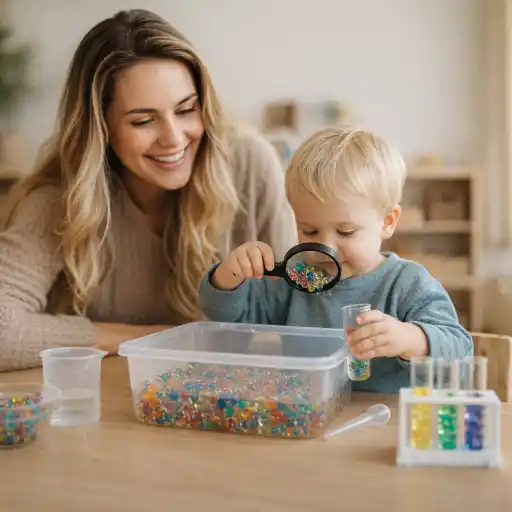
NAEYC’s discussion of toddler science describes how everyday classroom and outdoor experiences can reveal concepts such as solids and liquids, change, and cause and effect. Mud play can also join sensory, language, cooperation, and problem-solving experiences when adults describe children’s actions and invite them to notice what changes as water is added.
🧊 Keep the experience simple: a few contrasting materials and enough time to repeat an action are often more valuable than a crowded sensory bin.
How can providers plan sensory investigations safely and inclusively?
Thoughtful planning starts with the children—not just the activity idea. Consider each toddler’s developmental abilities, mouthing behavior, allergies, mobility, communication, and sensory preferences. Choose materials that are intact, non-toxic, age-appropriate, and too large to pose a choking hazard. Avoid small loose parts and anything sharp, breakable, or otherwise unsuitable for the children who will use it.
Prepare the space so children can explore while educators maintain active supervision. Place materials on a stable, easy-to-clean surface, keep the group size manageable, and decide in advance how materials will be cleaned and stored. During water play, remain close and attentive throughout, and empty containers immediately after use. Follow your program’s policies and applicable health and safety guidance; state requirements vary - check your state licensing agency.
Inclusion means offering meaningful ways to participate, not requiring every child to interact identically. A toddler may watch, point, use a tool instead of touching a material, communicate in a home language, or explore alongside a peer. Adapt the position of materials, provide larger tools when helpful, and respect a child’s decision to pause or step away. NAEYC’s guidance on mud play, for example, suggests accessible trays and tools for children who are hesitant about touching mud directly.
- Check materials for size, cleanliness, damage, and possible allergens before use.
- Offer choices and tools so children can engage at their comfort level.
- Keep the setup manageable, visible, and easy to clean.
How can a daily lesson plan support inquiry without making play rigid?
A brief plan helps educators prepare materials and identify what learning they hope to notice, while leaving room for toddlers to change direction. Use a daily lesson plan template as a guide—not a script. ChildCareEd’s article on baby steps to science emphasizes observing children’s repeated actions and building from their interests. A simple plan can connect those observations to a flexible next step.
Include a few practical elements:
- Observed interest: What have children been watching, touching, or repeating?
- Learning focus: What concept or process might the experience invite, such as comparing textures or noticing a change?
- Materials and safety: What will be offered, and how will the space be supervised and cleaned?
- Adult language: Which brief comments or open prompts may extend attention without directing every move?
- Observation and next step: What did children do, and what might be worth revisiting?
Keep documentation specific and objective: “Maya squeezed the sponge three times and watched water fall into the tray” is more useful than “Maya understood absorption.” Record children’s words or gestures when meaningful, then reflect with colleagues. The plan should help the team notice learning, communicate across shifts, and adapt the next experience—not pressure children to complete a predetermined outcome.
What common pitfalls can educators avoid?
Even joyful sensory play can lose its inquiry value when adults move too quickly, offer too much, or prioritize a neat result over children’s thinking. A few small adjustments can protect both the learning and the fun.
- Explaining before children explore: Pause and let children observe first; share words that describe rather than dictate the result.
- Asking too many questions: Offer one clear prompt, wait, and follow the child’s response.
- Expecting verbal explanations: Notice pointing, repeated actions, gaze, and gestures as meaningful communication.
- Overloading the setup: Begin with a few materials so children can focus and compare.
- Confusing a plan with a script: Follow children’s cues and adapt or end the experience when interest fades.
- Overlooking safety and access: Check materials and supervision needs before play, and offer more than one way to participate.
Also avoid treating a surprising result as failure. If a toddler predicts that an object will sink and it floats, the moment creates a reason to look again. Neutral language—“That surprised us,” or “Let’s see what happens when we try again”—supports confidence and persistence. Shared reflection among educators can further strengthen practice; NAEYC describes teacher collaboration and inquiry as important supports for high-quality science experiences with toddlers.
Conclusion: How does sensory play become toddler science?
Sensory play becomes a science investigation when educators notice children’s interests, offer safe and accessible materials, allow repeated exploration, and respond with language that helps children attend to what happens. Toddlers do not need formal experiments or advanced explanations to practice observation, prediction, testing, and communication. Their hands-on play is already a meaningful beginning.
Plan with flexibility: identify a simple focus, prepare a safe environment, document what children actually do, and use those observations to choose a next step. Most of all, trust children’s curiosity. With supportive adults and room to explore, an everyday sensory moment can grow into a rewarding classroom investigation.
For a deeper professional learning experience, explore Building Early Science Foundations Buy Now $16.00 or strengthen your planning practice with Meaningful Lesson Planning for Infants/Toddlers Buy Now $24.00. Check course details and verify any training-hour requirements with your program or licensing agency.
- 45 Hour Child Growth and Development
- 45 hour Growth and Development Birth-age 12 ONLINE
- CDA Infant/Toddler Credential
- The ABCs of Behavior: Turning Challenges into Learning Opportunities
- Tomorrow's Einsteins: Infant and Toddler Science
- Play with Purpose: Supporting Children with Autism
- Texas Director Credential
- Montessori Cultural Activities: Exploring the World Through Play and Learning
- Building Early Science Foundations
- Enhancing STEM Education for Infants and Toddlers
- ¿Cuáles son las mejores actividades del Día de la Tierra para niños en casa o en el aula?
- 10 Ejemplos de Cómo la Cultura Influye en el Desarrollo Infantil
- Actividades de Otoño Fáciles para Preescolares esta Temporada
- Calabazas, hojas y manzanas: actividades de otoño para preescolares
- Celebrando la amistad en el cuidado infantil durante el Día de los Mejores Amigos
- Canciones, juegos y preguntas de círculo para niños
- How can we explore sand, space, and science with young children in preschool settings?
- National Massachusetts Day for Kids: Explore the Bay State Through Play
- What’s Happening Outside? Fall Science Adventures for Preschoolers
- Fall Detectives: 10 Questions Pre-K Kids Can Investigate This Season
- No Playground Today! Rainy Day Activities for Kids All Ages.
- Can You See the Wind? 8 Outdoor Spring Activities That Help Children Explore It
- How Do Light vs. Heavy Activities Build Early Measurement Skills?
- How Can Child Care Providers Design Learning Centers That Support Play and Development?
- How Can Simple Sorting Activities Build Sustainable Habits in Early Childhood?
- How Can Educators Turn Indoor Insect Interest into Outdoor Investigation?
- How Can You Set Up Learning Centers in a Preschool Classroom?
- How Can One Science Question Become a Preschool Investigation?
- How Can Toddler Sensory Play Become a Science Investigation?
