A fallen leaf may look finished, but it is beginning a remarkable process of change—and a classroom investigation can help children notice that change for themselves. Explore Creating the Natural Outdoor Classroom  Buy Now $16.00 to build practical skills for using nature as a purposeful learning environment, and consider Building Early Science Foundations Buy Now $16.00 for strategies that support young children’s curiosity and inquiry. These courses offer a deeper professional learning experience as you plan an accessible, hands-on investigation that children can revisit over time.
Why is a fallen-leaf investigation meaningful for preschoolers?
Decomposition turns a familiar object into a story that unfolds gradually. Children see a leaf fall, but they may not yet understand that it can soften, break apart, and become part of the soil. Tracking those changes makes an otherwise hidden natural process concrete and gives children a reason to look closely, compare evidence, and return with new questions.
The investigation is about more than learning a science fact. When educators create time for children to observe, predict, discuss, and represent what they notice, they support early reasoning, vocabulary, collaboration, and persistence. Karen Worth’s discussion of science in early childhood classrooms emphasizes that children’s curiosity about the natural world can anchor inquiry while connecting science with language, mathematics, and working together.
Leaf studies also make environmental cycles visible. Decomposers—including fungi and bacteria—break down dead plant material, helping return nutrients to the environment. For preschoolers, you do not need to explain every biological detail. Begin with what they can observe: a leaf that was crisp is now softer, or a piece has become smaller and darker.
- Invite children to ask what might happen to a leaf after it falls.
- Support careful noticing rather than expecting a quick, fixed answer.
- Use the investigation to connect children with care for the natural world.
How can educators set up a simple, repeatable investigation?
Choose a small number of fallen leaves and a consistent place to observe them. If possible, collect leaves from a clean, familiar area and identify the plant before inviting children to handle them. Compare a dry leaf with a fresh leaf, or place one leaf in a clear, ventilated container outdoors in a protected spot. A second leaf kept in a dry indoor location can offer a comparison, but avoid presenting the setup as a controlled experiment unless you carefully manage conditions.
Begin with a shared question: “What do you think will happen to this leaf?” Record children’s predictions in their own words. Then return on a regular schedule—perhaps every few days or once a week—and observe together. A predictable routine helps children recognize that scientific learning can involve waiting and noticing small differences.
Offer basic tools such as a hand lens, a clipboard, a simple photo journal, and pencils or crayons. Children can draw, point, dictate, or choose a photograph; conventional writing is not required. A repeatable outdoor observation routine can help educators plan how to revisit a natural subject and preserve children’s thinking.
- Set a baseline: record the leaf’s color, texture, shape, and condition.
- Keep location and observation intervals as consistent as practical.
- Take a photo or make a drawing from a similar viewpoint each time.
- Ask children what changed and what stayed the same.
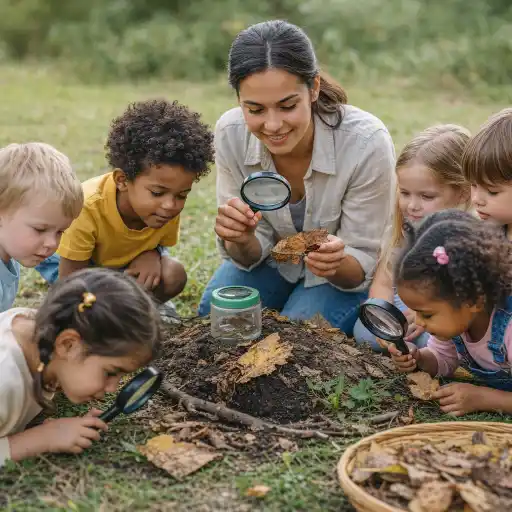
What can children observe and document as a leaf changes?
Make the journal a record of children’s observations, not a test of scientific vocabulary or drawing skill. On each visit, invite them to look closely and describe evidence. A child may notice that a leaf has become curled, spotted, softer, or more fragmented. Another may see that the color has changed or that the leaf is damp after rain. Preserve children’s exact words where possible; their explanations reveal how they are making sense of the process.
A photo journal can make gradual change easier to compare. Place a ruler or familiar object nearby for scale, but do not require measurement if it distracts from observation. Educators can add a date, a short child quote, and one neutral description. For example: “October 8: The edge is torn, and the leaf feels softer than last time.” This kind of documentation makes learning visible to colleagues and families while helping educators plan the next question.
Try prompts that invite comparison and reflection:
- “What do you notice first?”
- “How is today’s leaf different from the picture we made before?”
- “What might have caused that change? What evidence do we have?”
- “What would you like to check on our next visit?”
Children can sort photographs into “earlier” and “later,” dictate captions, or create a class sequence showing the leaf’s changes. These representations make an extended investigation manageable and meaningful.
How can educators explain decomposition accurately and accessibly?
Use language that is scientifically sound but appropriate to children’s experience. Explain that a fallen leaf does not simply disappear: over time, living things and environmental conditions help break it into smaller pieces. Fungi and bacteria are important decomposers, though children may not be able to see these tiny organisms without special equipment. Insects and other small animals may also feed on or fragment decaying material. Water, temperature, and the location of the leaf influence how quickly visible changes happen.
Keep explanations connected to evidence. If children notice a dark, soft leaf, you might say, “This leaf is changing. Small living things help break dead plants into pieces, and those materials can become part of the soil.” A child-friendly source such as the Brooklyn Botanic Garden’s introduction to compost and decomposition can help educators frame the idea that natural materials break down and contribute to soil.
Avoid implying that every leaf will decompose at the same speed or that a particular small animal is responsible without evidence. Decomposition varies with conditions, and some parts of the process are invisible. “We don’t know yet—let’s look for clues” models scientific humility and keeps inquiry open. The aim is a grounded early understanding: leaves change, decomposers help break them down, and materials cycle through the environment.
How can providers keep the inquiry safe, inclusive, and engaging?
Plan for supervision and hygiene before children begin. Inspect the area and materials, avoid leaves from roadsides or locations that may be contaminated, and do not allow children to taste leaves, soil, fungi, or small organisms. Identify plants where possible, consider family allergy information, and have children wash hands after outdoor exploration. State requirements vary - check your state licensing agency.
Inclusion means offering multiple ways to investigate. Children can observe from a path, use a magnifier or photo, draw indoors, dictate an observation, or take a turn as the group’s photographer. Offer adaptive tools and a quiet observation option when helpful. Children do not need to touch a leaf to participate as scientists.
Keep the project sustainable for staff, too. A short observation session repeated over time is often more valuable than an elaborate setup that is difficult to maintain. One common pitfall is expecting dramatic changes at every visit. Instead, treat small differences—or no obvious difference—as useful information and invite children to decide what to look for next.
- 🍂 Establish clear boundaries and active supervision outdoors.
- Use photographs or educator-handled samples if a material’s safety is uncertain.
- Offer a weather backup, such as comparing dated photographs indoors.
- Share a child quote and image with families to show the investigation’s progression.
Conclusion: What happens to a fallen leaf?
A fallen leaf gradually changes as weather, moisture, and decomposers help break it into smaller pieces. Over time, its materials can become part of the soil and the wider cycle of life. Preschoolers can begin to understand this process by observing real leaves, recording what changes, comparing evidence, and discussing what they wonder.
Start small: choose a safe leaf, invite a prediction, and return to it regularly with a photo journal or drawing. Keep explanations accurate and age-appropriate, make participation flexible, and let children’s questions guide the next observation. A leaf investigation is not about rushing to a perfect answer; it is about helping children notice that nature is always changing—and that their careful observations matter.
For additional professional learning, explore Creating the Natural Outdoor Classroom Buy Now $16.00, Building Early Science Foundations Buy Now $16.00, Basic Science in Early Childhood Buy Now $25.00, CDA: Creating the Outdoor Classroom Buy Now $16.00, and Preschool Assessments & Observations Buy Now $24.00. For a ready-to-use classroom extension, feature the Leaf Changes Photo Journal and Investigation Prompts resource alongside children’s own drawings and observations.
- CDA Preschool Credential
- CDA Preschool Credential with Portfolio Review
- Birth to Five CDA Credential with Portfolio Review
- CDA Bridge Bundle: Preschool
- CDA Bridge Bundle: Family Child Care without Portfolio Review
- CDA Bridge Bundle: Infant/Toddler without Portfolio Review
- CDA Bridge Bundle: Preschool without Portfolio Review
- Emergent Learning & Development
- Texas Director Credential
- Every Moment Matters: Schedules and Transitions
- Que es Título 22 en California?
- Actividades de Motricidad Gruesa que Desarrollan el Equilibrio, la Coordinación y la Fuerza
- 10 Ejemplos de Cómo la Cultura Influye en el Desarrollo Infantil
- Capacitación en Salud y Seguridad Preventiva en Línea para Proveedores de Cuidado Infantil
- Regulaciones de Licenciamiento de Cuidado Infantil en California para Centros y Hogares de Cuidado Infantil Familiar
- Proporciones de Cuidado Infantil y Tamaños de Grupo por Edad en Maryland (Guía Rápida para Centros y Hogares)
- Proporciones de Cuidado Infantil y Tamaños de Grupo por Edad en Virginia (Guía Rápida para Centros y Hogares)
- Actividades de Otoño Fáciles para Preescolares esta Temporada
- Cómo Ser Maestra de Preescolar en Virginia
- Calabazas, hojas y manzanas: actividades de otoño para preescolares
- Celebrando la amistad en el cuidado infantil durante el Día de los Mejores Amigos
- Canciones, juegos y preguntas de círculo para niños
- Cómo simplificar la capacitación para sus empleados de daycare
- Go on a Fall Hunt! Outdoor Learning Challenges for Preschoolers
- Can You Build a Leaf Bridge? Fall STEM Challenges for Pre-K
- How Can You Plan an Engaging Fall Curriculum for Preschoolers?
- How Can Preschool Teachers Use Fall Experiences to Support Individual Learning Needs?
- What Happens to Fallen Leaves? Exploring Decomposition With Young Children
- How Can One Leaf Collection Become a Week of Child-Led Learning?
- What Happens to a Fallen Leaf? How Can Preschoolers Investigate Decomposition?
