What does science learning look like for infants and toddlers?
For very young children, science is not a formal lesson or a collection of facts to memorize. Rather, scientific thinking develops through active engagement with people, objects, and events: noticing, exploring, repeating actions, and observing their consequences. An infant who drops a soft toy and watches an adult retrieve it is exploring an action and its result. A toddler who fills and empties a container is investigating capacity, movement, and cause and effect. These experiences are early forms of scientific inquiry, even when children do not yet have the language to articulate their observations.
Educators can identify this learning by observing sustained attention, repeated actions, shifts in a child’s approach, and gestures or vocalizations that signal interest. The goal is not to test the child or rush toward a correct answer, but to provide space for safe exploration and respond to the child’s cues. Play-based experiences are an appropriate foundation for early STEM learning with infants and toddlers, as described in Baby Steps to STEM: Infant and Toddler Science, Technology, Engineering, and Math Activities.
How can educators support infant science through responsive interactions?
Infant science begins with sensory and motor exploration within a secure relationship. Offer a small selection of safe, age-appropriate objects with contrasting textures, shapes, or sounds, and allow the infant time to look, reach, grasp, mouth when appropriate, and release. Stay close, supervise continuously, and follow the program’s safety practices. Avoid small objects, unsafe materials, and anything that could break, present a choking hazard, or otherwise be unsuitable for the child’s age and abilities.
Watch what captures the infant’s attention, then respond without taking over. If a baby repeatedly shakes a rattle, you might say, “You moved it, and it made a sound.” If the infant looks toward a window or follows a moving object, describe what you notice and pause to see whether the child continues the interaction. Calm narration connects actions with outcomes and supports language development while preserving the infant’s opportunity to explore.
Use familiar routines as opportunities for observation. During a supervised water-play experience or a mealtime, an infant may notice that materials feel, move, or sound different. Keep the experience brief and guided by the child’s engagement; infants may need time to rest or shift attention. Record specific observations, such as what the child looked at, reached for, or repeated, rather than making assumptions about what the child understood. Share these observations with families to connect classroom interests with familiar experiences at home.
What science experiences are appropriate for toddlers?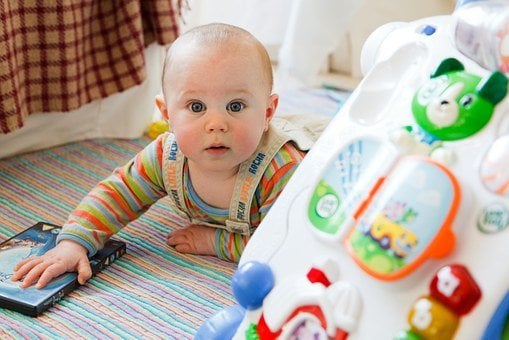
Toddlers can investigate simple questions through repeated, hands-on play. Provide sturdy containers for filling and emptying with large, safe objects; offer blocks that can be stacked, knocked down, and rebuilt; or invite children to notice how a ball moves across different safe surfaces. With close supervision and materials selected for the children’s ages and abilities, outdoor walks can prompt noticing of wind, shadows, leaves, or puddles. These are not demonstrations with a prescribed result: the value lies in children’s opportunities to act, notice, and try again.
Use open-ended prompts that invite observation rather than demand a particular answer: “What changed when you tipped the container?” “Where did the ball go?” or “What do you notice about this leaf?” Such questions invite children to compare observations, communicate emerging explanations, and revisit an investigation without implying that one response is expected. Toddlers may answer with words, gestures, facial expressions, or action. Acknowledge their ideas and give them time to respond. If interest continues, offer a small variation—such as a different-sized container or another ball—while keeping the activity manageable and safe.
Educators can extend investigations by documenting children’s words and actions, revisiting the experience, and offering related materials. For additional ideas about responsive observation and planning, see how child care providers can support infant and toddler development. For example, if a toddler returns to stacking, provide blocks with varied shapes and stable space to build. Connect exploration to early mathematics and language by naming size, position, movement, and quantity in context. For additional ideas about hands-on exploration, see how educators can encourage scientific thinking through hands-on exploration and how to introduce STEM concepts in early childhood.
How can educators plan safe, inclusive science exploration?
Start with children’s observed interests, developmental abilities, and individual access needs. Choose materials that children can explore in more than one way, and adapt positioning or tools where appropriate. A child can participate by watching, reaching, listening, moving, or communicating through an individual communication method. Avoid treating one response as the expected outcome; the same activity may invite different forms of participation and discovery.
Before an experience, check that materials are clean, intact, and appropriate for the children using them. Consider supervision, allergies, mouthing behavior, mobility, and the layout of the space. Keep the selection simple enough for children to engage with, and remove materials promptly when they become damaged or unsafe. Follow applicable program policies and health and safety guidance; the examples here are educational ideas, not substitutes for individualized safety planning.
Planning can remain flexible. Note the materials offered, children’s observable responses, and possible next steps. If children lose interest, end or change the experience rather than insisting they continue. If a child returns to an activity, consider what small adjustment could deepen exploration without making the task unnecessarily complex. Educators seeking broader ideas can explore STEAM learning in the early childhood education classroom, using everyday materials for meaningful STEM exploration, and how blocks, water play, cooking, and outdoor exploration introduce STEM.
How can educators build on children’s science interests?
Observe before planning: What does the child return to? Which actions are repeated? What seems to surprise or engage the child? Use those observations to select a small next step, such as offering another safe object with a different texture or giving a child more time to repeat an investigation. Describe what you see, listen for children’s cues, and document meaningful moments so colleagues and families can recognize emerging interests.
For professional learning focused specifically on infant and toddler science, educators may explore Tomorrow’s Einsteins: Infant and Toddler Science  Buy Now $16.00 and Building Early Science Foundations Buy Now $16.00. These course links are training options, not a guarantee of state or employer approval; check applicable requirements with the relevant agency, registry, or employer. Broader infant and toddler learning topics are covered in Early Learning with Infants and Toddlers Buy Now $24.00.
Summary: How can educators nurture early science?
Infants and toddlers begin exploring scientific ideas through everyday interactions with materials, people, and their environment. Educators can support this learning by following children’s interests, providing safe and accessible materials, allowing time for repeated exploration, using responsive language, and recording what children actually do. There is no need to turn play into a test: careful observation and thoughtful, developmentally appropriate extensions help children continue to explore and discover. #Science #Infants #Toddlers #STEM #Curiosity
Scientific learning may appear to be the subject for high school and college students, but believe it or not, it all begins with infants and toddlers!
Science is not just a subject of knowledge, but rather a way of thinking and acting. It is the study of discovering the nature of things and how they work. Science learning at any age involves curiosity, exploration, and discovery. These traits come naturally to most infants and toddlers.
Infant and toddler teachers can help children explore questions and investigate what interests them. For focused professional learning, explore Tomorrow’s Einstein’s: Infant and Toddler Science Buy Now $16.00 and Building Early Science Foundations Buy Now $16.00. Course acceptance varies by state, registry, employer, and role; verify eligibility before enrolling.
Course hours, CEUs, and eligibility for professional development credit vary by course and jurisdiction. Before enrolling, confirm the specific course’s current acceptance, required topics, and credit value with your licensing agency, registry, or employer. Visit the course catalog to review available training.
- Building Early Science Foundations
- CDA Infant/Toddler Credential
- Tomorrow's Einsteins: Infant and Toddler Science
- Birth to Five CDA Credential with Portfolio Review
- CDA Infant/Toddler Credential with Portfolio Review
- CDA Bridge Bundle: Infant/Toddler without Portfolio Review
- CDA Bridge Bundle: Infant/Toddler
- 45-Hour Infant and Toddler Curriculum
- Montessori Cultural Activities: Exploring the World Through Play and Learning
- Enhancing STEM Education for Infants and Toddlers
- SIDS Science: What Every Parent Needs to Know About Safe Sleep
- How Can Online ECE Training Transform Your Understanding of Child Development?
- 🚌❄️ Ideas de excursiones en Dakota del Norte
- ¿Cómo obtengo la certificación CDA en línea en Florida?
- Las Mejores Ideas de Excursiones para Guarderías en Dakota del Norte
- What age-appropriate learning activities should we use for infants, toddlers & preschoolers in New York?
- 8-Week-Old Baby Milestones: What Should Your Baby Be Doing?
- Baby Development by Week: Signs, Growth, and Red Flags
- How can Michigan infant caregivers prevent Shaken Baby Syndrome?
- How can I create a nurturing infant environment in my childcare program?
- What is SIDS prevention training and how can childcare providers use it to keep babies safe?
- How Can Child Care Providers Prevent SIDS and Use Safe Sleep Practices?
- Infant Lesson Plans for Play, Care, and Development
- How Can DC Providers Support Infants During the Child Care Subsidy Waitlist?
- How can school-age daycare use outdoor activities to teach, play, and stay safe?
- What Does the Science of Peekaboo Reveal About Infant Learning?
- Baby’s First Fall: Simple Ways to Explore the Season Through Play
- Hello, Fall! Cozy Activities to Help Babies Explore the Season
- How Can Infant Care Staff Prepare to Support a Baby with an Ongoing Health Condition?
- How Can Toddler Sensory Play Become a Science Investigation?
