Well-designed learning centers transform a classroom into an environment where children make choices, investigate ideas, and practice skills through meaningful play. If you want practical guidance for planning purposeful centers, the Spicing Up the Classroom: Learning Centers  Buy Now $16.00 course can deepen your understanding while supporting professional learning in CDA Subject Area 2. For broader room-design strategies, consider Classroom Setup for Child Care Buy Now $24.00, which focuses on creating welcoming, inclusive, and developmentally appropriate environments.
Why do learning centers matter in early childhood programs?
Learning centers are more than designated corners with attractive materials. They are intentional environments that invite children to choose, explore, collaborate, revisit ideas, and communicate meaning. When children engage in sustained play, they practice language, problem-solving, self-regulation, motor coordination, and social negotiation. The Texas Education Agency describes high-quality centers as hands-on, open-ended, freely chosen, and connected to meaningful learning experiences (Learning Centers/Stations in Early Childhood Classrooms).
For providers and directors, effective centers also make teaching more responsive. Rather than directing every action, educators can observe children’s interests and provide carefully timed questions, materials, or challenges. This approach honors children as capable learners while still giving adults a clear instructional purpose.
Learning centers can also support a stronger classroom community. Children learn to share space, negotiate roles, care for materials, and participate in routines. These experiences are especially valuable when the environment offers predictable choices without becoming rigid or overcrowded.
- 🔹 Children develop independence by selecting and returning materials.
- Centers connect play with literacy, mathematics, science, art, and social-emotional learning.
- Teachers gain natural opportunities to observe, document, and extend development.
Intentional center design helps the room become a partner in teaching rather than a backdrop. The goal is not to create a perfect display; it is to create a flexible environment that makes meaningful #learning possible.
How should providers plan learning centers before arranging the room?
Begin with the children rather than the furniture. Consider their ages, developmental strengths, interests, languages, sensory preferences, mobility, and current learning goals. A center designed for toddlers will require different materials, group sizes, and supervision than one designed for preschoolers. Individualization is essential because developmentally appropriate practice recognizes both common developmental patterns and meaningful differences among children (Individuality and Inclusive Practices for Early Childhood).
Before purchasing materials, answer three planning questions:
- What one or two skills or concepts should this center support?
- How many children can participate safely and comfortably?
- How will the center connect to children’s interests, families, curriculum, and routines?
Next, sketch the room. Mark doors, sinks, windows, storage, exits, and adult sight lines. Identify areas that are naturally noisy or messy and place them where supervision and cleanup are manageable. A block area may need enough open floor space for several children, while a reading area benefits from reduced traffic and softer acoustics. LibreTexts recommends considering space allocation, location, organization, and the particular developmental purposes of centers (Setting up the Learning Centers).
Plan a rotation system before the year becomes busy. Store supplemental materials in labeled tubs and introduce a small number of materials at a time. Three to seven carefully selected items may be more inviting than an entire shelf of unrelated choices. Keep a brief planning record that identifies the goal, materials, possible questions, safety considerations, and what staff should observe.
Which centers and materials best support whole-child development?
A balanced classroom usually includes several core centers, but the exact arrangement should reflect available space and children’s needs. Common options include blocks or construction, dramatic play, art, literacy, writing, mathematics, science and discovery, sensory play, music and movement, and a quiet or calming area. These categories should not become isolated subjects. Strong environments allow children to carry ideas and materials across areas, creating richer forms of cross-area play.
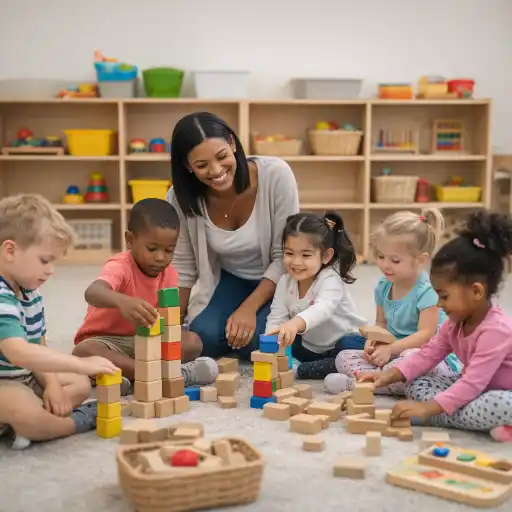
Materials should be open-ended, durable, culturally responsive, and developmentally appropriate. Blocks, fabric, cardboard, natural objects, magnetic tiles, play dough, clipboards, puppets, books, measuring tools, and loose parts can support many kinds of thinking. In construction play, children explore balance, spatial relationships, planning, and early engineering. In dramatic play, they develop language, perspective-taking, cooperation, and symbolic thought. In literacy areas, books and storytelling props create authentic reasons to communicate, listen, draw, and write.
- Construction: varied blocks, ramps, vehicles, tubes, and loose parts.
- Dramatic play: realistic props, culturally diverse role-play materials, menus, signs, and writing tools.
- Art: paper, clay, paint, collage items, drawing tools, and process-focused invitations.
- Science and sensory: magnifiers, natural objects, water, sand, droppers, and observation tools.
- Literacy and writing: books, puppets, story cards, labels, blank books, markers, and clipboards.
Safety must guide selection. Inspect materials for choking hazards, sharp edges, toxic substances, breakage, and sanitation concerns. Include books, images, and props that reflect children’s families, cultures, abilities, and languages. State requirements vary - check your state licensing agency before introducing specialized equipment, water materials, or small loose parts.
How can the physical layout promote independence, supervision, and calm?
The physical arrangement communicates expectations before an adult says a word. Low shelves, picture-and-word labels, baskets, and clearly defined boundaries help children understand where materials belong and how to participate. At the same time, boundaries should not create blind spots. Staff need unobstructed sight lines and enough space to move quickly between areas.
Place active centers, such as blocks, dramatic play, and music, near one another when possible. Keep quieter areas, including books, puzzles, and writing, away from the highest levels of movement and sound. Messy centers work best near sinks or on washable surfaces. A science or nature area may benefit from natural light, while a calming space should be cozy, partially enclosed, and visible to adults. The classroom-space guidance from ChildCareEd emphasizes clear zones, open pathways, low shelving, balanced activity levels, and simplified material choices (Designing Classroom Spaces That Support Learning and Play).
Design for children’s actual group sizes. If four children are likely to build together, the block center needs sufficient floor area and storage. If only two children can use a sensory bin comfortably, establish a simple capacity routine. Visual markers, name cards, or a limited number of center spaces can make access fairer without eliminating choice.
Independence also depends on predictable routines. Teach children how to select materials, use tools, ask for help, solve conflicts, and clean up. Model one step at a time, practice when the classroom is calm, and use photographs or icons for children who benefit from visual information.
How can teachers connect playful exploration to intentional learning?
Purposeful learning does not require turning play into a worksheet. Instead, identify a learning intention and design conditions that make exploration possible. A mathematics goal might involve counting, comparing quantities, measuring, or noticing patterns. A literacy goal might involve vocabulary, storytelling, print awareness, or communication. The objective should guide the environment without dictating a single correct product.
Provocations are brief invitations that encourage investigation. A basket of tubes beside blocks might prompt, “How can you make a road that goes under the bridge?” A collection of leaves and magnifiers might invite, “What differences do you notice?” In dramatic play, adding order forms, menus, maps, or appointment cards can deepen language and mathematical thinking.
Use a restrained sequence of teacher moves:
- Observe: Notice what children choose, repeat, avoid, explain, or negotiate.
- Listen: Record children’s words, theories, and questions.
- Ask: Offer one open-ended question rather than a series of adult directions.
- Extend: Add a related material, vocabulary word, representation, or manageable challenge.
- Document: Capture a photograph, quotation, work sample, or short observation.
Documentation should inform the next decision. If children repeatedly build towers that fall, add photographs of stable structures, longer blocks, or a balance scale. If children avoid writing, offer clipboards in dramatic play or provide invitations to make signs for construction. The most powerful assessment often occurs during ordinary play because children demonstrate skills in authentic contexts.
Protect uninterrupted center time whenever possible. Frequent transitions can fragment complex play, while longer periods allow children to plan, revise, collaborate, and return to ideas. Schedules should balance child choice with predictable routines and developmentally appropriate pacing (Helping Children Understand Routines and Classroom Schedules).
How can directors and teachers avoid common learning-center problems?
Even thoughtful centers can become ineffective when materials, staffing, or routines are not reviewed. Treat difficulties as information about the environment rather than evidence that children are failing. A quick team reflection can reveal whether a center is too crowded, too difficult, too repetitive, poorly located, or insufficiently supported.
- Overcrowded shelves: Remove duplicates, rotate materials, and display only what children can use meaningfully.
- Over-directed play: Model briefly, then observe and let children lead whenever safety allows.
- Frequent conflict: Reduce group size, add duplicate high-interest materials, and explicitly teach turn-taking.
- Centers that are ignored: Connect materials to current interests, add a compelling provocation, or relocate the area.
- Unsafe access: Adjust materials and supervision to age, ability, and licensing expectations.
- Messy transitions: Use visual schedules, cleanup songs, labeled containers, and consistent staff roles.
Inclusive design requires more than placing diverse pictures on a wall. Ask whether every child can physically reach the materials, understand the routine, communicate choices, participate with peers, and show learning in more than one way. Provide visual supports, adapted tools, varied seating, sensory options, home-language materials, and collaboration with families and specialists when appropriate. The goal is access, participation, and meaningful support for all children (Building an Inclusive Environment in Early Childhood Classrooms).
Directors can strengthen consistency by creating a short center checklist covering setup, supervision, cleaning, rotation, and documentation. Review the room with staff, invite their observations, and trial one change for a defined period. Small adjustments, evaluated thoughtfully, are often more sustainable than a complete redesign.
Conclusion: What makes learning centers effective?
Effective learning centers combine intentional planning with genuine child choice. They provide open-ended materials, clear organization, appropriate challenge, safe access, and enough uninterrupted time for children to develop complex play. They also position educators as careful observers who extend learning without taking control of it.
To strengthen your centers this week:
- Map the room and identify one layout change that would improve sight lines or traffic flow.
- Choose one learning goal for each priority center.
- Remove excess materials and add one open-ended provocation.
- Teach or revisit a visual routine for choosing, using, and returning materials.
- Document one child’s idea and use it to plan the next invitation.
- Check accessibility, representation, sanitation, and licensing expectations.
The central question is not how many centers a classroom contains, but whether each area helps children feel capable, curious, connected, and ready to learn. When environments are thoughtfully designed, #centers become active partners in teaching, and #children gain repeated opportunities to #play, communicate, investigate, and grow.
Additional ChildCareEd courses:
- Classroom Designers ONLINE Buy Now $24.00 — explores age-appropriate classroom design and materials.
- Creating Environments that Nurture Growth and Community Buy Now $55.00 — connects room arrangement, learning centers, inclusion, families, and outdoor environments.
- Facilitating Learning in the Preschool Classroom Buy Now $35.00 — focuses on intentional planning and child-led learning experiences.
- 45 Hour Child Growth and Development
- Bienvenido! Welcoming All Families
- 24 Hour Texas Pre-Service
- The Best Promotion is Play
- Play with Purpose: Supporting Children with Autism
- Creating Engaging and Meaningful Learning Experiences
- Creating Environments that Nurture Growth and Community
- Texas Director Credential
- How motor skills shape child development and creative ways educators can foster them.
- CDA Certification en Español: Recursos y Consejos para Educadores Bilingües
- How can I organize an effective preschool classroom?
- Learning Through Creative Daycare Activities
- How can I create engaging learning centers in my classroom?
- Canciones, juegos y preguntas de círculo para niños
- Designing Classroom Spaces That Support Learning and Play
- How can I create a daily schedule that meets Michigan's active learning expectations?
- How can I make the case for play-based learning in my Michigan program?
- How can I create engaging learning centers for preschoolers?
- What Is the Reggio Emilia Approach and How Can Child Care Programs Use It?
- How Can I Create Engaging Learning Centers for Preschoolers?
- How Can You Turn a Superhero Theme Into a Full Week of Preschool Learning Centers?
- How Can Recycled Materials Create Engaging Learning Centers?
- How Can Child Care Providers Help Children Build Healthy Friendship Skills?
- How Can Child Care Providers Make Outdoor Learning Meaningful, Safe, and Inclusive?
- How Can Child Care Providers Design Learning Centers That Support Play and Development?
- How Can Child Care Providers Create Effective Learning Centers in Small Spaces?
- How Can You Set Up Classroom Learning Centers for Maximum Engagement?
- When Do Too Many Materials Make a Learning Center Harder to Use?
