Children may not be able to see wind, but they can feel it, hear it, and observe what it does. Thoughtfully planned spring experiences turn that invisible force into meaningful #science, movement, language, and creative learning; for deeper guidance, explore Creating the Natural Outdoor Classroom  Buy Now $16.00 to strengthen outdoor environment design and earn practical professional development hours.
Why does exploring wind matter in early childhood?
Wind is an especially accessible topic because children encounter it in ordinary moments: hair moves, flags wave, leaves scatter, and bubbles drift. These visible effects give children concrete evidence for an abstract idea. The American Chemical Society explains that wind is moving air and that tiny air particles can push objects. For young children, however, the most useful starting point is simple language: “Wind is air that moves.”
Outdoor inquiry also supports much more than science knowledge. The CDC notes that outdoor play gives children opportunities to move, test limits, develop physical skills, and engage attention, language, and emotional development. NAEYC similarly describes nature as a setting rich in physical, sensory, cognitive, social, and emotional learning.
Providers do not need elaborate equipment. A ribbon, paper, bubble wand, or lightweight object can become a tool for observation. The educator’s role is to slow down, notice children’s questions, and extend their thinking without taking over.
How can children observe wind with their senses?
Begin with a short “wind detective” walk. Invite children to stand quietly and notice how the air feels on their faces, how it sounds through trees, and what objects are moving. Offer scarves, ribbons, or streamers attached to craft sticks so children have a visible indicator of moving air. Ask, “How do you know the wind is here if you cannot see it?”
Repeat the experience on a calm day when possible. Comparing windy and still conditions encourages children to describe differences and use evidence. Add simple vocabulary such as breeze, gust, blow, move, and observe. Children can draw what they noticed or dictate a sentence for a class weather journal.
- What moved fastest?
- Did the wind feel cool, warm, gentle, or strong?
- Did the streamer move in one direction or several?
- What sounds did the wind make?
These prompts support oral language, sensory awareness, and early documentation. Avoid correcting every explanation immediately; instead, respond with curiosity: “That is your idea. What could we test?”
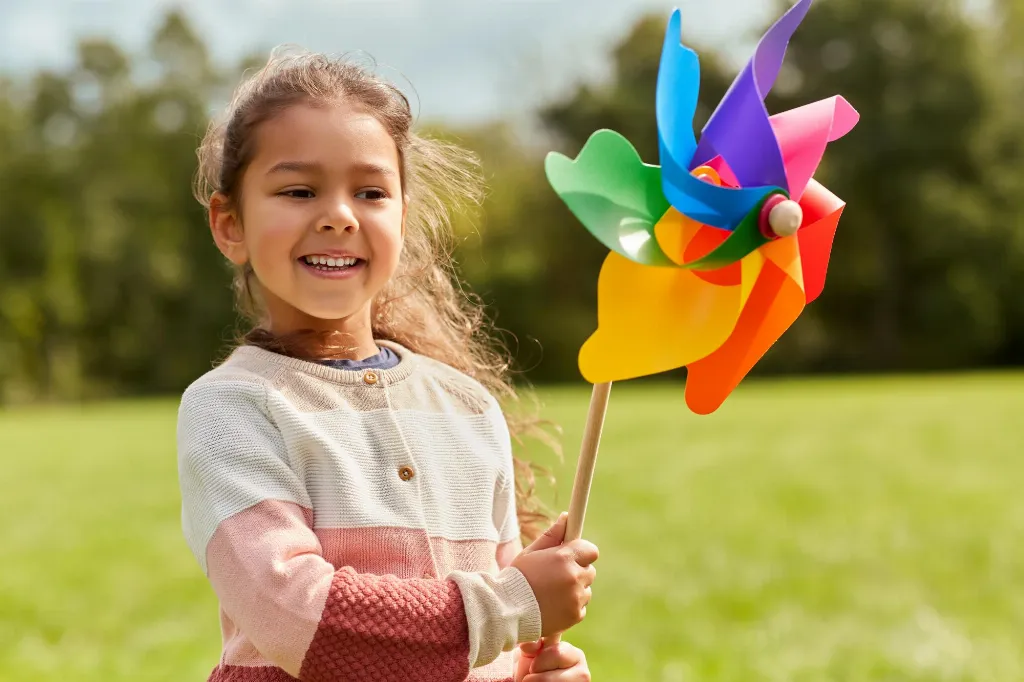
Which eight outdoor spring activities make wind visible?
- Streamer study: Tie ribbons to a fence or stick and compare their movement in different locations.
- Pinwheel investigation: Children decorate pinwheels, then test whether walking, standing, or facing different directions changes how quickly they spin.
- Windsock design: Create windsocks from paper and crepe-paper strips. Observe them daily and discuss direction and strength.
- Bubble watching: Blow bubbles and track how the wind changes their path, size, and speed.
- Wind-moving challenge: Place feathers, cotton balls, paper scraps, foam pieces, and small balls on a marked surface. Children predict which will move farthest, then test their ideas.
- Nature wind art: Arrange leaves, grass, or petals on paper and let a gentle breeze shift them before children glue or redraw the design.
- Wind dance: Invite children to move like swaying trees, fluttering leaves, birds, or kites. This connects body awareness with imaginative play.
- Kite exploration: Use small, nonmetal kites in an open area. Children can decorate, hold, observe, and take turns launching with adult support.
These activities can be rotated across several days rather than presented as a single crowded event. The goal is not a perfect product or a correct prediction; it is sustained #curiosity and increasingly precise observation.
How can providers connect wind play to STEM and literacy?
Wind activities naturally integrate science, technology, engineering, and mathematics. Children can test whether object weight, shape, or surface area affects movement. They can design a paper airplane, wind-powered boat, or simple windmill and revise the design after observing what happens. Older preschoolers may help make a basic wind vane or anemometer with adult assistance, while toddlers can focus on cause and effect.
Use an inquiry cycle: notice, predict, test, compare, and explain. Record results with drawings, tally marks, photographs, or a class graph. Ask children to compare which item moved farther, which structure stood longer, or which design caught more air. Keep measurements informal and developmentally appropriate.
Literacy extensions include reading a wind-themed book, labeling a weather chart, dictating observations, or creating a group story about a leaf traveling through the neighborhood. Invite families to share observations from home, such as a windy walk or a kite experience. Nature-based STEM research emphasizes that teachers can act as co-learners and co-researchers by observing alongside children rather than immediately supplying every answer.
For additional preparation in inquiry-based science, consider Basic Science in Early Childhood Buy Now $25.00, which focuses on meaningful opportunities for children to explore, investigate, question, and experiment.
How can every child participate safely and meaningfully?
Inclusion begins by offering multiple ways to engage with the same concept. A child does not need to run with a kite to investigate wind. Children may hold a ribbon, operate a fan during an indoor extension, choose materials, photograph movement, dictate predictions, or serve as an observer. Visual schedules, picture cues, shorter steps, adapted handles, lightweight materials, and a quieter observation area can reduce barriers.
Consult family information and individualized plans when applicable. Assign roles according to strengths, such as decorator, recorder, direction caller, materials manager, or wind observer. For children who experience sensory sensitivity, begin with brief exposure and allow them to watch from a comfortable distance. Never require touching or participation in a particular way.
Safety planning is equally intentional. Before outdoor play, inspect for wires, traffic, bodies of water, unstable branches, insects, and uneven surfaces. Establish boundaries and staff positions. Check forecasts for lightning, extreme gusts, heat, and poor air quality. Maintain sight-and-sound supervision, headcounts, hydration, shade, and appropriate clothing. The CDC also recommends protection from sun and insects and careful supervision around water.
State requirements vary - check your state licensing agency. For more focused supervision training, explore Active Supervision: A Strategy That Works Buy Now $35.00.
How can educators avoid common mistakes during wind activities?
A frequent mistake is treating the activity as a demonstration in which adults explain the answer and children simply watch. Wind is better understood through repeated, hands-on encounters. Another pitfall is asking questions with only one expected response. Open prompts such as “What do you notice?” and “How could we find out?” invite children to reason from evidence.
Overplanning can also reduce the quality of play. Choose a few materials, provide time, and follow children’s interests. If children become fascinated by a leaf traveling across the yard, that moment may be more valuable than moving quickly to the next station. Document their ideas and return to them later.
- 🎈 Avoid using plastic bags, long strings, or materials that create entanglement risks.
- Do not fly kites near roads, power lines, water, or crowded play areas.
- Do not schedule outdoor wind play during lightning, dangerous gusts, or unsafe air conditions.
- Do not confuse product completion with learning; a decorated windsock is useful only when children observe and discuss its movement.
- Prepare an indoor alternative, such as straws, paper strips, hand fans, or a tabletop investigation.
Finally, document both learning and safety decisions. A brief note about children’s predictions, vocabulary, adaptations, and weather checks helps directors and families see the intentionality behind outdoor play.
Conclusion: Can children see the wind after all?
Children cannot see wind directly, but they can develop a powerful understanding of it by observing its effects. Streamers, pinwheels, windsocks, bubbles, moving objects, nature art, wind dances, and kites transform invisible air into an experience children can feel, describe, measure, and question.
The strongest practice combines play with intentional teaching: begin with sensory observation, invite predictions, test ideas, document discoveries, and revisit questions over time. Provide flexible roles so every child can participate, and place active supervision and weather-related safety at the center of planning.
When providers treat the outdoor space as a learning environment rather than simply a place to release energy, spring breezes become opportunities for #STEM reasoning, language development, cooperation, movement, and wonder. The essential question remains: Can you see the wind? Not directly—but with thoughtful teaching, children can learn to recognize, investigate, and explain what it does.
Recommended ChildCareEd courses
- Creating the Natural Outdoor Classroom Buy Now $16.00 — supports intentional nature-based environment design.
- Basic Science in Early Childhood Buy Now $25.00 — strengthens play-based science inquiry.
- Active Supervision: A Strategy That Works Buy Now $35.00 — develops practical supervision strategies.
- Balancing Active Play in Child Care Buy Now $16.00 — helps providers plan balanced physical and creative experiences.
- Engaging Indoor Activities for Inclement Weather Buy Now $24.00 — supports meaningful alternatives when outdoor conditions are unsafe.
- 45 Hour Child Growth and Development
- CDA Home Visitor Subject Area 2 Part 3 Birth to 5
- 45 Hour Preschool Methods and Materials
- 45 Hour School Age Methods and Materials
- CDA Bridge Bundle: Family Child Care without Portfolio Review
- CDA Bridge Bundle: Infant/Toddler without Portfolio Review
- CDA Bridge Bundle: Preschool without Portfolio Review
- Creating Environments that Nurture Growth and Community
- Texas Director Credential
- Every Moment Matters: Schedules and Transitions
- Winter Wonders: Incorporating Seasonal Science in Preschool Curriculum
- CDA Certification en Español: Recursos y Consejos para Educadores Bilingües
- Outdoor Spring Play: 10 Engaging Activities to Stimulate Young Minds
- 💛🧩 ¿Cómo puedo hacer que mi enseñanza sea inclusiva para los niños con autismo?
- ❄️ What Outdoor Activities Work Well for Illinois Kids in Every Season? 🌷🍂
- Illinois Weather & Outdoor Time at Daycare
- California Weather & Outdoor Time at Daycare
- Last Day of Winter Activities: Learning Centers and Outdoor Play Ideas
- How can I build a clear Spring outdoor safety checklist for my childcare program?
- How can child care programs use outdoor learning ideas for all seasons?
- ¿Cuáles son las mejores actividades del Día de la Tierra para niños en casa o en el aula?
- Actividades de Motricidad Gruesa que Desarrollan el Equilibrio, la Coordinación y la Fuerza
- ¿Qué Temperatura Es Demasiado Fría para Jugar al Aire Libre en el Cuidado Infantil?
- Consejos de Supervisión Activa para Salones de Preescolar y el Juego al Aire Libre
- How can we use nature-based learning through Minnesota's outdoor seasons?
- Celebrando la amistad en el cuidado infantil durante el Día de los Mejores Amigos
- Canciones, juegos y preguntas de círculo para niños
- How can seasonal activities (spring, summer, fall, winter) combine fun with clear educational goals?
- Can You See the Wind? 8 Outdoor Spring Activities That Help Children Explore It
- How Can Child Care Providers Help Children Explore Weather Indoors and Outdoors?
