What if a small set of picture prompts could make center time calmer, more purposeful, and more independent? Task cards give children clear entry points for hands-on learning while allowing educators to observe, scaffold, and support individual needs. To strengthen your approach to purposeful centers, explore Spicing Up the Classroom: Learning Centers  Buy Now $16.00, a practical course that can expand your planning strategies and provide professional training hours.
Why do task cards matter in early childhood learning centers?
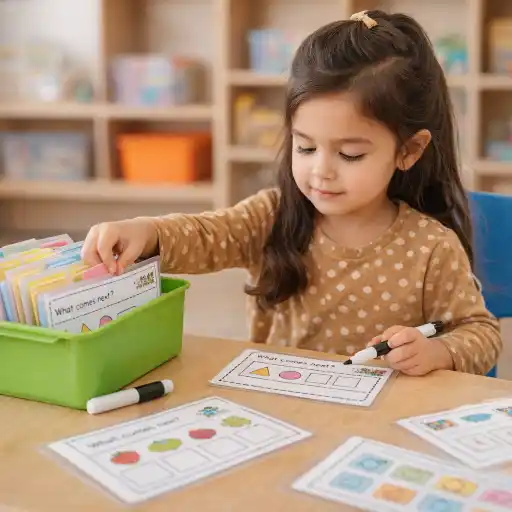
Task cards are concise visual or written prompts that show children what to do with available materials. They might invite a child to build a pattern, sort objects by color, create a playdough shape, retell a story, or design a structure. Their value is not that they turn play into worksheets; rather, well-designed cards preserve hands-on exploration while making the learning possibility visible.
For busy providers, task cards can reduce repeated explanations during center time. Children gain a dependable reference, while teachers gain more opportunities to observe #preschoolers’ language, problem-solving, and social interactions. This supports a gradual shift from adult-directed participation toward genuine #independence.
Task cards are especially useful when a classroom includes children with different experience levels. A single center can offer beginning, developing, and extending prompts without requiring every child to complete the same product. The educator remains responsive: the card is an invitation, not a demand.
How should educators design effective task cards?
Effective cards are brief, concrete, and matched to children’s developmental abilities. Begin with one observable action rather than several directions. Use photographs, simple illustrations, symbols, or a combination of text and images. Picture directions are particularly helpful for emerging readers, multilingual learners, and children who benefit from predictable visual information.
- State one clear challenge: “Make a tower with five blocks.”
- Show the materials children should select.
- Use sequential images for multistep activities.
- Include a choice whenever possible: “Build, draw, or explain your design.”
- Laminate cards or place them in protective sleeves for repeated use.
Consider numbering cards so children can progress gradually, but avoid implying that every child must finish the entire sequence. Fine-motor task boxes commonly use numbered cards and picture directions to help children work independently while strengthening hand muscles, an approach reflected in the referenced playdough task-box example.
Use language that communicates possibility rather than compliance. “Can you find three objects that begin with the same sound?” encourages inquiry more effectively than “Complete this task.”
Which learning goals can task cards support?
Task cards can connect open-ended centers to intentional curriculum goals. The strongest cards preserve active exploration while highlighting a specific concept, skill, or disposition. For example, a block-center card can focus on balance and spatial reasoning; a literacy card can invite rhyming; and a sensory card can encourage comparison and descriptive vocabulary.
- Fine motor: pinch, thread, mold, clip, trace, or transfer objects.
- Literacy: match letters, clap syllables, identify beginning sounds, or retell a familiar story.
- Mathematics: count, sort, compare quantities, create patterns, or measure.
- Science and STEAM: predict, test, observe, and represent findings.
- Social-emotional learning: practice turn-taking, name feelings, or plan collaborative work.
References on literacy centers describe hands-on activities for rhyme, syllables, initial sounds, CVC words, and letter recognition. These examples illustrate an important principle: task cards work best when children manipulate meaningful materials rather than simply select an answer.
Write one learning intention on the back of each card for adults. This helps teachers document observations without placing assessment pressure on children.
Prefer ready-made cards to starting from scratch?
You don't have to design every prompt yourself. Picture-based printable sets can turn a center into an independent station in minutes, and because the directions are visual, they work well for emerging readers and multilingual learners. For a math and fine-motor center, a set like Shapes Bingo Buy Now $1.99 or Fruits Bingo Buy Now $1.99 gives children clear picture cards to match and sort on their own. For science and vocabulary, Land Animals Bingo Buy Now $1.99 invites comparison and descriptive talk. And to pair task cards with a literacy center, printable emergent readers such as Emergent Readers - I like Buy Now $1.75 and Emergent Readers - Shapes Buy Now $1.75 let children "read," retell, and build early print awareness independently. Each is a low-cost printable you can laminate once and reuse across the year.
How can task cards promote independence without isolating children?
Independence does not mean children must work alone or solve every problem without support. It means they have meaningful choices, accessible materials, and strategies for beginning and continuing an activity. Task cards can provide that structure while maintaining opportunities for conversation, cooperation, and shared thinking.
Teach the routine explicitly. Model how to choose a card, gather materials, look at the visual directions, try a strategy, ask a peer for help, and return materials. Practice these steps when the classroom is calm rather than introducing them during a rushed transition.
- Place cards at children’s eye level beside clearly labeled materials.
- Offer a “help” card, peer-support option, or teacher signal.
- Allow children to adapt the challenge or invent a variation.
- Invite children to create and dictate their own task cards.
- Use partner cards to encourage collaboration rather than competition.
Visual organization matters. The referenced guidance on refreshing centers recommends clear, labeled bins, visible group limits, and simple rotation cues. Pairing those systems with task cards helps children navigate the environment with less adult interruption.
What common mistakes should providers avoid?
The most common mistake is treating task cards as mandatory assignments. When every card has one correct answer, children may become focused on completion instead of exploration. Offer several ways to respond and accept authentic variations. A child’s tower does not need to look like the photograph to demonstrate planning, persistence, or spatial thinking.
Another pitfall is using too many cards at once. A crowded ring or overflowing basket can overwhelm children and make center management harder. Start with two or three carefully chosen prompts, observe how children use them, and revise before adding more.
- Too much text: replace paragraphs with concise phrases and images.
- Unclear materials: photograph the actual items children will find.
- Mismatch in difficulty: prepare simpler and more complex versions.
- Limited representation: include names, families, objects, and images reflecting the community.
- Insufficient supervision: assess choking, allergy, tool, and sensory-material risks.
Task cards should never replace active supervision or responsive interaction. Review materials regularly, especially when cards involve small parts or sensory fillers. State requirements vary - check your state licensing agency.
How can directors and teachers launch a task-card system this week?
Begin with one familiar center rather than redesigning the entire classroom. Identify a goal children are already practicing, gather materials that are accessible, and create three prompts at different levels of complexity. Test the cards yourself from a child’s perspective: Can the images be understood? Are the materials reachable? Is the task possible within the available time?
During the first week, observe rather than judge. Record whether children can select a card, begin without repeated adult directions, persist after difficulty, communicate with peers, and clean up. These observations reveal whether the card, the environment, or the level of challenge needs adjustment.
- Choose one center and one developmental goal.
- Create or adapt three visual prompts.
- Model the routine and practice it with a small group.
- Place prompts with labeled, limited materials.
- Review observations and revise weekly.
Invite children’s voices into the process. Ask which cards they enjoy, what they would change, and what new challenge they want to design. This transforms task cards from teacher-made directions into a shared classroom resource. For additional planning support, educators may also explore Lesson Planning for Preschoolers Buy Now $24.00, Classroom Setup for Child Care Buy Now $24.00, Supporting Children’s Independence Buy Now $24.00, and Environments That Inspire Independence and Exploration Buy Now $55.00.
Conclusion: Can task cards make learning centers more independent?
Yes—when they are used as flexible invitations within a thoughtfully prepared environment. The most effective task cards are visual, concise, developmentally appropriate, culturally responsive, and connected to meaningful materials. They help children enter activities with confidence while giving educators more time to observe, document, and extend learning.
Start small, teach the routine, and revise based on children’s responses. Independence grows through repeated opportunities, supportive relationships, and environments that make success accessible.
- CDA Home Visitor Subject Area 3 Part 3 Birth to 5
- CDA Bridge Bundle: Preschool
- CDA Bridge Bundle: Family Child Care without Portfolio Review
- CDA Bridge Bundle: Infant/Toddler without Portfolio Review
- CDA Bridge Bundle: Preschool without Portfolio Review
- Creating Engaging and Meaningful Learning Experiences
- Texas Director Credential
- Spicing Up the Classroom: Learning Centers
- 👶 ¿Cuáles son las proporciones y grupos requeridos en Dakota del Norte? 🏫
- 10 Ejemplos de Cómo la Cultura Influye en el Desarrollo Infantil
- Proporciones de Cuidado Infantil y Tamaños de Grupo por Edad en Maryland (Guía Rápida para Centros y Hogares)
- Proporciones de Cuidado Infantil y Tamaños de Grupo por Edad en Nueva Jersey (Guía Rápida para Centros y Hogares)
- Proporciones de Cuidado Infantil y Tamaños de Grupo por Edad en Virginia (Guía Rápida para Centros y Hogares)
- Canciones, juegos y preguntas de círculo para niños
- Cómo simplificar la capacitación para sus empleados de daycare
- How can childcare providers support fine motor development with simple activities?
- How Can Task Cards Build Independent Learning Centers?
- Stop Giving the Answer: How Teachers Can Build Independent Thinkers in the Classroom
- How Can Task Cards Make Independent Center Time Run Smoothly?
- What Makes Task Cards Perfect for Small-Group Instruction?
- Why Are Self-Checking Clip Cards Great for Independent Practice?
- How Can Picture Task Cards Support Emerging Readers?
- How Can Task Cards Encourage Independent Learning?
- What Makes Task Cards a Teacher’s Time-Saving Favorite?
- How Can Print-and-Play Resources Support Any Learning Center?
- Which Printable Activities Belong in Every Preschool Classroom?
- What Should Providers Put in a Classroom Waiting Basket?
- How Can Independent Practice Connect Numerals and Number Words?
