How can a small, hands-on activity give children meaningful practice while helping educators protect time for observation and support? Self-checking clip cards offer immediate feedback, fine-motor engagement, and a manageable pathway toward independence. To strengthen your center design and intentional practice, explore Spicing Up the Classroom: Learning Centers  Buy Now $16.00, which can help you plan purposeful centers and earn professional training hours.
What makes self-checking clip cards different from ordinary task cards?
Self-checking clip cards are compact task cards that present a question, picture, or problem with several possible answers. A child marks a choice with a clothespin, clip, dot, or dry-erase mark and then turns the card over to compare the response with an answer cue. This simple “clip, flip, check” routine transforms an activity from a teacher-dependent exercise into a structured opportunity for #independence.
Unlike a worksheet, a clip card invites children to manipulate materials and make a visible decision. Unlike an open-ended invitation, it usually focuses attention on a specific learning objective. The format is particularly useful when a provider wants repeated practice without requiring constant verbal correction.
- Cards can target one skill at a time, such as rhyming, beginning sounds, counting, or syllables.
- Children receive feedback soon after responding rather than waiting for an adult to review the work.
- Clothespins add a tactile component that supports hand strength and pincer-grasp development.
- Laminated cards can be reused in centers, small groups, task boxes, or individualized work baskets.
The answer cue should be placed discreetly on the reverse side so children must first reason, respond, and then verify. The goal is not merely to identify right or wrong answers; it is to help children develop a habit of checking their thinking.
Why does immediate feedback support independent learning?
Independent practice is most productive when children can determine what to do next. Immediate feedback closes the distance between an attempt and reflection: the child chooses an answer, checks it, notices whether it matches, and decides whether to continue, reconsider, or ask for help. This sequence supports early self-monitoring and metacognition.
Research-informed guidance describes metacognition as planning, monitoring, and evaluating one’s learning. A self-checking card does not replace adult teaching, but it gives children a concrete way to practice those processes at an appropriate level. For beginning readers, self-checking can encourage them to notice when a sound or word does not make sense and try again.
Feedback is most helpful when it is emotionally safe. A child who discovers an incorrect answer should not experience the card as a public test. Educators can normalize revision with language such as, “You checked your thinking. What could you try next?” This approach protects motivation while building #persistence.
- Model the complete routine: look, think, clip, flip, check, and adjust.
- Use encouraging language that emphasizes strategy rather than speed.
- Teach children that checking is part of learning, not evidence of failure.
- Keep an adult available for clarification, especially when the answer cue is confusing.
Immediate feedback is valuable, but it must be accurate and developmentally appropriate. If cards contain ambiguous pictures or unfamiliar vocabulary, children may be practicing confusion rather than the intended skill.
Which developmental skills can clip cards strengthen?
A thoughtfully selected set can support several domains at once. Early literacy cards may focus on rhyming, phonological awareness, syllables, beginning sounds, vowel sounds, or letter recognition. Mathematics cards may address numeral identification, counting, quantity, patterns, or simple comparisons. Because children physically grasp and position a clip, the activity also incorporates visual-motor coordination.
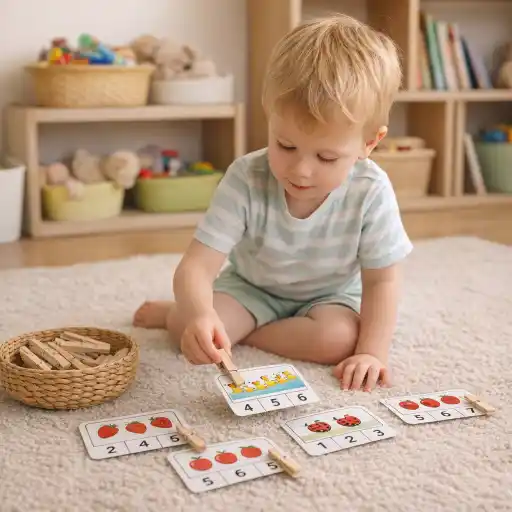
References on phonological-awareness clip cards emphasize beginning with sounds before expecting children to connect sounds to written letters. For example, rhyme cards can ask children to listen for matching word endings without requiring them to read print. Syllable cards may invite children to say, stretch, and clap a word before checking the answer.
- Language: name pictures, compare sounds, build vocabulary, and explain choices.
- Literacy: practice phonological awareness, phonics, and emergent print concepts.
- Mathematics: match numerals to quantities, count objects, and recognize patterns.
- Fine motor: squeeze clothespins, coordinate both hands, and place a marker precisely.
- Executive function: follow a routine, sustain attention, check work, and recover from an error.
These overlapping benefits do not mean every card must teach multiple objectives. In fact, clarity is a strength. One clearly defined goal makes it easier for children to understand the task and easier for educators to observe progress.
How should providers introduce clip cards in a classroom?
Successful independent practice begins with explicit teaching. Before placing cards in a center, demonstrate the materials and narrate the thinking process. Show children how to select one card, identify the question, consider each option, attach the clip, turn the card over, and respond to the result.
Begin with a small number of familiar cards. Work alongside children until they can complete the routine without repeated prompts. Then place the activity in a clearly labeled tray with a picture direction card. A ring or small container can keep the set organized; lamination is useful when cards will be handled frequently.
- Choose a skill children have already encountered in instruction.
- Prepare three to six cards with clear images, uncluttered choices, and reliable answer cues.
- Model one correct response and one thoughtful correction.
- Invite children to practice with an adult or peer before working independently.
- Observe how children use the cards and revise the set when needed.
Offer flexible participation. A child may use a clothespin, a large clip, a reusable counter, or a dry-erase marker, depending on motor ability and sensory preference. For children who are still developing language, name each image and provide gestures or home-language support. For children ready for challenge, ask them to explain why an answer fits rather than simply checking it.
Active supervision remains essential. Small clips and manipulatives may pose choking or safety risks for younger children. State requirements vary - check your state licensing agency.
How can educators differentiate and avoid common mistakes?
Clip cards are easy to differentiate because the number, complexity, and presentation of cards can change without redesigning the entire center. Provide fewer cards for a child who benefits from a short workload, a simpler set for developing skills, and an extension set for children who demonstrate mastery. Different children can work on different objectives during the same center period.
- 🔹 Use larger images, fewer choices, and larger clips for children who need accessibility supports.
- Offer picture-only cards when the goal is auditory awareness or when children are emerging readers.
- Add written words, explanation prompts, or more complex examples for advanced learners.
- Pair cards with recording sheets only when documentation serves a clear purpose.
- Use partner practice when conversation and reasoning are important learning goals.
Common mistakes include presenting too many cards, using overly difficult vocabulary, and treating self-checking as a substitute for instruction. An answer mark can tell a child whether a response matches the key, but it cannot explain a misconception. Teachers should periodically review children’s responses and use observations to plan follow-up experiences.
Another pitfall is overemphasizing correctness. Young children may clip randomly if they believe finishing quickly matters more than thinking. Slow the pace, invite children to say the picture names aloud, and praise careful checking. Also inspect the backs of cards regularly; misplaced stickers, faded marks, or unclear answer cues undermine trust in the system.
How can directors use clip cards to strengthen classroom practice?
For directors, clip cards can become part of a broader center system rather than an isolated printable activity. Staff can select cards from curriculum goals, organize them by developmental level, and use brief observation notes to identify patterns. A child who consistently misses a sound distinction may need more small-group modeling, while a child who completes cards accurately may benefit from an open-ended application.
Invite teachers to discuss three questions during planning meetings:
- What specific skill does this set address?
- What evidence will show that children are thinking rather than guessing?
- What will we offer next if a child needs support or extension?
Connect the activity to meaningful play. After using rhyme cards, children might generate silly rhymes during a song. After counting cards, they might count real snack items or classroom materials. After beginning-sound cards, they might sort familiar objects from the room. Transfer demonstrates that the skill belongs in children’s everyday world.
Family communication can also be simple: send home a few cards or describe the “clip, flip, check” routine so caregivers can practice with household items. Maintain confidentiality and use observations to support children, not rank them.
For additional professional learning, providers may also explore Student Success: Expectations & Independence Buy Now $16.00, Supporting Children’s Independence Buy Now $24.00, and Classroom Tools for Emergent Literacy Buy Now $25.00. These courses can deepen staff understanding of independence, learning environments, and early literacy practices.
Summary: Why are self-checking clip cards great for independent practice?
Self-checking clip cards are effective because they combine focused practice, immediate feedback, tactile engagement, and a predictable routine. They help children learn to pause, make a choice, verify their thinking, and adjust—foundational habits for independent learning. They also give educators a practical way to differentiate instruction, observe development, and preserve time for responsive interaction.
The strongest implementation is intentional rather than automatic: select a clear objective, teach the routine, use accessible materials, supervise actively, and connect card practice to richer classroom experiences. When clip cards function as supportive invitations instead of compliance tasks, they can strengthen confidence, fine-motor coordination, language, early academic skills, and self-regulation.
Start with one small set this week. Watch how children respond, listen to their explanations, and revise the experience around their strengths and needs.
Frequently asked questions
Are self-checking clip cards appropriate for preschoolers?
Yes, when the images, language, motor demands, and number of choices match children’s development. Adult modeling is especially important at first.
Do children need to use clothespins?
No. Large clips, counters, reusable dots, playdough, or dry-erase markers can provide alternatives.
Can clip cards replace teacher-led instruction?
No. They are practice tools. Educators still introduce concepts, clarify misunderstandings, and plan responsive follow-up.
How many cards should be available?
Begin with a small selection—often three to six cards—and add more only when children can manage the routine comfortably.
How do I know whether children are learning?
Observe accuracy, explanations, persistence, and the amount of prompting needed. Combine card performance with conversations and hands-on applications.
Are state training rules the same everywhere?
No. State requirements vary - check your state licensing agency.
- CDA Certification en Español: Recursos y Consejos para Educadores Bilingües
- 🌙 ¿Cómo afecta el tiempo frente a las pantallas el sueño y el comportamiento infantil? 😴
- 🧩 ¿Cómo puedes hacer que tu aula sea más inclusiva para los niños con autismo?
- 🥦✨ ¿Cómo apoyar a los niños selectivos a probar nuevos alimentos sin presión?
- 😅❌ ¿Cómo Puedo Manejar a un Niño que Dice “¡NO!” a Todo en el Aula?
- ¿Cómo puedo usar escenarios de juego de roles de primeros auxilios en mi aula?
- ¿Cuáles son las mejores actividades de primeros auxilios para adultos?
- Actividades de Fiesta para Niños de Preescolar y Primaria
- Actividades de Otoño Fáciles para Preescolares esta Temporada
- Las Mejores Ideas de Excursiones para Guarderías en Texas
- Cómo simplificar la capacitación para sus empleados de daycare
- How Can Task Cards Build Independent Learning Centers?
- How Can Task Cards Make Independent Center Time Run Smoothly?
- How Do Clip Cards Build Fine Motor Strength and Focus?
- Why Are Self-Checking Clip Cards Great for Independent Practice?
- How Do Clip Cards Build Fine Motor Strength and Focus?
- How Can You Create Easy Preschool Math Centers with Print, Prep, and Start Learning?
- How Can Task Cards Encourage Independent Learning?
- How Can Clip Cards Build Focus and Fine Motor Skills?
- ¿Qué habilidades preceden al recorte y cuándo deben aprender los niños a usar tijeras?
