When children wait for an adult to solve every puzzle, disagreement, or design challenge, they lose valuable opportunities to practice judgment, persistence, and self-direction. You can shift that pattern without becoming distant: Supporting Children's Independence  Buy Now $24.00 offers a practical three-hour foundation for strengthening self-regulation, decision-making, and everyday independence while adding relevant professional learning. For educators ready to connect these strategies to intentional curriculum, Children at the Wheel: Emergent Curriculum Buy Now $25.00 explores how children’s interests can guide inquiry and planning.
Why does independent thinking matter in early childhood classrooms?
Independent thinking is not the expectation that young children should manage everything alone. It is the gradual development of agency: children learn to notice a problem, generate an idea, try a strategy, evaluate what happened, and seek help appropriately. These habits support cognitive flexibility, language, self-regulation, and social competence.
Research and practice summarized by classroom strategies for independent thinking emphasize that #independence grows from intentional design, predictable routines, accessible materials, and adult interactions that extend thinking rather than replace it. Inquiry-based learning similarly combines collaborative problem-solving with reflection and social-emotional growth, as described by CASEL’s inquiry-based learning guidance.
This matters for providers and directors because children who can begin tasks, persist, and negotiate solutions require fewer repeated directions. Teachers gain more time to observe, document, and deepen learning. The classroom also becomes a place where mistakes are treated as information rather than evidence of failure.
How can teachers replace answers with productive prompts?
The first move is to pause. Before responding, observe for several seconds and identify what the child already understands. A child struggling to balance blocks may be testing stability; a child who cannot open a container may need a different grip, not an adult who completes the task.
Use prompts that reveal process:
- “What are you trying to make happen?”
- “What have you tried so far?”
- “What else could we try?”
- “What do you notice?”
- “How will we know whether it worked?”
Questions should be genuine, brief, and developmentally appropriate. Avoid turning every interaction into an interrogation. Sometimes a descriptive comment is more helpful: “The bridge fell when the heavy block went on top.” This gives children useful information without prescribing the next step.
When a child asks, “Is this right?” resist the reflex to confirm or correct. Try, “What do you think?” or “What makes you think that?” If the child is stuck, provide one scaffold—a picture, tool, partial model, or choice between two strategies—then step back again. This gradual release preserves both support and ownership.
How do planning and reflection make thinking visible?
Independent thinking becomes stronger when children have opportunities to plan before acting and reflect afterward. Planning is more than choosing a material; it involves identifying an intention and anticipating what may be needed. Reflection is more than recalling events; it helps children analyze what they learned and decide what to do next.
Use a simple plan-do-review cycle:
- Plan: “What will you try first? What materials might help?”
- Do: Observe, allow experimentation, and offer minimal scaffolding.
- Review: “What happened? What surprised you? What might you change?”
For younger children, planning may be expressed through gestures, pointing, or a single phrase. Offer photographs, object choices, or sentence stems. Older preschoolers might sketch a structure, dictate a prediction, or describe a next step. The goal is not polished language; it is making intention and strategy increasingly explicit.
A short reflection circle can follow center time. Invite children to share one discovery, challenge, or question. Document exact words and photographs when possible. These records help teachers see whether children are initiating ideas, using planning language, persisting, and transferring strategies to new contexts. The planning-and-reflection cycle described by Lemberg Children’s Center connects these practices with broader language, social, mathematical, and scientific development.
How should classroom environments invite children to solve problems?
The environment can either create dependence or quietly teach autonomy. Arrange materials so children can locate, use, and return them with minimal adult assistance. Low shelves, labeled baskets, photographs, defined interest areas, and uncluttered pathways communicate, “You are capable of participating here.”
 Design centers as invitations rather than assignments:
- Place blocks, ramps, tubes, and varied objects together so children can investigate balance, force, and motion.
- Offer loose parts, art materials, and open-ended tools without a required finished product.
- Use visual task cards with one clear challenge and multiple possible responses.
- Provide a quiet space where children can pause, regulate, and reconsider a strategy.
- Keep a small number of meaningful choices visible to prevent cognitive overload.
In the block area, for example, ask children to design a path that carries a ball across the rug. The challenge has purpose, but there is no single correct structure. Studies of young engineers show how block play naturally engages spatial reasoning, material properties, balance, and iterative design; the early childhood engineering research on ramps and pathways offers a useful model.
Accessibility is essential. Adapt tools with larger handles, provide visual or tactile cues, allow additional time, and collaborate with families and specialists. Independence means access to meaningful participation—not requiring every child to use identical materials or methods. Safety remains active supervision, and state requirements vary - check your state licensing agency.
How can teachers support productive struggle without causing frustration?
Productive struggle is effort directed toward understanding or solving a meaningful challenge. It is not prolonged distress, repeated failure, or adults withholding needed assistance. Teachers must distinguish between a child who is concentrating and a child whose emotional regulation is deteriorating.
Use a graduated support sequence:
- Wait and observe.
- Name the problem neutrally: “The lid is not opening yet.”
- Invite the child’s idea: “What could you try?”
- Offer a limited choice: “Would you like to twist it or ask a friend to hold the container?”
- Model one step if needed.
- Fade support as soon as the child resumes independent action.
Emotional coaching is part of problem-solving. Say, “You are disappointed that the tower fell. Your body is safe, and we can think about another way.” Children need permission to pause, breathe, and return. A calm corner, visual coping sequence, or peer-support routine can help them regulate without making the adult the automatic solution.
Be especially attentive to equity. Some children have learned that adults expect compliance; others may have experienced repeated correction or exclusion. Invite ideas, honor different communication styles, and avoid praising only speed or verbal confidence. Feedback should focus on strategy: “You changed the base after you noticed it was tipping.” That language builds #resilience and communicates that thinking is a process.
What common mistakes prevent independent thinking, and how can programs avoid them?
Well-intentioned teachers often overhelp because schedules are tight, safety feels urgent, or a child’s frustration is uncomfortable. The solution is not to withdraw care; it is to plan supports that make thoughtful waiting possible.
- ❌ Giving the answer immediately: Replace it with one open question or observation.
- ❌ Offering too many choices: Begin with two or three meaningful options.
- ❌ Confusing independence with isolation: Teach children how to seek peer and adult support.
- ❌ Using vague praise: Name the strategy, revision, or persistence you observed.
- ❌ Designing single-answer activities: Use open-ended materials and accept varied solutions.
- ❌ Expecting skills without rehearsal: Practice routines during calm periods.
Directors can support consistency through brief coaching cycles. Choose one teacher move—such as wait time, open prompts, or strategy-focused feedback—observe it, discuss evidence, and practice again. Track indicators such as child-initiated activity, length of engagement, planning language, peer negotiation, and the level of adult prompting required.
Targeted professional learning can reinforce this work. Spicing Up the Classroom: Learning Centers Buy Now $16.00 supports purposeful center planning; Tailoring Instruction to Children's Needs Buy Now $24.00 addresses differentiation and scaffolding; and Creating Engaging and Meaningful Learning Experiences Buy Now $55.00 connects choice, leadership, self-regulation, and inclusive planning.
How can teachers begin building independent thinkers tomorrow?
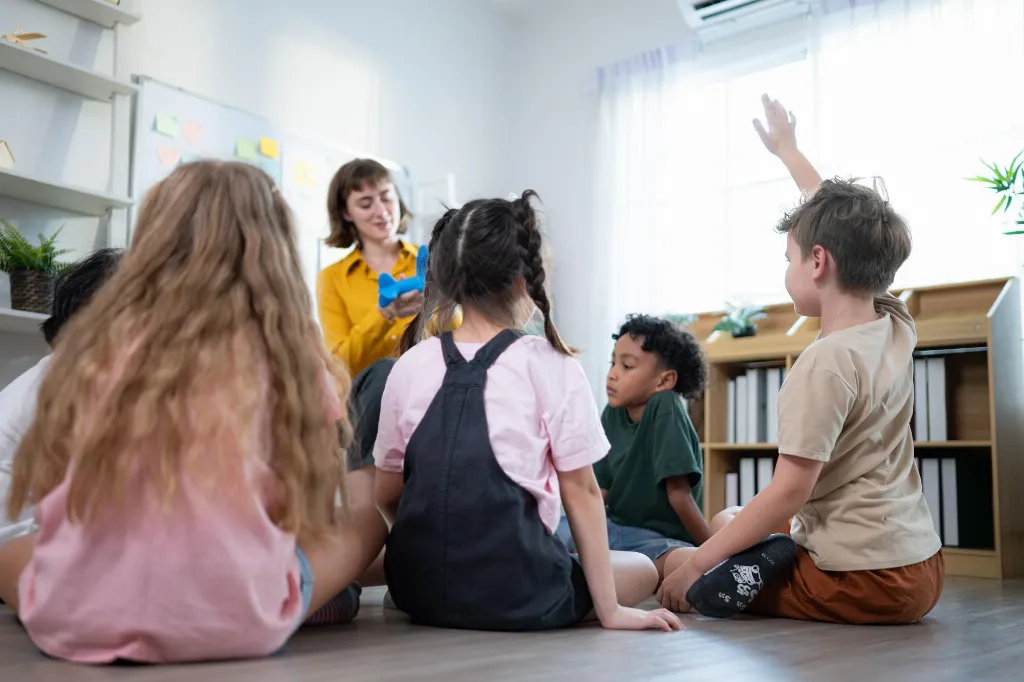
Start with one routine, one center, and one adult habit. During a familiar activity, pause before helping and record the prompt that allowed the child to continue. Add a visual plan-do-review sequence to the block or art area. At the end of the day, ask children what they tried, what changed, and what they might investigate next.
A practical launch plan might include:
- Choose one observable goal, such as beginning a task without repeated adult directions.
- Prepare accessible materials and limit visible choices.
- Teach children how to use a help signal, peer support, or visual prompt.
- Practice two open-ended questions with the teaching team.
- Document one child quote, photograph, or work sample per day.
- Review evidence weekly and fade supports when children demonstrate competence.
Expect uneven progress. A child may independently solve a block problem but need substantial support during conflict or transitions. Development is contextual, and independence grows through repeated, trusting relationships. The Montessori Classroom: Theory to Practice Buy Now $25.00 is another relevant option for educators who want practical training on child-directed activity, prepared environments, and materials that foster self-directed learning.
Conclusion: How do teachers build independent thinkers without giving away the answer?
Teachers build independent thinkers by designing environments that make participation possible, asking questions that reveal children’s reasoning, teaching planning and reflection, and offering only as much support as the moment requires. The aim is not to make children struggle alone; it is to help them experience themselves as capable problem-solvers.
Pause before answering. Notice the strategy already emerging. Offer a prompt, tool, or model, then return responsibility to the child. Over time, these small choices transform the #classroom into a community where #children ask questions, revise ideas, collaborate, and trust their own #thinking as they continue #learning.
References: ChildCareEd: Independent Thinking; ChildCareEd: Problem-Solving Without Always Solving; ChildCareEd: Teaching Problem-Solving; ChildCareEd: Open-Ended Activities; ChildCareEd: Scaffolding Instruction; ChildCareEd: Task Cards; ChildCareEd: Self-Directed Learning; NCTM: Asking Questions; NAEYC: Inquiry; CASEL: Inquiry-Based Learning; EEF: Metacognition; Chen et al.: Self-Regulated Learning; Lemberg: Planning and Reflection; Brightwheel: Inquiry-Based Learning; ECRP: Young Engineers; PBS: Creative Play; Scholastic: Preschool Problem-Solving; ChildCareEd: Montessori Independent Thinkers; ChildCareEd: Hands-On Montessori Learning; and ChildCareEd: Classroom Design for Independence.
- Birth to Five CDA Credential with Portfolio Review
- Pediatric RSV First Aid & CPR/AED
- 45 Hour School Age Methods and Materials
- CDA Bridge Bundle: Family Child Care without Portfolio Review
- CDA Bridge Bundle: Infant/Toddler without Portfolio Review
- CDA Bridge Bundle: Preschool without Portfolio Review
- Texas Director Credential
- Environments That Inspire Independence and Exploration
- Every Moment Matters: Schedules and Transitions
- CDA Certification en Español: Recursos y Consejos para Educadores Bilingües
- 🥦✨ ¿Cómo apoyar a los niños selectivos a probar nuevos alimentos sin presión?
- 🤔 ¿Cómo hablo con los padres cuando un niño no está avanzando en el entrenamiento para ir al baño?
- 👶 ¿Cuáles son las proporciones y grupos requeridos en Dakota del Norte? 🏫
- Recursos en Español sobre el Sueño Seguro del Bebé
- 10 Ejemplos de Cómo la Cultura Influye en el Desarrollo Infantil
- Actividades de Fiesta para Niños de Preescolar y Primaria
- Proporciones de Cuidado Infantil y Tamaños de Grupo por Edad en Nueva Jersey (Guía Rápida para Centros y Hogares)
- Proporciones de Cuidado Infantil y Tamaños de Grupo por Edad en Virginia (Guía Rápida para Centros y Hogares)
- Retraso del Habla en la Guardería: Cómo Pueden Ayudar los Proveedores
- Cómo Ser Maestra de Preescolar en Illinois
- Celebrando la amistad en el cuidado infantil durante el Día de los Mejores Amigos
- Canciones, juegos y preguntas de círculo para niños
- How can childcare programs support homework without doing the work for children?
- How do you build a classroom that encourages independent thinking?
- Stop Giving the Answer: How Teachers Can Build Independent Thinkers in the Classroom
- How Can Child Care Providers Nurture Critical Thinking in Young Children?
- How Can You Create Easy Preschool Math Centers with Print, Prep, and Start Learning?
- How Can Everyday Classroom Problems Become Child-Led Investigations?
