When children are not yet reading conventional text, pictures can make literacy learning visible, inviting, and achievable. Picture task cards give providers a practical way to build sound awareness, vocabulary, comprehension, and independence through brief, playful activities; for deeper preparation, explore Science of Reading Foundations in the Pre-K Classroom Buy Now $16.00, which offers training on the early skills that support later reading.
For educators who want ready-to-use classroom strategies, Classroom Tools for Emergent Literacy Buy Now $25.00 provides a broader professional learning experience focused on interactive read-alouds, reading buddies, labels, and other practical supports. Or you can use one of our ready-made resources like: Task Cards - Counting Money Buy Now $2.49, Sorting Mat - Sink or Float Buy Now $1.49
Why do picture task cards matter for emerging readers?
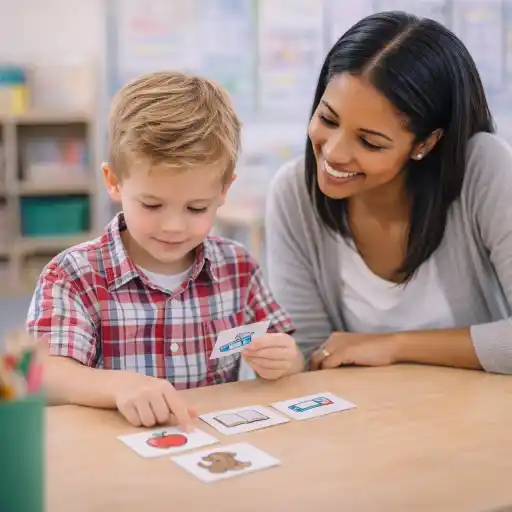
Emerging readers are developing several systems at once: oral language, attention, memory, print knowledge, phonological awareness, and the understanding that symbols communicate meaning. A picture task card offers an accessible entry point. Instead of asking children to decode a written direction, it shows the materials, action, or outcome they can explore.
This does not mean pictures replace print. Rather, pictures reduce unnecessary language demands so children can concentrate on the intended literacy goal. A card showing a sun, sock, and sandwich might invite children to say each word and decide which words begin with the same sound. Another card might show three story images that children arrange and retell.
Research and professional guidance emphasize that phonological awareness concerns spoken sounds, not merely the letters used to represent them. Picture prompts are therefore especially useful for oral activities involving rhyme, syllables, alliteration, and beginning sounds. The phonological awareness guidance from Victoria’s Literacy Teaching Toolkit describes these skills as important foundations for later blending, reading, and spelling.
- They make directions understandable to nonreaders.
- They support children who are learning English or another classroom language.
- They encourage repeated practice without turning learning into a worksheet.
- They help educators observe children’s language, reasoning, and #literacy behaviors.
Which emerging reading skills can picture cards develop?
Picture task cards are flexible enough to support multiple domains, but each card should have one primary learning intention. A card can invite children to listen, speak, match, sequence, predict, or represent an idea. The goal is purposeful interaction rather than rapid identification of isolated images.
For phonological awareness, use cards for rhyming pairs, syllable clapping, beginning-sound sorting, and oral blending. The Reading Universe picture-card resource explains how images can represent spoken words while children focus on syllables, onset-rime patterns, and phonemes. If the objective is hearing sounds, avoid allowing printed labels to become the answer.
Cards can also strengthen vocabulary and comprehension. A card might show an unfamiliar animal and invite children to describe its features, compare it with another animal, or connect it to a nonfiction book. Story cards can support sequencing, character discussion, prediction, and retelling. Picture-based conversations are valuable because children can communicate ideas before they can independently write or read sentences.
- Sound awareness: sort pictures by rhyme or initial sound.
- Vocabulary: name, describe, categorize, and use new words.
- Comprehension: sequence events and explain relationships.
- Print concepts: match a picture to a familiar environmental label.
- Emergent writing: draw, dictate, label, or attempt a word response.
How should providers design developmentally appropriate picture task cards?
Effective cards are visually clear, physically manageable, and connected to materials children can actually access. Begin with the child’s perspective: Can the child understand the image? Is the pictured object familiar? Does the card show one action or an overwhelming series of steps?
Use photographs or illustrations that reflect the classroom’s real materials and the children’s families, languages, interests, and communities. A card showing a generic object may be less meaningful than a photograph of the actual basket, book, or block set children will use. For multistep tasks, show a small sequence of images from left to right or top to bottom.
- State one observable goal, such as “Find two pictures that rhyme.”
- Show the materials and the expected action.
- Use high contrast, uncluttered backgrounds, and durable construction.
- Offer graduated levels: match, explain, then create or extend.
- Include a choice of response, such as speaking, pointing, drawing, or acting.
- Keep printed words limited when the goal is oral sound awareness.
Picture cards should function as invitations, not compliance tools. A child may respond through gestures, home-language discussion, approximated words, or an alternative representation. That flexibility makes the task more inclusive and gives educators better information about what the child understands.
How can task cards be used in centers and small groups?
Picture task cards are most effective when embedded in a predictable routine. Introduce the card during a brief small-group lesson, model the thinking aloud, and then place it with clearly labeled materials in a center. Children can revisit the same card independently or with a peer while the educator observes and offers targeted support.
For example, in a beginning-sound center, children choose a card, name each pictured item, and place objects or counters beneath the pictures that begin with the same sound. In a story center, children arrange three images, retell the sequence, and use puppets to act it out. In a book area, a card might ask children to find a picture that shows a character’s feeling and explain the evidence.
Use the gradual release of responsibility: first model the activity, then complete it together, then invite children to try it with decreasing adult assistance. This approach aligns with guidance on reading with children and emergent literacy, which describes movement among modeled, shared, guided, and independent experiences.
- Place cards at children’s eye level beside the relevant materials.
- Limit a center to two or three choices at first.
- Teach how to select a card, try it, request help, and clean up.
- Use partner cards to encourage conversation and cooperation.
- Invite children to create cards by drawing and dictating directions.
How can picture cards be inclusive and responsive?
Accessibility begins with recognizing that not every child receives information most effectively through the same visual format. Some children benefit from photographs; others respond better to simplified icons, objects, tactile symbols, gestures, or spoken directions. Picture cards should be one part of a multimodal system rather than a universal solution.
For children with visual impairments, pair images with real objects, textured symbols, verbal descriptions, or tactile graphics. Guidance for students who are blind or visually impaired emphasizes tactile exploration, object associations, auditory resources, Braille, and hand-under-hand support without forcing participation. For children with communication differences, offer pointing, eye gaze, sign language, AAC, or partner-assisted scanning as valid responses.
Representation also matters. Review cards for stereotypes, limited family structures, cultural assumptions, and inaccessible examples. Ask families about words and experiences that are meaningful at home, and incorporate children’s home languages when possible. Supporting a first language strengthens conceptual knowledge and gives children a stronger bridge to additional language learning.
- Use actual classroom photographs when helpful.
- Provide bilingual labels or home-language versions with family input.
- Include diverse names, homes, abilities, occupations, and community experiences.
- Offer tactile, auditory, gestural, and object-based alternatives.
- Adjust the challenge without lowering expectations for participation.
Visual supports can increase participation when they are intentionally taught and individualized. The Center for Inclusive Childcare resource on classroom visuals and supports highlights the value of visuals that help children understand expectations and engage more fully in learning environments.
What mistakes should educators avoid, and how can they assess learning?
The most common mistake is confusing correct card completion with reading development. A child may match every picture while having limited vocabulary, or name a beginning letter without hearing the corresponding sound. Observe the process: What does the child say? What strategies do they use? Can they explain a choice, transfer the skill to new words, or participate without adult prompting?
Avoid overloading cards with text, tiny images, too many choices, or multiple unrelated objectives. Avoid quizzing children repeatedly during play. Instead, use responsive comments and open prompts: “You put sun and sock together. What do you hear at the beginning?” or “Tell me how you know these pictures belong together.”
- Pitfall: One correct answer only. Improve: accept drawing, acting, pointing, and explanation.
- Pitfall: Cards disconnected from books and play. Improve: link them to stories, songs, objects, and meaningful themes.
- Pitfall: Too much adult help. Improve: model once, wait, and provide the smallest useful prompt.
- Pitfall: No documentation. Improve: record brief notes, quotes, photos, or work samples.
Directors can support consistency by creating a simple observation form with columns for independent use, language response, sound awareness, and next steps. Review cards regularly for cultural relevance, durability, choking hazards, and alignment with classroom goals. State requirements vary - check your state licensing agency.
Summary: How can picture task cards support emerging readers?
Picture task cards support emerging readers when they make purposeful literacy actions accessible without reducing learning to memorization. They can help children hear and manipulate sounds, build vocabulary, understand stories, practice print concepts, and communicate ideas through speech, gesture, drawing, or play.
The strongest system is small, intentional, inclusive, and responsive. Choose one learning goal, use clear images, connect the card to meaningful materials, model the routine, and observe how children respond. Then revise the card or level of support rather than assuming a child’s difficulty reflects a lack of ability.
For further professional learning, providers may explore Building Vocabulary  Buy Now $16.00, Reading Aloud and Storytelling Buy Now $16.00, and Understanding Print Knowledge in Preschool Buy Now $16.00. Used thoughtfully, picture cards become more than classroom materials: they become bridges from children’s spoken language and visual understanding toward confident reading.
- Science of Reading Foundations in the Pre-K Classroom
- CDA Home Visitor Subject Area 3 Part 3 Birth to 5
- CDA Home Visitor Subject Area 2 Part 3 Birth to 5
- Language Development in School Age
- Reading Aloud and Storytelling
- Language and Literacy Foundations in Pre-K
- Texas Director Credential
- Classroom Tools for Emergent Literacy
- Classroom Tools for Emergent Literacy
- CDA Certification en Español: Recursos y Consejos para Educadores Bilingües
- 🔍 ¿Qué ves cuando observas a un niño aprender?
- 💛🧩 ¿Cómo puedo hacer que mi enseñanza sea inclusiva para los niños con autismo?
- 10 Ejemplos de Cómo la Cultura Influye en el Desarrollo Infantil
- Proporciones de Cuidado Infantil y Tamaños de Grupo por Edad en Virginia (Guía Rápida para Centros y Hogares)
- Cómo Trabajar en el Cuidado Infantil en Carolina del Norte: Requisitos y Pasos
- Celebrando la amistad en el cuidado infantil durante el Día de los Mejores Amigos
- Canciones, juegos y preguntas de círculo para niños
- Cómo simplificar la capacitación para sus empleados de daycare
- How Can Task Cards Build Independent Learning Centers?
- How Can Task Cards Make Independent Center Time Run Smoothly?
- Why Are Self-Checking Clip Cards Great for Independent Practice?
- How Can Picture Task Cards Support Emerging Readers?
- How Does Cleanup Time Reveal Hidden Learning in Early Childhood Classrooms?
- How Can Task Cards Turn Free Play Into Purposeful Learning?
- How Can Task Cards Encourage Independent Learning?
- What Makes Task Cards a Teacher’s Time-Saving Favorite?
- How Can Cleanup Time Become a Lesson in Sorting, Counting, and Teamwork?
- How Do Color-Word Activities Support Reading Automaticity?
- Are Holiday Word Searches Suitable for Children Learning English?
