What if a small, thoughtfully designed card could help children begin, persist, and reflect with less adult prompting? Task cards make learning possibilities visible while preserving hands-on choice, conversation, and play. To deepen your classroom practice, explore Supporting Children’s Independence  Buy Now $24.00, a three-hour course that offers practical strategies for self-regulation, problem-solving, and age-appropriate independence.
Task cards are not miniature worksheets or substitutes for responsive teaching. They are environmental supports: concise prompts that connect accessible materials with a possible action. When used thoughtfully, they help educators create a more intentional #classroom in which #children can practice #independence, #problem-solving, and #persistence while teachers observe and scaffold.
Why does independent learning matter in early childhood?
Independent learning does not mean children must work alone or solve every difficulty without support. It means children have meaningful choices, know how to begin, can use available strategies, and understand how to request help. These capacities develop gradually through warm relationships, predictable routines, and repeated opportunities to make decisions.
Task cards support this process by reducing uncertainty. A child who sees a photograph of blocks and the prompt “Build a bridge for the animal” has an accessible entry point. The child may then choose materials, invite a peer, test a design, and revise the plan. The card establishes direction without dictating one correct product.
This matters for providers and directors because independence can improve the quality of center time without requiring constant adult reminders. Educators gain more opportunities to observe language, reasoning, collaboration, and persistence. The New York State Education Department similarly emphasizes that adults should circulate through centers, engage children in conversation, extend thinking, and support problem-solving rather than simply supervise from a distance.
- Children practice planning and decision-making.
- Teachers repeat fewer procedural directions.
- Children can collaborate while still managing parts of the routine.
- Educators receive clearer evidence of children’s strategies and interests.
What makes a task card developmentally appropriate?
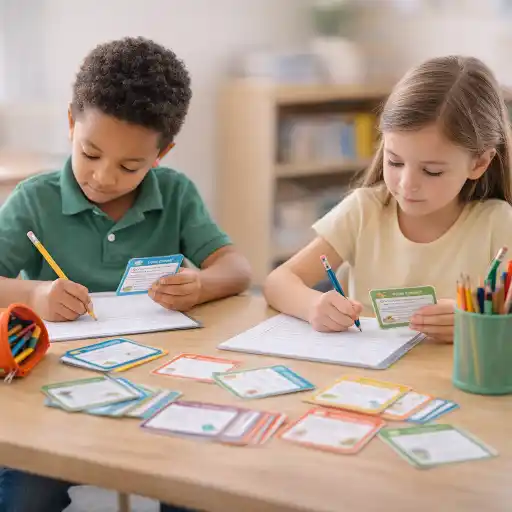
Effective task cards are brief, concrete, visually clear, and connected to materials children can reach. Begin with one observable action rather than several objectives. “Make an AB pattern with buttons” is more usable than “Explore mathematical relationships.” Photographing the actual classroom materials can make the prompt easier to interpret.
Picture directions are particularly useful for emerging readers, multilingual learners, and children who benefit from predictable visual information. However, pictures should not be treated as a universal solution. Some children may need gestures, object cues, tactile symbols, spoken language, communication boards, or AAC in addition to the card.
- State one primary challenge.
- Show the materials children should select.
- Use numbered pictures for multistep activities.
- Offer beginning, developing, and extending versions.
- Allow responses through building, drawing, speaking, pointing, or acting.
- Use high contrast, large images, and uncluttered backgrounds.
Use invitation language such as “Can you find three objects that feel different?” or “What could you change?” Avoid wording that implies compliance or a single correct answer. A task card should make participation more accessible, not turn play into a test.
How can task cards connect independence with meaningful learning?
Task cards are most valuable when they connect children’s actions to intentional learning goals without narrowing exploration. A block prompt can encourage spatial reasoning and balance; a literacy prompt can invite rhyme, sequencing, or retelling; a sensory prompt can develop comparison and descriptive vocabulary.
- Fine motor: pinch, thread, clip, mold, transfer, or construct.
- Language and literacy: identify sounds, match letters, retell stories, describe pictures, or dictate messages.
- Mathematics: count, sort, compare quantities, measure, and create patterns.
- Science and STEAM: predict, test, observe, classify, and revise designs.
- Social-emotional learning: practice turn-taking, identify feelings, plan with a peer, and solve disagreements.
For example, a science card might say, “Which object will sink? Make a prediction, test it, and tell a friend what happened.” Children are not merely completing directions; they are using language, forming hypotheses, manipulating materials, and reflecting on evidence. Project-based learning guidance likewise highlights children’s voice and choice, sustained inquiry, reflection, and revision as important features of meaningful learning.
Write the adult-facing learning intention on the back of each card. This allows teachers to document learning without placing assessment pressure on children. The card guides observation, while the child’s process provides the richest evidence.
How should educators teach children to use task cards?
Posting cards is not enough. Children need explicit modeling and supported practice before they are expected to use them independently. Introduce one card during a calm small-group moment and narrate the routine: choose a card, look at the picture, gather materials, try the first step, check the plan, ask for help if needed, and clean up.
The gradual-release sequence—“I do, we do, you do”—is useful. First, model the complete process. Next, invite children to complete the steps with prompts. Finally, reduce adult assistance while remaining available. Task analysis research supports breaking complex skills into smaller, achievable steps and providing positive feedback as children progress.
- Demonstrate one familiar card.
- Complete the routine together.
- Invite children to practice with a partner.
- Allow independent use while observing.
- Revise the card or environment when children encounter repeated barriers.
Organize materials so independence is physically possible. Place cards at eye level, use labeled trays, limit visible choices, and show where materials belong. A help card, peer-support signal, or teacher cue communicates that independence includes knowing how to seek assistance.
Partner cards can preserve social learning: “Build together,” “Take turns choosing,” or “Ask your partner what they notice.” Independence is strengthened through participation, not isolation.
How can task cards be differentiated and inclusive?
A single task can be adjusted through materials, language, complexity, or adult support. This makes task cards especially useful in mixed-ability classrooms. Children may explore the same concept while working at different levels of challenge.
For a counting center, one card might say, “Find five objects and touch each one as you count.” A developing prompt might ask, “Make two groups. Which has more?” An extending card could ask, “Change one group so both groups have the same number. Explain what you changed.” The shared materials create community, while the prompts respect individual readiness.
Use discreet differentiation rather than public labels. Consider:
- larger manipulatives or adapted tools for motor access;
- photographs, symbols, home-language labels, or object cues;
- fewer steps and fewer choices for children who need reduced cognitive load;
- prediction, explanation, measurement, or leadership roles for children ready for extension;
- pointing, drawing, gesture, sign language, or AAC as valid ways to respond.
For deeper support with differentiation and scaffolding, explore Tailoring Instruction to Children’s Needs Buy Now $24.00. For environmental accessibility and inclusion, Environments That Inspire Independence and Exploration Buy Now $55.00 offers strategies for designing spaces that invite curiosity and participation.
What common mistakes can limit independent learning?
The most common mistake is treating task cards as mandatory assignments with one correct answer. When children focus on matching a model or finishing a sequence, they may lose opportunities for experimentation and authentic problem-solving. Ask what children planned, changed, noticed, or discovered rather than whether the result looks identical.
- Too much text: Replace paragraphs with concise phrases, images, and demonstrations.
- Too many cards: Start with two or three prompts per center.
- Unclear materials: Photograph the actual items children will use.
- Difficulty mismatch: Prepare beginning, developing, and extending versions.
- Limited representation: Include families, languages, abilities, and community experiences reflected in the program.
- Adult withdrawal: Continue active supervision, warm interaction, and responsive scaffolding.
Cards can also fail when adults introduce them during a rushed transition or never observe how children interpret them. If a child struggles, examine the whole system: Is the image understandable? Are materials reachable? Is the center overcrowded? Does the child need a partner or a different communication mode?
Safety remains essential. Review small parts, allergens, tools, sensory fillers, and choking hazards before placing an activity in a center. State requirements vary - check your state licensing agency.
How can directors and teachers begin this week?
Start with one familiar center and one observable goal. Create three prompts with increasing complexity, then test them from a child’s perspective. Ask whether the images are understandable, the materials are reachable, and the task fits the available time.
- Choose one center and one developmental goal.
- Create two or three concise visual prompts.
- Model the routine with a small group.
- Place cards beside labeled, limited materials.
- Observe whether children begin, persist, collaborate, request help, and clean up.
- Revise weekly based on evidence rather than assumptions.
Brief notes are sufficient: “Maya selected the pattern card, created an AB pattern independently, and explained her rule to a peer.” Such documentation helps teachers plan the next challenge. The course Tracking Progress, Shaping Futures: Observation & Assessment Skills Buy Now $55.00 can strengthen staff knowledge of objective observation and using evidence to individualize learning.
Invite children to help improve the system. Ask which cards are interesting, which pictures are confusing, and what new challenge they want to design. Children can draw and dictate their own task cards, turning independence into an authentic literacy and community-building experience.
Conclusion: Can task cards encourage independent learning?
Yes—when task cards are flexible invitations within a thoughtfully prepared environment. The strongest cards are visual, concise, developmentally appropriate, inclusive, and connected to meaningful hands-on materials. They help children see how to begin while preserving choice, collaboration, creativity, and reflection.
Begin small, model the routine, observe, and revise responsively. Independence grows not from removing adult support, but from providing the right support at the right time and gradually making confident participation possible.
Additional professional learning
- Spicing Up the Classroom: Learning Centers Buy Now $16.00
- Classroom Tools for Emergent Literacy Buy Now $25.00
- Supporting Children’s Independence Buy Now $24.00
- Tailoring Instruction to Children’s Needs Buy Now $24.00
- Tracking Progress, Shaping Futures: Observation & Assessment Skills Buy Now $55.00
- Guiding School-Aged Children
- CDA Infants/Toddlers: Health and Safety
- CDA Infants/Toddlers: Abuse and Neglect Reporting Requisites
- Creating Engaging and Meaningful Learning Experiences
- Texas Director Credential
- CDA Infants/Toddlers: Brain Development and Gene Expression
- CDA Infants/Toddlers: Stages of Development
- CDA Infants/Toddlers: Classroom Setup
- CDA Infants/Toddlers: Smart Nutrition & Feeding
- CDA Certification en Español: Recursos y Consejos para Educadores Bilingües
- 10 Ejemplos de Cómo la Cultura Influye en el Desarrollo Infantil
- Proporciones de Cuidado Infantil y Tamaños de Grupo por Edad en Virginia (Guía Rápida para Centros y Hogares)
- Canciones, juegos y preguntas de círculo para niños
- How can childcare providers support fine motor development with simple activities?
- How Can Task Cards Build Independent Learning Centers?
- Stop Giving the Answer: How Teachers Can Build Independent Thinkers in the Classroom
- How Can Task Cards Make Independent Center Time Run Smoothly?
- What Makes Task Cards Perfect for Small-Group Instruction?
- How Do Clip Cards Build Fine Motor Strength and Focus?
- Why Are Self-Checking Clip Cards Great for Independent Practice?
- How Can Picture Task Cards Support Emerging Readers?
- What Makes Task Cards a Great Tool for Mixed-Age Classrooms?
- How Can Task Cards Encourage Independent Learning?
- What Makes Task Cards a Teacher’s Time-Saving Favorite?
- Why Do Task Cards Work Well for Active Addition Practice?
- How Can Independent Practice Connect Numerals and Number Words?
